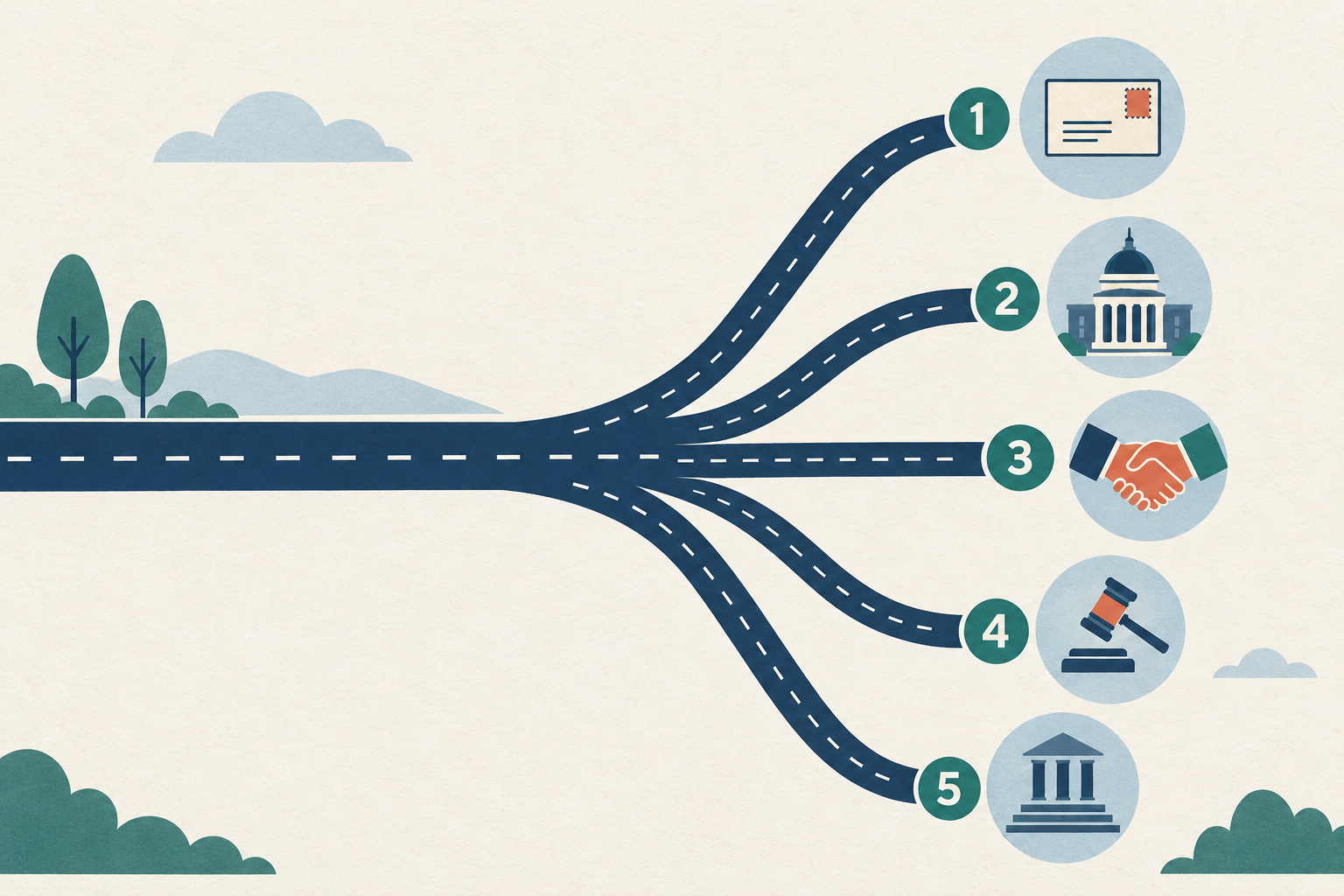
Financial dispute resolution covers every method of settling a money disagreement short of a full trial: a written complaint, regulator mediation, private mediation, binding arbitration and small claims court. For most borrowers the cheapest and fastest route is a dated written dispute under the law that covers the product, followed by a complaint to the Consumer Financial Protection Bureau if the company stonewalls. Arbitration and court come last because they cost time and money, and your loan contract often decides which of the two you can use.
What counts as a financial dispute
A financial dispute is any disagreement with a lender, bank, card issuer, servicer, debt collector or broker about money you owe or money owed to you. Common borrower cases include fees charged that the contract never disclosed, payments applied late or lost, a loan reported inaccurately to the credit bureaus, and a debt collector chasing a balance you already paid or never owed.
The amount in play is usually small, which is exactly why the process you choose matters. Here is what a typical disputed loan looks like.
| Amount | Fee or APR | Term | Total repaid |
|---|---|---|---|
| $500 payday loan | $75 fee, about 391% APR | 14 days | $575 |
| Same loan, rolled over twice | $225 in fees | 42 days | $725 |
The APR math is plain: $75 on $500 is 15% for two weeks, and there are about 26 two-week periods in a year, so 15% times 26 is roughly 391%. If the lender rolled the loan without your consent, the extra $150 in fees is the sum in dispute, and that figure should drive how much time and money you spend recovering it.
Before you borrow
Most loan and card contracts contain a mandatory arbitration clause that waives your right to sue in court or join a class action. Read for it before signing, and check whether the contract lets you opt out in writing within 30 to 60 days.
Route 1: A written dispute under the law that applies
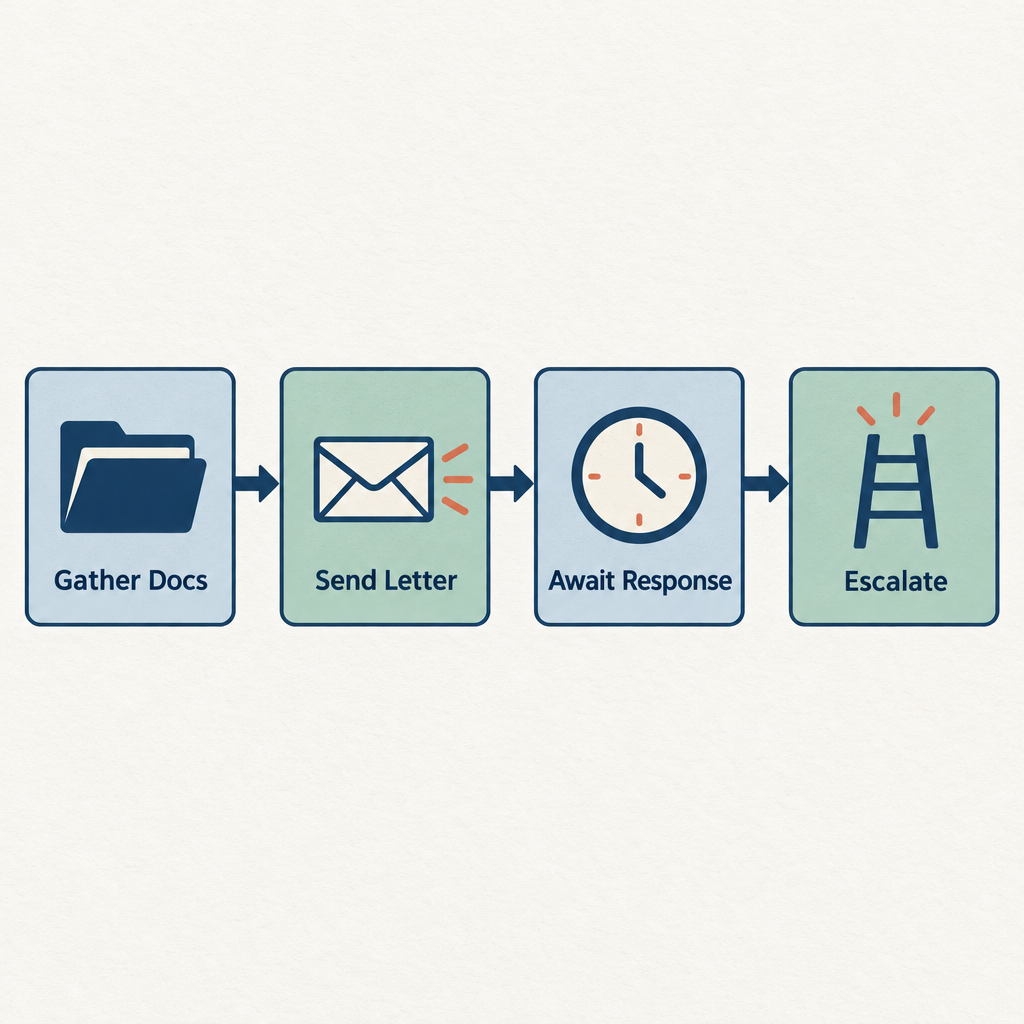
Federal consumer law gives you dated deadlines that force a response, and you need no lawyer to use them.
- Credit card billing errors: under the Fair Credit Billing Act, write to the issuer within 60 days of the statement; it must acknowledge within 30 days and resolve the matter within two billing cycles, never more than 90 days.
- Unauthorized or wrong electronic payments: under the Electronic Fund Transfer Act and Regulation E (12 CFR 1005), report within 60 days; the bank generally has 10 business days to investigate or must give provisional credit.
- Credit report errors: under the Fair Credit Reporting Act, the bureau must investigate within 30 days, or 45 days if you send extra information.
- Collection claims: under the Fair Debt Collection Practices Act and Regulation F, a written dispute within 30 days of the validation notice means the debt collector must stop collecting until it verifies the debt.
Send every dispute by a method that gives you proof of delivery, keep copies of statements, contracts and screenshots, and date everything. Those documents become your case file for every later step.
Route 2: Regulator complaints
The CFPB complaint portal forwards your complaint to the company, which is expected to respond within 15 days, and if that initial response is not final, the company has up to 60 days to provide a final response. Banks answer to the Office of the Comptroller of the Currency, the Federal Reserve or the FDIC, credit unions to the National Credit Union Administration, and licensed lenders to your state regulator, whose license lookup also tells you whether the company is legally operating at all. Brokers and investment accounts fall under FINRA and the Securities and Exchange Commission.
Route 3: Mediation
Mediation is voluntary and non-binding; a neutral mediator helps both parties reach a settlement without ruling on who is right. FINRA runs a mediation program for investor disputes, the American Arbitration Association offers consumer mediation, and many counties have community mediation centers that charge little or nothing. If no deal emerges, you lose nothing but time and keep every other option.
Route 4: Arbitration
Arbitration is private and binding: an arbitrator hears both sides, reviews the documents and issues an award. Under the Federal Arbitration Act, a court will enforce that award and will vacate it only on narrow grounds such as fraud or arbitrator misconduct, so you get one real opportunity to present your evidence. AAA’s Consumer Arbitration Rules cap the consumer’s share of filing fees at a few hundred dollars and put the rest on the business, and FINRA’s simplified process for smaller claims is decided on documents alone with no hearing.
Two groups keep their court rights no matter what the contract says. The Military Lending Act bans mandatory arbitration for active-duty servicemembers and their dependents, and the Servicemembers Civil Relief Act adds protections on rates and default judgments.
Route 5: Small claims court
Small claims court is for borrowers whose contract has no arbitration clause, who opted out, or who are being sued. Filing fees vary widely by state, from roughly $20 to $60 in Kentucky to $42 to $300 in Tennessee once local litigation taxes are added, lawyers are usually optional, and the dollar limit ranges from about $2,500 in Kentucky to $25,000 in Tennessee. Judges here will also apply state usury laws, which is why a lender that charged an illegal rate often settles rather than defend it.
State availability
A payday loan is banned or capped at 36% in roughly 20 states and the District of Columbia, so a lender collecting payday fees there has a weak position in any forum. Courts will generally strike an arbitration clause that explicitly waives your statutory rights under state lending law, but arbitration can still limit what you recover in practice by barring class actions, capping damages or restricting remedies, and arbitrators are not always bound to apply state law the way a judge would.
Cheaper options first
Start with a free written dispute and a CFPB complaint before paying any filing fee.
Nonprofit credit counseling agencies and legal aid offices handle borrower disputes at no cost.
Your state attorney general’s consumer office mediates many lender complaints for free.
How to escalate a borrower dispute
- Send a dated written dispute citing the law that applies and keep proof of delivery.
- File a CFPB complaint if the deadline passes without a real answer.
- Report the company to the state regulator and check its license.
- Offer mediation in writing.
- Choose arbitration or small claims court based on the contract and the amount at stake.
FAQ
What are the three types of dispute resolution?
Negotiation, mediation and arbitration. Negotiation is direct talks between the parties, mediation adds a neutral who helps but does not decide, and arbitration adds a neutral who issues a binding decision. Court litigation is the fourth, formal option.
What happens after a dispute resolution hearing?
The arbitrator issues a written award, which FINRA generally requires within 30 business days of the record closing. The losing party must pay or comply, and under the Federal Arbitration Act you have three months to ask a court to vacate the award on limited grounds.
How much does it cost to hire a private FDR?
“FDR” is mostly a UK family-court term. In the US, private mediators bill hourly and the parties usually split the cost, while community mediation centers and regulator programs are often free. Consumer arbitration fees are capped by the forum’s rules, with the business paying most of them.
What is a financial dispute?
Any disagreement over money with a lender, bank, servicer, collector or broker, from an undisclosed fee to an inaccurate credit entry. Most are resolved by a written dispute under federal consumer law, and only a minority ever reach arbitration or court.
Laws and regulations referenced
- Fair Debt Collection Practices Act, 15 U.S.C. 1692
- Regulation F (debt collection), 12 CFR Part 1006
- Fair Credit Reporting Act, 15 U.S.C. 1681
- Electronic Fund Transfer Act, 15 U.S.C. 1693
- Regulation E (electronic transfers), 12 CFR Part 1005
- Fair Credit Billing Act, 15 U.S.C. 1666
- Military Lending Act, 10 U.S.C. 987
- Servicemembers Civil Relief Act, 50 U.S.C. 3901
Links go to the official text on government sites.
Check, verify or complain
Sources
- law.cornell.edu › uscode › text › 9 › 10 law.cornell.edu
- library.nclc.org › article › getting court initiating arbitration library.nclc.org

Elena writes about getting through a money emergency, assistance programs, budgeting on a tight income, banking basics and borrower rights. Her guides list the cheaper options first and link the agency or program that can actually help.