Blog

  • What is an NFT and how do NFTs work

    What is an NFT and how do NFTs work

    An NFT, short for non-fungible token, is a unique digital record stored on a blockchain that says who controls a specific item, usually a piece of digital art, a game item, a music file or a membership pass. You can trade it, prove you hold it and move it between wallets, but it is not insured, its value can fall to zero, and the IRS taxes it as property. This guide explains how NFTs actually work, what they cost, where the risks sit and how US tax rules apply.

    NFT stands fornon-fungible token
    Main blockchainEthereum, plus Solana, Bitcoin, Polygon
    Key standardsERC-721 and ERC-1155
    IRS treatmentproperty, sometimes a collectible
    Insurancenone, not FDIC or SIPC
    Peak sale$69.3 million, Christie's, March 2021

    NFT meaning: what “non-fungible” means

    Fungible means interchangeable. One dollar bill is worth exactly the same as any other dollar bill, and one bitcoin is the same as any other bitcoin. You can swap them with nobody caring which one they got.

    Non-fungible means one of a kind. A signed first-edition book, a house, your passport. Each has its own identity and history, so you cannot swap it one-for-one with another and call it even.

    An NFT applies that idea to digital files. Before NFTs, a JPEG could be copied a million times with no way to say which copy was “the” original. An NFT creates a single blockchain entry tied to that file, with a serial number and an owner address. The file itself can still be copied. The token cannot.

    Feature Fungible token (bitcoin, ETH, USDC) Non-fungible token (NFT)
    Interchangeable? Yes, every unit identical No, each token has a unique ID
    Divisible? Yes, down to fractions Usually no, you hold whole tokens
    Typical use Money, payments, trading Art, collectibles, game items, tickets, memberships
    Ethereum standard ERC-20 ERC-721, ERC-1155
    Value driver Supply, demand, utility as money Scarcity, creator, community, utility of the specific item

    How NFTs work, step by step

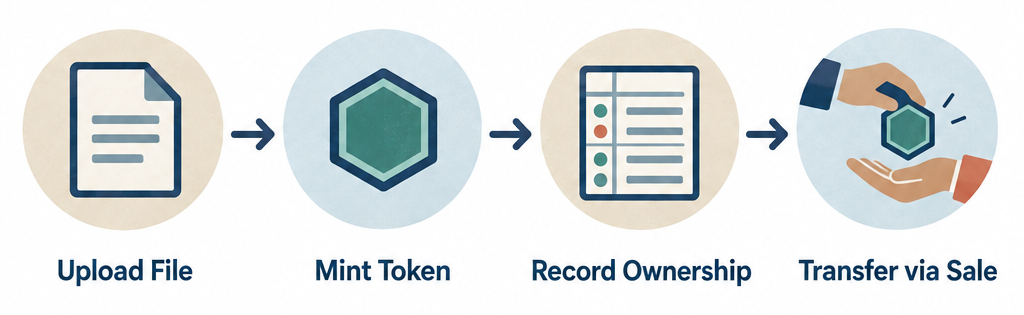
    Flow diagram showing the four steps of NFT creation and transfer: Upload File, Mint Token, Record Ownership, Transfer via Sale

    An NFT lives inside a smart contract, which is a program running on a blockchain. On Ethereum, most NFTs follow the ERC-721 standard, finalized in 2018, which defines a token with a unique ID and an owner. ERC-1155 came later and lets one contract issue both unique items and batches of identical items, which is why games prefer it.

    Creating an NFT is called minting. The creator uploads a file, writes the metadata (name, description, traits) and calls the contract to issue the token. The token points to the file’s location. Many projects store the actual image on IPFS, a decentralized file system, while some store it on a regular web server. That distinction matters, and we come back to it under risks.

    Ownership is just an entry saying “token #4821 belongs to wallet 0xAB12…”. When you sell, the contract updates that entry. Anyone can look up the full history on a block explorer such as Etherscan. That public, tamper-resistant record is the whole point.

    You hold NFTs in a crypto wallet. Software wallets like MetaMask or Phantom hold the private keys on your device. A hardware wallet keeps keys offline. Whoever controls the keys controls the NFT, so losing a seed phrase or signing a malicious transaction loses the token for good. There is no customer service line that can reverse it.

    What you actually own

    This is where many buyers get burned. Holding an NFT typically does not give you copyright. You own the token. The creator usually keeps the intellectual property unless the project’s license says otherwise. Some collections, including Bored Ape Yacht Club, grant holders commercial rights to their specific image. Many others grant personal display rights only. Read the license before you assume you can print T-shirts.

    Where NFTs show up in practice

    Profile-picture collections such as CryptoPunks and Bored Ape Yacht Club drove the 2021 boom. Holders used them as social identity, and some projects attached community perks: private chat rooms, event access, merchandise drops.

    Games use NFTs for characters, land and gear. Axie Infinity’s play-to-earn model drew millions of players in 2021, mostly in the Philippines and Venezuela, before its in-game token collapsed and the Ronin bridge was hacked for roughly $600 million in March 2022. NBA Top Shot sold officially licensed video highlights as NFTs on the Flow blockchain.

    Beyond collectibles, NFTs have been tested for concert tickets, domain names (Ethereum Name Service addresses like yourname.eth are NFTs), music royalties and tokenized real-world assets. Bitcoin joined the field in January 2023 when the Ordinals protocol enabled inscriptions on individual satoshis.

    Notable sale Date Reported price Why it mattered
    Beeple, “Everydays: The First 5000 Days” March 2021 $69.3 million at Christie’s First major auction house NFT sale
    CryptoPunk #5822 February 2022 About $23.7 million (8,000 ETH) Highest CryptoPunk sale on record
    Jack Dorsey’s first tweet March 2021 About $2.9 million Resold attempt in 2022 drew bids under $300
    Bored Ape Yacht Club Launched April 2021 Mint price 0.08 ETH, roughly $190 then Became the signature “club membership” NFT

    Those headline prices tell you what a handful of items fetched at the peak. They say nothing about what a typical NFT is worth, which is usually very little.

    What it costs to create, buy or sell an NFT

    NFTs have fees at every step. Blockchain “gas” pays validators to process your transaction, marketplaces take a cut, and many contracts pay the original creator a royalty on each resale. Gas on Ethereum swings with network traffic; in 2021 a single mint could cost over $100, while quiet periods and layer-2 networks like Polygon or Base bring it under a dollar.

    Here is a worked example for selling an NFT you bought for $500 on an Ethereum marketplace. The fee percentages are illustrative; check each marketplace’s current disclosure.

    Item Amount
    Purchase price $500
    Gas to buy (variable) $8
    Sale price six months later $650
    Marketplace fee at 2.5% $16.25
    Creator royalty at 5% $32.50
    Gas to list and transfer $6
    Net proceeds before tax $595.25
    Gain subject to tax About $87

    Notice how a $150 paper profit shrinks to under $90 once fees come out, before any tax. On a $50 NFT the same fee structure can wipe out the gain entirely.

    Before you spend money on an NFT

    Most NFTs minted in 2021 and 2022 now trade for a tiny fraction of their peak or do not trade at all. Treat any money spent as money you can afford to lose completely, because there is no deposit insurance, no refund mechanism and often no buyer when you want out.

    The main risks

    Total loss of value. NFTs are illiquid. A fungible coin can be sold on an exchange in seconds; an NFT needs a specific buyer who wants that specific item. When demand dries up, the price does not fall gradually, it simply stops existing. Several research firms tracking NFT markets reported in 2023 that the large majority of collections had a market value near zero. If you look up a “capitulation definition” in crypto, the NFT market in late 2022 is a textbook case.

    No insurance. FDIC insurance covers bank deposits. SIPC covers brokerage accounts. Neither covers crypto or NFTs. If a marketplace fails, is hacked or freezes withdrawals, you are an unsecured creditor at best.

    Custody and phishing. The most common way people lose NFTs is signing a transaction they did not understand. A fake mint page asks you to “approve” and the signature hands a scammer permission to move everything in your wallet. Wallet drainers stole hundreds of millions of dollars in crypto and NFTs across 2022 and 2023, according to blockchain security firms.

    Broken links. If the token points to an image on a normal web server and the project shuts down, you own a token that points at nothing. Projects that store files on IPFS or fully on-chain are more durable.

    Wash trading and rug pulls. Because anyone can trade with themselves across two wallets, volume and price history can be faked. Chainalysis documented wash trading across NFT marketplaces in its crypto crime reports. A rug pull is when founders take mint money and disappear, which happened repeatedly in 2021 and 2022.

    Legal uncertainty. Some NFT sales have been treated as unregistered securities offerings. In August 2023 the SEC charged Impact Theory, which agreed to pay about $6.1 million, and in September 2023 it charged Stoner Cats 2, which paid a $1 million penalty. Both projects had marketed NFTs with promises about future value. The agency’s stance softened in 2025, when it closed its OpenSea investigation without charges, but a project that sells tokens with investment promises still carries securities-law risk for its creators and holders.

    Lower-risk ways to learn

    Set up a test wallet with nothing in it and practice signing on a testnet before touching real funds.
    Claim a free mint from a known project to see how gas and metadata work.
    Keep any NFT you care about in a hardware wallet separate from the wallet you use to interact with new sites.

    US rules and taxes on NFTs

    The IRS has treated virtual currency as property since Notice 2014-21, and that framework extends to NFTs. Buying an NFT with ETH is a taxable disposal of the ETH. Selling the NFT later is a second taxable event. Minting your own and selling it produces ordinary income, and creator royalties are ordinary income too.

    In March 2023 the IRS issued Notice 2023-27, announcing it intends to treat certain NFTs as collectibles using a “look-through” test: if the NFT represents a collectible under the tax code, such as artwork or a gem, the NFT is a collectible. Long-term gains on collectibles are taxed at a maximum 28% rate instead of the 0%, 15% or 20% rates for other capital assets. Short-term gains are ordinary income either way.

    Every Form 1040 now asks whether you received, sold or disposed of a digital asset during the year. Answer it honestly. Starting with sales on or after January 1, 2025, US brokers including custodial marketplaces must report gross proceeds on Form 1099-DA, so the IRS will see centralized-platform sales directly. Our “1099-da” explainer walks through what the form includes. Peer-to-peer and self-custody sales are not on that form but remain taxable.

    Event Tax treatment
    Buy NFT with ETH Capital gain or loss on the ETH spent
    Sell NFT held under one year Short-term gain, ordinary income rates
    Sell NFT held over one year Long-term gain, up to 28% if a collectible
    Mint and sell your own NFT Ordinary income, possibly self-employment tax
    Receive creator royalties Ordinary income
    Receive an airdropped NFT Ordinary income at fair market value when you gain control
    NFT becomes worthless No deduction until you sell or abandon it

    Keep records of every wallet address, transaction hash, date and dollar value at the time. Rev. Proc. 2024-28 requires taxpayers to track cost basis wallet by wallet from 2025 onward, which makes casual record-keeping expensive to fix later.

    How to check an NFT project before spending anything

    1. Find the official contract address from the project’s verified social account, then confirm it on a block explorer.
    2. Read the license to learn what rights, if any, come with the token.
    3. Check where the image is stored: on-chain, IPFS, or a plain URL that can vanish.
    4. Look at holder distribution; a few wallets holding most of the supply is a warning sign.
    5. Search the founders’ names and the project on the SEC’s litigation releases and the FTC’s scam alerts.
    6. Report fraud to the FBI’s IC3 and the FTC at ReportFraud if you are targeted.

    FAQ

    What does NFT mean?

    NFT stands for non-fungible token. “Non-fungible” means unique and not interchangeable, and “token” means a blockchain entry controlled by a wallet. Put together, it is a one-of-a-kind digital certificate of control over a specific item.

    Are NFTs still a thing?

    Yes, but the market is much smaller than in 2021 and 2022. Trading activity, floor prices and new-project launches all fell steeply after the peak, and many 2021 collections have no active buyers. The technology continues to be used for gaming items, domain names, event tickets and tokenized assets, where the uniqueness of each token matters more than speculation.

    Are NFTs worth anything anymore?

    A small number of established collections, such as CryptoPunks, still trade for meaningful sums. The vast majority of NFTs are worth whatever a buyer will pay, and for most that is close to nothing. Research from several analytics firms in 2023 and 2024 found most collections had little or no trading volume. Price depends entirely on demand for that specific item.

    How much is 1 NFT worth?

    There is no standard price, because there is no standard NFT. One can sell for a few cents or for tens of millions of dollars, and the same token can drop from thousands to zero if interest fades. The only way to estimate value is to look at recent verified sales of comparable items in the same collection and ask whether those sales were real rather than wash trades.

    Do I owe tax if my NFT lost value?

    Only when you dispose of it. Selling at a loss lets you claim a capital loss, which offsets gains and up to $3,000 of ordinary income a year, with the rest carried forward. Simply holding a worthless NFT creates no deduction.

  • Capitulation: what it means in crypto and stock markets

    Capitulation: what it means in crypto and stock markets

    Capitulation is the moment investors give up. The capitulation definition in markets is a wave of panic selling in which holders dump an asset at almost any price because they cannot stand the losses any longer, or because a lender forces them out. The word comes from the military idea of surrender, and in crypto and stock markets it describes the same thing: the fight is over, and the sellers walk off the field.

    Plain meaningsurrender, giving up
    Market meaningpanic selling at any price
    Word formscapitulation, capitulate, capitulating
    Typical signshuge volume, sharp price drop
    Crypto insurancenone, not FDIC or SIPC
    Tax treatmentIRS treats crypto as property

    Capitulation definition: the plain-English meaning

    Open any dictionary and the entry is short. Capitulation is a noun meaning the act of surrendering, especially on agreed terms. Merriam-Webster and Cambridge both lead with the military sense: an army capitulates when it stops fighting and accepts defeat. The second, older meaning is the document that lists those surrender terms.

    The word traces back to the Latin capitulum, a “little head” or chapter, which gave rise to capitulare, to draw up an agreement under headings. A surrender was literally a list of conditions written out point by point. That is why “capitulation” and “chapter” share a root.

    The verb is capitulate. The present participle is capitulating, the adjective is capitulatory, and the plural is capitulations. A few example sentences show the range:

    • The garrison’s capitulation came after a nine-day siege.
    • She refused to capitulate to pressure from the board.
    • The team spent the fourth quarter capitulating on every drive.
    • Analysts described Friday’s crash as a classic capitulation.

    That last sentence is the one this article is about. Finance borrowed the word because it captures something ordinary price language misses. A “drop” or a “sell-off” is a number. Capitulation is a feeling, the point where holding on hurts more than letting go.

    What does capitulation mean in a market?

    In trading, capitulation means that the people who were still holding a losing position finally sell, all at once, and usually at the worst possible prices. Three groups tend to sell during a capitulation:

    1. Exhausted holders. They bought high, watched the asset fall for weeks or months, and told themselves it would recover. One more bad day breaks that story.
    2. Forced sellers. Anyone who borrowed to buy gets a margin call or an automatic liquidation. They do not choose to sell; the lender or the exchange sells for them.
    3. Funds hit by redemptions. When clients pull money, a fund has to raise cash and sells whatever it can, including good assets.

    Those three groups feed each other. Forced selling pushes the price down, which triggers more margin calls, which pushes it lower still. Volume explodes because almost everyone is on the sell side. Then, often within hours, the selling stops, because the people who were going to sell already have.

    Market commentators like to say that capitulation “washes out the weak hands.” We think that phrase is unkind, but the mechanics behind it are real. After a capitulation, the remaining holders are the ones who did not need to sell. With fewer sellers left, prices can stabilize, at least for a while.

    Signs analysts look for

    There is no official measure. Nobody rings a bell. Analysts piece together a judgment from a few signals:

    • Volume far above normal, often several times the recent daily average.
    • A sharp price gap down, meaning the asset opens well below the prior close.
    • Fear gauges at extremes. For stocks, the Cboe Volatility Index (VIX) is the usual reference. In crypto, many people watch the Crypto Fear and Greed Index published by Alternative.me, where readings from 0 to 24 count as “extreme fear.”
    • Forced-selling evidence. In crypto, that means a spike in liquidations of leveraged positions. In stocks, it shows up as margin debt falling sharply in FINRA’s monthly data.
    • A reversal the same day or soon after. The price bounces because sellers are exhausted, not because any news improved.

    The honest caveat is that all of this is a label assigned in hindsight. During the event, a capitulation looks exactly like the middle of a crash.

    Capitulation in the stock market: two examples

    The US stock market has clear circuit breakers under rules that took their current form in 2013. If the S&P 500 falls 7% from the prior close before 3:25 p.m. Eastern, trading halts for 15 minutes. A 13% drop triggers a second halt. A 20% drop ends trading for the day. Those rules exist to slow capitulation down, and twice in modern history they got a serious workout.

    Episode Peak to trough What capitulation looked like Fear reading
    2008 financial crisis S&P 500 from 1,565 (Oct 2007) to 677 (Mar 2009), about 57% Massive volume in October 2008 after Lehman Brothers failed; the final low came five months later VIX hit a record intraday high of 89.53 on Oct 24, 2008
    COVID crash, 2020 S&P 500 from 3,386 (Feb 19) to 2,237 (Mar 23), about 34% Level 1 circuit breakers tripped on March 9, 12, 16 and 18 VIX closed at a record 82.69 on Mar 16, 2020

    The 2008 example is worth a closer look because it shows how capitulation and “the bottom” are not the same thing. October 10, 2008 is still cited as one of the heaviest selling days in the history of the New York Stock Exchange. Many commentators called it capitulation. The S&P 500 then fell another 20% before bottoming on March 9, 2009. The panic in October was real. It just was not the last panic.

    March 2020 went the other way. The capitulation on March 16 and the low on March 23 were a week apart, and the market recovered its losses within about five months. Same word, two completely different follow-throughs.

    Capitulation in crypto: 2018, 2020 and 2022

    Crypto has no circuit breakers, trades 24 hours a day and lets people borrow far more against their positions than any US stock broker would allow. That makes crypto capitulations faster and deeper.

    Episode Price move (bitcoin) What forced the selling
    2018 bear market From roughly $19,800 (Dec 2017) to about $3,200 (Dec 2018), around 84% Slow grind lower all year, then a November 2018 break below $6,000 that liquidated leveraged longs
    “Black Thursday,” Mar 12, 2020 Roughly 40% lower in about 24 hours Global margin calls across every asset class; DeFi lending protocols liquidated collateral at fire-sale prices
    2022 bear market From about $69,000 (Nov 2021) to about $15,500 (Nov 2022), around 77% TerraUSD lost its dollar peg in May; Celsius froze withdrawals on June 12; Three Arrows Capital was ordered into liquidation in June; FTX filed for bankruptcy on November 11

    The 2022 cycle produced at least three separate capitulations, and that is the lesson. In May, the collapse of the Terra ecosystem wiped out a token that had ranked among the ten largest by market value within days. In June, Celsius halted customer withdrawals with bitcoin trading in the low $20,000s, and within days the price fell below $20,000 for the first time since 2020, briefly touching the $17,000s. Plenty of analysts called that the capitulation. Five months later, FTX failed, and the price fell another 15% to its cycle low.

    Each of those events cleared out leveraged positions. None of them was the final one until the last.

    Why crypto capitulations hit harder

    Four structural differences make the crypto version of capitulation more violent than the stock version.

    Leverage. Under Regulation T, a US stock broker can lend at most 50% of a purchase, and FINRA Rule 4210 requires 25% maintenance equity. Offshore crypto derivatives exchanges have advertised leverage of 50x or 100x. At 100x, a 1% move against you wipes out your entire margin. A cascade of those liquidations is what turns a 5% dip into a 20% crash.

    No trading halts. A stock capitulation pauses at 7%, 13% and 20%. A crypto capitulation at 3 a.m. on a Sunday just keeps going.

    Thin order books. Beyond bitcoin and ether, most tokens have very little real buying interest below the current price. When forced sellers hit the market, there is nobody there to catch them.

    Counterparty failure. In stocks, capitulation hurts your portfolio. In crypto, it can take down the company holding your coins. Celsius, Voyager, BlockFi and FTX customers did not just see lower prices; they lost access to their assets and became unsecured creditors in bankruptcy court, waiting years for partial recoveries.

    The risks of acting on capitulation

    Before you act on a "capitulation" call

    Nobody can identify a market bottom in real time, and in crypto an asset can capitulate all the way to zero. Crypto held on any exchange or in any wallet is not FDIC insured and is not covered by SIPC, so losses from price moves and from platform failures fall entirely on you.

    The appeal of the word is obvious. If capitulation marks the point where sellers run out, buying there sounds like a bargain. Here is what that framing leaves out.

    Capitulation is not a floor. October 2008 and June 2022 both show capitulation followed by further declines of 15% to 20%. A bounce after panic selling can be a “dead cat bounce” that fades within days.

    Some assets never come back. LUNA fell from more than $60 to fractions of a cent in May 2022 and did not recover. Thousands of smaller tokens from the 2017 and 2021 cycles are effectively worthless. In stocks, a capitulation in a single company can end in bankruptcy, where common shareholders typically get nothing.

    Forced sellers are forced for a reason. If you are the one being liquidated, “buying the capitulation” is not an option. Borrowed money removes your choice about when to sell.

    Emotion cuts both ways. The same panic that makes others sell at the low can make us freeze, average down into a dead asset, or borrow to “make it back.” Research on investor behavior, including work summarized by the SEC’s Office of Investor Education, consistently finds that individuals who trade around fear and greed underperform those who do not.

    Platform risk peaks during capitulation. Exchanges and lenders are most likely to fail exactly when prices crash, because that is when their own leveraged bets go wrong. FTX halted withdrawals on November 8, 2022 and filed for bankruptcy three days later.

    Safer ground during a panic

    Keep crypto you want to hold through a crash in self-custody or at a platform that publishes audited reserves and is registered where it operates.
    Never fund crypto with borrowed money, and never with money you need for rent, food or minimum debt payments.
    If a loss has left you behind on bills, a nonprofit credit counselor (NFCC member agencies) can set up a hardship plan at no or low cost.

    Capitulation and borrowed money

    A capitulation is when leverage does the most damage, and we want to be direct about one pattern that shows up in CFPB complaint data every cycle: people borrowing at high cost to cover crypto losses or to buy a dip.

    A payday loan carries fees that work out to annual percentage rates of 300% to 600% in the states that allow them, and it is due in full in about two weeks. Using one to buy an asset that just fell 40% means betting that the asset recovers faster than the loan compounds. If it does not, the borrower is now dealing with a crash and a debt collector at the same time. Under the Fair Debt Collection Practices Act, collectors cannot harass or lie to you, but the debt itself does not go away because the coins did.

    Margin in a brokerage account is cheaper but carries the same core problem. The broker can sell your positions without asking during a capitulation, and under FINRA rules it does not have to wait for you to meet the call first.

    What capitulation means for your taxes

    Selling at a loss during capitulation has one concrete consequence we can state with confidence: it is a taxable event, and the loss can be useful.

    Under IRS Notice 2014-21, the IRS treats cryptocurrency as property. Every sale, swap or spend is a disposal that produces a capital gain or loss, reported on Form 8949 and Schedule D. Stocks work the same way.

    The rules that matter after a loss:

    • Netting. Capital losses offset capital gains dollar for dollar, short-term against short-term first, then across categories.
    • The $3,000 limit. If losses exceed gains, you can deduct up to $3,000 of the excess against ordinary income per year under Internal Revenue Code Section 1211(b), or $1,500 if married filing separately. The rest carries forward indefinitely.
    • Wash sales. The wash sale rule in Section 1091 disallows a loss on “stock or securities” if you buy the same asset within 30 days before or after the sale. As of the 2025 tax year, no federal law has extended that rule to crypto, though Congress has proposed doing so more than once. For stocks, it absolutely applies.
    • Reporting. Starting with 2025 transactions, US crypto brokers must send Form 1099-DA showing gross proceeds, with cost basis added for assets bought in 2026 or later. The first of those forms reached taxpayers in early 2026. If you sold during a crash, expect the IRS to have a copy.

    Capitulation losses on a platform that went bankrupt are messier. Until the bankruptcy resolves and you know what you will recover, the IRS generally does not consider the loss realized. People with funds stuck at FTX or Celsius found this out the hard way, and a tax professional is worth the fee in that situation.

    Capitulation versus a crash, a correction and a bear market

    These terms get mixed together, so here is how we separate them.

    Term What it describes Typical scale
    Correction A decline from a recent high 10% to 20%
    Bear market A sustained decline 20% or more
    Crash A sudden, steep drop Often 10%+ in days
    Capitulation The panic-selling climax inside a crash or bear market A moment, not a period

    A bear market can last a year. A crash can last a week. Capitulation is the hour, day or handful of days when the selling becomes indiscriminate. You can have a crash without a clear capitulation, and a bear market can contain several.

    The opposite of capitulation is euphoria, sometimes called a blow-off top: buying at any price because everyone is afraid of missing out. November 2021 in crypto and early 2000 in dot-com stocks are the standard examples. Both words describe a crowd abandoning judgment, just in opposite directions.

    How to check a platform before a panic, not during one

    Capitulation is when platforms fail, and the time to verify one is before you need to withdraw. This is the process we use.

    How to verify a crypto platform's US registration

    1. Search the company name in FinCEN’s MSB Registrant Search to confirm it is registered as a money services business.
    2. Check your state regulator’s license lookup; New York requires a BitLicense, and most states require a money transmitter license.
    3. If the platform offers anything it calls a security or a brokerage account, look it up on FINRA BrokerCheck and the SEC’s EDGAR system.
    4. Read the terms of service for the words “custody,” “lend” and “rehypothecate” to see what the platform can do with your coins.
    5. Report anything that does not match at the CFPB complaint portal, FTC ReportFraud or the FBI’s IC3.

    FAQ

    What does capitulation mean in simple terms?

    It means giving up. In a market, capitulation is the point where investors who were holding onto losses finally sell in a panic, often all at the same time, pushing prices down sharply on very heavy volume.

    Is capitulation the same as a market crash?

    No. A crash is a fast, steep price decline. Capitulation is the emotional and mechanical climax inside a crash or bear market, when selling becomes indiscriminate. A crash can happen without a clear capitulation, and a long bear market can include more than one.

    Does capitulation mean the bottom is in?

    Not reliably. October 2008 and June 2022 were both widely called capitulations, and prices fell another 15% to 20% afterward. The label is assigned in hindsight. In crypto, some assets capitulate all the way to zero and never recover.

    How do analysts identify capitulation?

    They look for a combination of signals: volume several times the normal daily average, a sharp gap down in price, extreme readings on fear gauges such as the VIX or the Crypto Fear and Greed Index, a spike in forced liquidations, and a reversal soon after. None of these is official, and they only confirm a capitulation after it is over.

    Can I deduct losses from selling during a capitulation?

    Yes, within limits. The IRS treats crypto as property, so a sale at a loss is a realized capital loss reported on Form 8949. Losses offset gains first, then up to $3,000 of ordinary income per year, with the remainder carried forward. The wash sale rule currently applies to stocks and securities but not to crypto under federal law as of the 2025 tax year.

    What is the opposite of capitulation?

    Euphoria, or a blow-off top. That is when buyers pay any price out of fear of missing out, the mirror image of sellers accepting any price out of fear of further losses.

  • What is scalping in trading and what it risks

    What is scalping in trading and what it risks

    Scalping is a trading style built on holding a position for seconds or minutes and closing it for a tiny gain, often less than half a percent, then repeating the process dozens or hundreds of times a day. A scalp trader wins by stacking many small profits while cutting losers fast. In crypto, where markets run all night and fees are high, the math works against most people who try it, and we explain exactly why below.

    Holding periodseconds to a few minutes
    Typical target per trade0.1% to 0.5%
    Trades per sessiondozens to hundreds
    Biggest costexchange fees and spread
    Insurance on cryptonone (not FDIC or SIPC)
    Tax treatmentshort-term gains, ordinary rates

    Scalping defined

    The plain scalping definition is this: a scalper tries to capture the smallest profitable move in a price and get out before the market has time to reverse. The trade is called a scalp trade. The person is a scalp trader or scalper. Scalp trading is the activity as a whole.

    Three features separate scalping from every other style.

    • Holding time is extremely short. Many scalps last under a minute.
    • Profit targets are small, often measured in a few ticks or a few hundredths of a percent.
    • Volume is high. Because each win is tiny, the scalper needs many of them.

    A position that stays open for an hour is a day trade, not a scalp. A position that sits overnight is swing trading. The lines blur in practice, but the intent is different. A scalper is not betting on where Bitcoin will be tomorrow. The scalper is betting on where the next few trades will print.

    How a scalp trade works

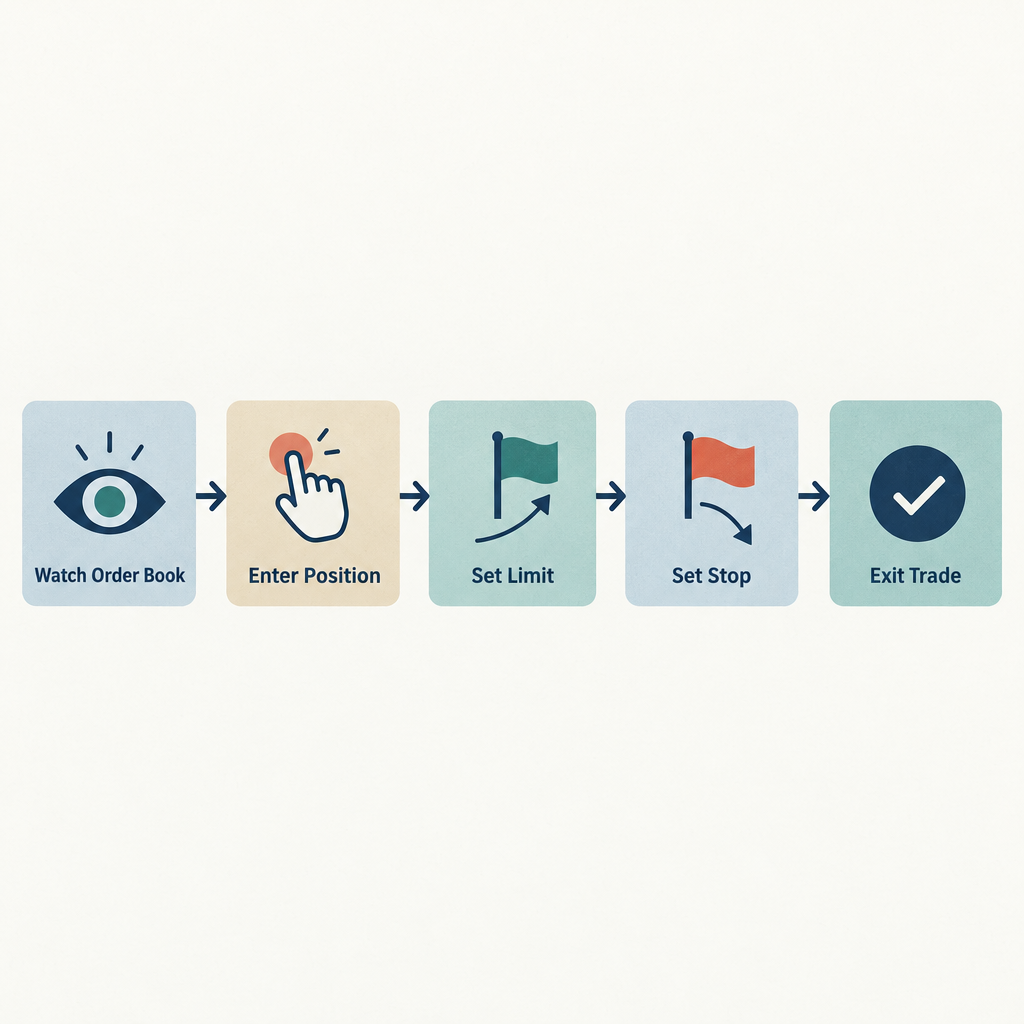
    Flow diagram showing five steps of a scalp trade: Watch Order Book, Enter Position, Set Limit, Set Stop, Exit Trade

    Every scalp runs through the same loop. We walk through one using numbers, with no suggestion that any of these prices are a forecast.

    Suppose a scalper watches Ether trading around $3,000 on an exchange’s order book. The best bid is $2,999.90 and the best ask is $3,000.10, so the spread is $0.20. The scalper sees heavy buy orders stacked just below $2,999 and decides the price is unlikely to fall through them in the next minute.

    1. The scalper buys 0.5 ETH at $3,000.10 with a market order, paying the ask.
    2. A sell limit order is placed at $3,006.00, a gain of about 0.2%.
    3. A stop order is placed at $2,997.00, a loss of about 0.1%.
    4. Within 40 seconds the price ticks up, the limit fills, and the trade closes for a $2.95 gross profit on $1,500 of capital.

    Before fees, that is a clean win. After fees it may not be. We come back to that, because the fee line is where most scalping stories end.

    The tools scalpers lean on

    A scalp trader almost never uses a daily chart. The working screen is a one-minute or tick chart, a level-two order book showing resting bids and asks, and a time-and-sales feed (the “tape”) showing every executed trade. Scalpers read the order book to guess where the next few trades will go. Momentum scalpers use short moving averages or volume spikes instead.

    Order type matters a lot. A market order fills instantly but pays the taker fee and crosses the spread. A limit order sits on the book, may earn the lower maker fee, but might never fill. Scalpers who rely on market orders pay the highest possible cost per trade.

    Scalping compared with other trading styles

    The table below shows how scalping sits next to the two styles people most often confuse it with. Figures are typical ranges, not rules.

    Style Holding period Trades per day Target per trade Main cost driver Time at the screen
    Scalping Seconds to minutes 20 to several hundred 0.05% to 0.5% Fees and spread Constant, every second
    Day trading Minutes to hours 1 to 10 0.5% to 3% Fees, slippage Most of the session
    Swing trading Days to weeks A few per week 3% to 20% Overnight gaps, funding Daily check-ins

    Notice the direction of the cost column. The shorter the hold, the more fees matter relative to the gain. That is the structural problem with scalping and it never goes away.

    Why fees decide whether scalping can work

    Here is the number that matters more than any chart pattern. If a round trip (buy plus sell) costs 0.8% in fees and spread, the scalper needs to be right by more than 0.8% on average just to reach zero. Every scalp that gains 0.3% is a loss after costs.

    US exchanges publish tiered fee schedules. The base tier, which applies to anyone trading under roughly $10,000 a month, is the one that matters for a new scalper. The figures below are the published base-tier rates at the time of our last review. Exchanges change them often, so the current fee page on each exchange is the source that counts.

    Venue (advanced or pro interface) Base maker fee Base taker fee Round-trip cost using market orders
    Coinbase Advanced 0.40% 0.60% 1.20%
    Kraken Pro 0.25% 0.40% 0.80%
    Gemini ActiveTrader 0.20% 0.40% 0.80%

    Now put a realistic session against those numbers. Say a scalper trades $2,000 per position, 30 round trips a day, always with market orders on a venue charging 0.40% per side.

    Item Per trade Per session (30 trades)
    Position size $2,000 $60,000 traded
    Taker fee at 0.40%, buy side $8.00 $240
    Taker fee at 0.40%, sell side $8.00 $240
    Total fees $16.00 $480
    Gain needed to break even 0.80% 0.80% average
    Fees as a share of a $5,000 account 0.32% 9.6%

    A scalper running this pattern burns almost 10% of a $5,000 account in fees every single day before any market losses. To be net positive, the average scalp has to beat 0.8%, and scalps by definition aim for far less than that. The spread adds more on top, since the buyer pays the ask and the seller receives the bid.

    How to work out your breakeven move

    1. Find your maker and taker fee on the exchange’s current schedule.
    2. Add the fee for entering to the fee for exiting. That is your round-trip fee.
    3. Add the typical spread on your pair as a percentage of price.
    4. The total is the minimum average gain per scalp you need just to lose nothing.

    Professional scalpers survive because they do not pay retail fees. High-volume tiers on the same exchanges drop maker fees to near zero. Proprietary trading firms run co-located servers that react in microseconds and pay rebates to provide liquidity. A person clicking a mouse on a laptop is competing against that, at twenty times the cost per trade.

    Scalping trading styles

    Not every scalper trades the same way. Four approaches show up most often.

    Market-making scalps

    The scalper places a bid slightly below the current price and an ask slightly above it, hoping both fill and the spread becomes the profit. This earns maker fees and can work in calm markets. It gets destroyed by a sudden one-way move that fills one side and leaves the scalper holding the bag.

    Momentum scalps

    The trader waits for a burst of volume or a break of a very short-term level, jumps in, and exits within a minute. This relies on market orders, so fees are at their worst. It also fails constantly on fake breakouts, which are more common in thin crypto pairs than in large-cap stocks.

    Order-book or tape reading

    The scalper watches large resting orders and the flow of executed trades, trying to read where big players are leaning. In crypto this is hard because many large orders are placed to be seen and then cancelled, a practice called spoofing that the CFTC has prosecuted in futures markets.

    Cross-venue scalps

    When the same coin trades at slightly different prices on two exchanges, a scalper buys on the cheaper venue and sells on the dearer one. This looks risk-free on paper. In practice, withdrawal times, network fees and the second price moving before the first trade settles eat most of the gap.

    What a scalp trader actually risks

    Before you scalp crypto

    Crypto can lose all of its value, and nothing you hold on an exchange is FDIC or SIPC insured. A scalping account can also bleed to zero through fees alone, with no dramatic crash required.

    The asset itself

    Scalping does not remove the risk of the underlying coin. A scalper who is in a position when an exchange halts trading, a stablecoin breaks its peg or a token’s issuer is charged by the SEC is simply stuck. The short holding period limits exposure most of the time, but it offers no protection in the minute that matters.

    No insurance behind the account

    Bank deposits are backed by the FDIC up to $250,000 per depositor, per bank, per ownership category. Securities at a failed broker-dealer are protected by SIPC. Crypto on an exchange has neither. The FDIC said so plainly in a 2022 advisory after several crypto companies implied otherwise. When FTX collapsed in November 2022, customers became unsecured creditors in a bankruptcy. A scalper with a five-figure balance sitting on an exchange faces that risk every day.

    Leverage and liquidation

    Many scalpers use margin or perpetual futures because small moves on unleveraged capital do not produce meaningful dollars. Leverage turns a 1% adverse move into a 10% or 20% loss at 10x or 20x, and crypto venues liquidate automatically. If a leveraged account goes negative, exchange terms generally allow the company to pursue the shortfall, which can mean a debt collector eventually calling about money lost in a trade that lasted ninety seconds.

    Slippage and outages

    A stop order is a promise to try, not a guarantee of price. In a fast move, a stop at $2,997 can fill at $2,990. During the busiest minutes, exactly when scalpers are most active, exchanges have historically slowed, frozen or thrown errors. A scalper who cannot click out of a position is holding a day trade they never intended.

    The evidence on short-term traders

    The research is one-sided. A study of Brazilian equity futures traders published in 2020 by Chague, De-Losso and Giovannetti found that 97% of individuals who day traded for more than 300 days lost money, and only 1.1% earned more than the Brazilian minimum wage. Barber, Lee, Liu and Odean studied every day trader in Taiwan over fifteen years and found fewer than 1% could reliably earn positive returns after costs. Scalping sits at the most expensive, most frequent end of that spectrum.

    Overtrading and tilt

    Scalping rewards speed and punishes hesitation, which makes it a magnet for revenge trading after a loss. Thirty planned trades become eighty impulsive ones, and each one pays a fee. People under financial pressure are most exposed here. Scalping is not a way to cover a bill due Friday. A bad session can take the rent money in an afternoon. Someone short on cash should compare fixed-cost options first, and should know that even a payday loan, among the most expensive legal products, at least has a disclosed price. A scalp session does not.

    US rules that touch scalping

    Crypto scalping sits in a patchwork of rules. We separate what is law from what is only proposed.

    The pattern day trader rule does not reach crypto spot

    Under FINRA Rule 4210, a customer who makes four or more day trades within five business days in a margin account at a securities broker is flagged as a pattern day trader and must keep at least $25,000 in equity. This applies to stocks, options and other securities held at a FINRA member. Buying and selling Bitcoin on a crypto exchange is not covered. FINRA has proposed amendments to the rule, so the current text at finra.org is the one to check. Crypto ETFs and crypto-related stocks are securities and the rule does apply to scalping those.

    Who regulates the venue

    The CFTC treats Bitcoin and Ether as commodities and regulates futures on them. Under the Commodity Exchange Act, leveraged retail commodity transactions must take place on a CFTC-registered exchange unless actual delivery happens within 28 days, which is why offshore perpetual-futures platforms block US customers on paper and why using a VPN to reach them puts a trader outside every US protection. Spot crypto exchanges register with FinCEN as money services businesses and hold state money transmitter licenses, including New York’s BitLicense. Before scalping anywhere, confirm the venue appears in FinCEN’s MSB registrant search and your state regulator’s license lookup.

    Market manipulation is still illegal

    Spoofing, wash trading and pump-and-dump schemes violate the Commodity Exchange Act and, where tokens are securities, the Securities Exchange Act of 1934. A retail scalper is more likely to be a victim than a perpetrator, but anyone coordinating trades in a chat group to move a thin coin is taking legal risk on top of financial risk.

    Lower-risk ways to learn the same skills

    Paper trade on an exchange sandbox for at least a month and track fees as if they were real.
    Trade a spot position with money you can lose entirely, no leverage, and keep a written log of every fill.
    Focus on one highly liquid pair where the spread is a few hundredths of a percent, not a thin altcoin.

    How the IRS treats scalping profits

    Every closed scalp is a taxable event. There is no exception for small trades or short holds.

    Under IRS Notice 2014-21, the IRS treats virtual currency as property. Each sale, and each swap of one coin for another, triggers a capital gain or loss equal to the sale proceeds minus cost basis. Because scalps are held for one year or less, every gain is short-term and taxed at ordinary income rates, which currently run up to 37% at the federal level. High earners may also owe the 3.8% net investment income tax. State income tax applies on top in most states.

    Tax question How it works for a crypto scalper Source
    Is each scalp a taxable event? Yes, every sale or crypto-to-crypto swap IRS Notice 2014-21
    What rate applies? Short-term capital gains at ordinary income rates, top federal bracket 37% Internal Revenue Code and current brackets
    Can losses offset gains? Yes, capital losses offset capital gains, then up to $3,000 of ordinary income per year Internal Revenue Code section 1211
    Does the wash sale rule apply? Not to crypto as of this writing; section 1091 covers stock and securities, and Congress has proposed extending it Internal Revenue Code section 1091
    Will the exchange report trades? Yes, on Form 1099-DA, gross proceeds for 2025 sales onward, with cost basis added for later years Treasury final regulations, 2024
    Who tracks basis across 500 trades a day? You do, with exchange exports or tax software, lot by lot IRS guidance on digital asset records

    Two points deserve emphasis. First, a scalper who makes 300 trades a day generates tens of thousands of taxable transactions a year, and the IRS expects each one reconciled on Form 8949. Second, a trader can finish the year with a net loss and still owe tax if gains landed in one tax year and the offsetting losses in the next. Form 1099-DA now puts those gross proceeds in front of the IRS, so the days of untracked scalping on US exchanges are over.

    Some traders ask about the “trader tax status” election under Internal Revenue Code section 475, which lets qualifying securities and commodities traders mark positions to market and treat losses as ordinary. Whether and how that applies to spot crypto is unsettled, and anyone considering it needs a tax professional who works with active traders, not a general preparer.

    Other meanings of scalping

    The word shows up in three unrelated contexts, and search traffic for the term mixes them together.

    Ticket scalping

    Ticket scalping means buying event tickets and reselling them above face value. Federal law does not ban resale itself. The Better Online Ticket Sales Act of 2016, known as the BOTS Act, makes it illegal to use software to bypass purchase limits or security measures on ticket sites, and the FTC brought its first enforcement cases under it in 2021. Several states regulate resale through price caps, licensing or venue-area restrictions, and those rules vary widely.

    Scalping in slang

    In everyday speech, “scalping” or “getting scalped” means being overcharged or beaten badly, as in a sports team getting scalped. Among sneaker and console buyers, a scalper is someone who buys limited stock to flip it. The meaning is always the same at root: taking a thin slice off the top, quickly, often at someone else’s expense.

    The historical practice

    Scalping as the removal of a scalp from an enemy is documented in warfare across many cultures and eras. In North America it was practiced by some Indigenous nations before contact and was then expanded dramatically by European colonial governments, which paid cash bounties for scalps. We address this briefly in the FAQ because the question appears in search data, not because it relates to trading.

    Who scalping can make sense for, and who it cannot

    We will be direct. Scalping can be a viable approach for a trader with institutional-level fees, low-latency infrastructure, a tested edge in a specific market and enough capital that a bad day is a rounding error. That describes professional desks and automated market-making firms.

    It is a poor fit for someone trading a few thousand dollars on a retail fee tier, learning the order book in real time, and hoping the activity replaces income. The fee math alone makes the outcome predictable. Add leverage, exchange risk and the tax burden of thousands of short-term transactions, and the expected result is a smaller account and a complicated return.

    Anyone who still wants to learn the mechanics should treat it as expensive education, size positions so that a 100% loss changes nothing about next month’s budget, and keep every receipt.

    FAQ

    What is scalping in trading?

    Scalping in trading is a style where a trader opens and closes a position within seconds or minutes to capture a very small price move, usually well under 1%, and repeats this many times a session. The scalper, or scalp trader, relies on volume of trades rather than size of gains. Fees and the bid-ask spread are the main obstacle, since every scalp must beat the round-trip cost just to break even.

    What is scalping and why is it illegal?

    Scalping in financial markets is legal. The illegal kind people usually mean is ticket scalping done with bots. The BOTS Act of 2016 makes it a federal violation to use software to get around ticket purchase limits or security checks, and the FTC enforces it. Resale itself is regulated at the state level, with some states capping markups or requiring licenses. In markets, the related illegal acts are spoofing and wash trading, which are forms of manipulation, not scalping.

    What is scalping slang for?

    As slang, scalping means profiting by skimming a quick margin, often unfairly. A ticket scalper or sneaker scalper flips scarce goods above retail. “Getting scalped” means being charged far too much or losing badly. In trading forums, “a scalp” simply means a very short trade.

    Why did Native Americans practice scalping?

    Historians document scalping as a wartime practice in several Indigenous North American cultures before European contact, where a scalp served as proof of a defeated enemy and carried spiritual or status meaning that varied by nation. The practice was then greatly expanded by colonial authorities, including governments in New England, New France and later Mexico, which paid bounties for Native scalps and in doing so encouraged settlers and soldiers to take part. It was never a uniquely Native American practice.

    Is scalping crypto legal in the United States?

    Yes, buying and selling crypto quickly on a licensed US exchange is legal. The FINRA pattern day trader rule and its $25,000 minimum apply to securities accounts, not to spot crypto. What is not legal is trading leveraged crypto futures on an offshore platform that is not registered with the CFTC, or using coordinated trades to manipulate a price. Every closed trade is still taxable under IRS rules treating crypto as property.

    How much money does scalping take?

    There is no legal minimum for crypto spot scalping, but the fee math sets a practical floor. A scalper paying 0.40% per side needs each trade to gain more than 0.8% before showing a profit, regardless of account size. Larger accounts reach lower fee tiers, which is one reason the style favors well-capitalized professionals over small retail traders. Whatever the amount, it should be money whose complete loss would not affect rent, food or debt payments.

  • Form 1099-DA explained for crypto investors

    Form 1099-DA explained for crypto investors

    Form 1099-DA, titled “Digital Asset Proceeds From Broker Transactions,” is the IRS form that US crypto exchanges and other custodial brokers use to report your sales of cryptocurrency, stablecoins and NFTs. It debuted for sales made on or after January 1, 2025, and the first copies reached customers in early 2026. If you sold crypto through a US platform, the IRS now has a record of your proceeds, and your return needs to match it.

    Form name1099-DA, Digital Asset Proceeds
    First tax year covered2025 sales
    Furnished to youby mid-February each year
    Shows gross proceedsyes, starting with 2025
    Shows cost basis2026 purchases onward
    Legal authorityIRC Section 6045, TD 10000

    What Form 1099-DA is

    The IRS treats crypto as property, a position it first laid out in IRS Notice 2014-21. Every time you sell, swap or spend a digital asset, you realize a gain or loss, and that has been true since long before this form existed. What changed is who tells the IRS about it.

    For stocks, brokers have reported sales to the IRS on Form 1099-B for decades. Crypto had no equivalent until Congress rewrote Section 6045 of the Internal Revenue Code in the Infrastructure Investment and Jobs Act of 2021. That law widened the definition of “broker” to cover businesses that handle digital asset sales for customers. The Treasury Department finalized the rules in Treasury Decision 10000, published in the Federal Register on July 9, 2024, and Form 1099-DA is the paperwork those regulations created.

    Think of it as a 1099-B rebuilt for crypto. It lists what you sold, how many units, when you sold it and how much money or value you got back. Over time it will also show what you paid, which is the number that actually determines your tax.

    Who sends it and who gets one

    The form comes from “digital asset brokers,” a term the regulations define more narrowly than the crypto community feared in 2021. As the rules stand now, the businesses required to file include:

    • Centralized exchanges that hold customer assets, such as Coinbase, Kraken and Gemini
    • Hosted wallet providers that take custody of your coins
    • Crypto ATMs and kiosks
    • Certain payment processors that settle crypto payments to merchants, which the regulations call PDAPs

    You should receive a 1099-DA if you are a US customer of one of these businesses and you sold, swapped or spent a digital asset through it during the year. The broker sends you a copy and files a matching copy with the IRS.

    Several categories were left out. Miners and validators are not brokers just because they confirm transactions. Self-custody wallet software that never touches your keys does not report. Decentralized finance front ends were going to be covered by a separate rule, Treasury Decision 10021 from December 2024, but Congress repealed that rule under the Congressional Review Act in April 2025. So a swap you make from your own wallet through a decentralized protocol does not generate a 1099-DA. It is still taxable, and you still have to report it yourself.

    Two de minimis rules also matter. Under the final regulations, a broker can skip reporting sales of qualifying stablecoins if your total stablecoin sales through that broker stay under $10,000 for the year, and it can report larger stablecoin volumes as a single annual total rather than trade by trade. Specified NFT sales have a similar aggregate option with a $600 floor. Payment processors only report once a customer’s crypto payments pass $600 in a year.

    How the form works, year by year

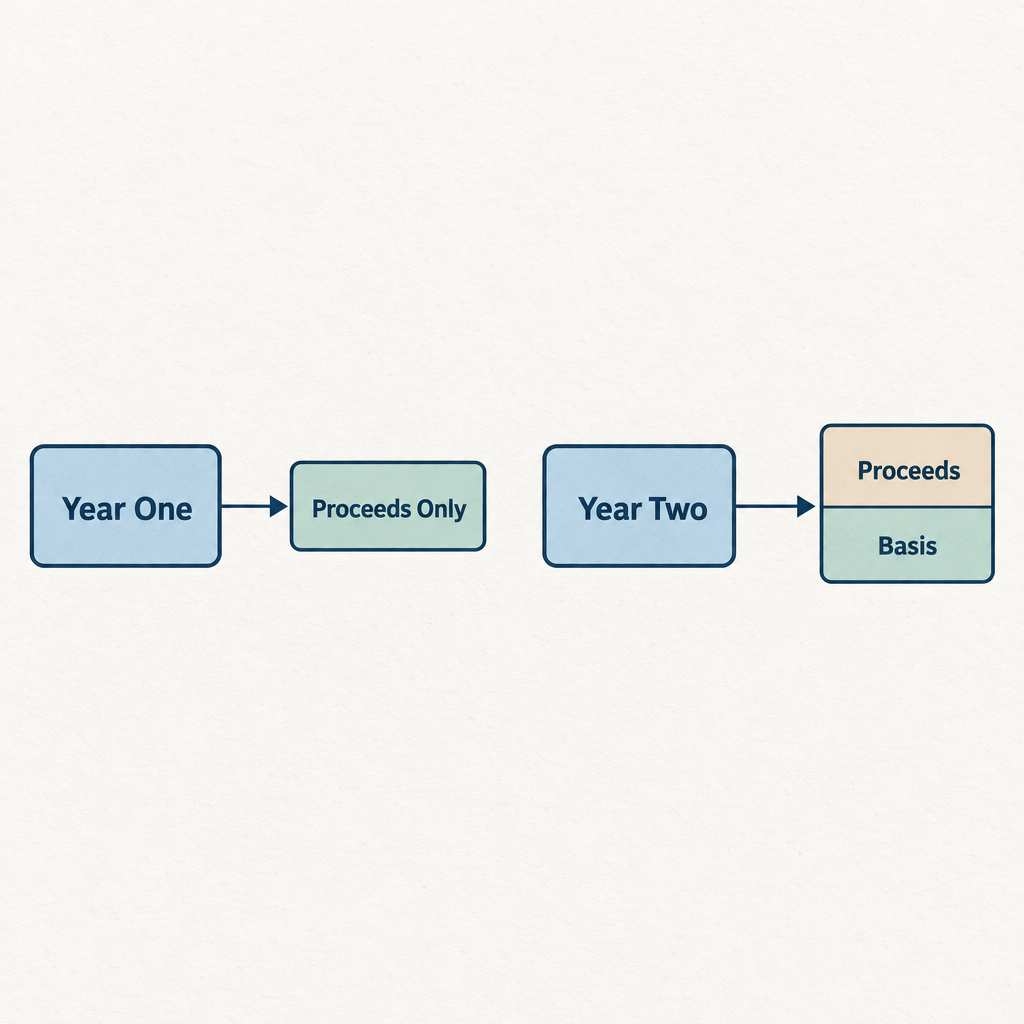
    Flow diagram showing two phases of 1099-DA reporting: first year proceeds only, second year proceeds plus basis

    The IRS phased the reporting in over two tax years, and the phase-in is the source of most of the confusion.

    Tax year What the broker reports When you receive it
    2025 sales Gross proceeds only; basis box generally blank February 17, 2026
    2026 sales Proceeds, plus cost basis for assets bought on or after January 1, 2026 in that same account mid-February 2027
    2027 and later Same as 2026, with more assets qualifying as “covered” over time mid-February each year

    The phrase “covered digital asset” does the heavy lifting here. A covered asset is one you bought through the broker on or after January 1, 2026 and kept in that same account until you sold it. For those, the broker knows your purchase price and must report it. Anything bought before 2026, or transferred in from another wallet or exchange, is “noncovered.” The broker reports the proceeds but leaves basis to you, and it ticks a box on the form telling the IRS that basis was not reported.

    For 2025 sales, nearly everything was noncovered by definition. That means your first 1099-DA almost certainly showed a proceeds figure with no basis next to it.

    The IRS also carved out transaction types it was not ready to handle. Notice 2024-57 told brokers they do not have to report wrapping and unwrapping tokens, liquidity pool deposits and withdrawals, staking, crypto lending, short sales and notional principal contracts until the IRS says otherwise. Those activities can still create taxable income for you. They just will not appear on this form yet.

    What the form actually shows

    Each 1099-DA covers a single sale or disposition, though most brokers deliver them as one consolidated statement that runs through every transaction. The key fields are:

    • An identifier and name for the digital asset
    • The number of units disposed of
    • The date you acquired the asset, if the broker knows it
    • The date you sold or disposed of it
    • Gross proceeds, usually the dollar value you received after any fees the broker netted out
    • Cost or other basis, when the asset is covered
    • A checkbox showing whether basis was reported to the IRS
    • Whether the holding period was short-term or long-term, when the broker can determine it
    • Any federal income tax withheld

    Early drafts of the form in 2024 asked for wallet addresses, transaction hashes and the exact time of day of each sale. After public comments, the IRS dropped those fields from the version brokers now use.

    One more detail worth knowing: the proceeds figure can reflect value you received in other crypto, not only cash. If you traded ETH for SOL on an exchange, the broker reports the fair market value of the SOL you received as your proceeds from selling ETH. Swaps count as sales for tax purposes and always have.

    Why a proceeds-only form can cost you money

    Here is the problem with a form that reports what you sold for but not what you paid. The IRS runs an automated matching program that compares the 1099s it receives against the income on your return. When a 1099-DA arrives showing $45,000 in proceeds and your return shows nothing, the system does not assume you broke even. It can treat the entire $45,000 as gain and send you a CP2000 notice proposing extra tax, interest and an accuracy penalty.

    A worked example shows the gap:

    Item Your real numbers What a bare 1099-DA shows
    Sold 0.5 BTC on a US exchange 0.5 BTC
    Proceeds $45,000 $45,000
    Cost basis $38,000 (bought in 2024) blank, noncovered
    Actual gain $7,000 unknown to IRS
    Tax at a 15% long-term rate $1,050 could be assessed on $45,000 if you fail to report

    The fix is entirely in your hands. You report the sale on Form 8949 with your own basis figure, carry the total to Schedule D, and the proceeds you report match what the broker filed. The matching program is satisfied, and you pay tax on the $7,000 you actually made.

    Ignoring the notice is the expensive route. Unpaid balances accrue interest daily, and the IRS can file liens, levy bank accounts and, for older inactive accounts, assign the debt to a private debt collector under its private collection program. None of that happens if you reconcile the form the first time.

    Tracking basis under the new rules

    Because the broker will not know your basis for most older coins, the IRS has issued a cluster of guidance on how you prove it.

    Wallet-by-wallet accounting. Revenue Procedure 2024-28 ended the informal “universal” method many investors used, where all their coins across every exchange were treated as one big pool. As of January 1, 2025, basis must be tracked account by account and wallet by wallet. The revenue procedure gave a safe harbor for allocating your existing unused basis to specific wallets as of that date. If you never made that allocation, you need to do it now using records you already had.

    Default method is FIFO. If you do not specifically identify which units you are selling, the regulations treat you as selling the earliest units acquired in that account first. For coins bought cheaply years ago, FIFO can produce the largest possible gain.

    Specific identification. You can choose which lots to sell, which often lowers your gain, but under the regulations the identification has to be made no later than the time of the sale and the broker needs to be able to record it. Because most exchanges did not have that capability ready, Notice 2025-7 gave taxpayers relief for 2025: you could rely on your own books and records to identify the units sold, as long as you kept them. Check whether your exchange now supports lot selection before you assume that relief continues.

    Transfers. When you move coins from one exchange to another, the receiving exchange has no idea what you paid. The final regulations did not require brokers to pass basis information between each other, so the burden of carrying that number across platforms is yours. Keep the original purchase confirmation, the transfer record and the dates.

    How to reconcile your 1099-DA

    1. Download every 1099-DA and the broker’s full transaction history for the year.
    2. Confirm the proceeds on the form match the sum of your sales in the history export.
    3. Pull your own basis for each sale from purchase records, prior-year forms or your tracking software.
    4. Enter each sale on Form 8949, using the box for basis not reported to the IRS where the form marks the asset noncovered.
    5. Carry the totals to Schedule D, and answer “Yes” to the digital asset question on Form 1040.
    6. Keep the records for at least three years after filing, and longer if the IRS questions a return.

    Risks the form does not change

    A 1099-DA reports taxes, it does not protect you from losses. Crypto can lose all of its value, and holding it on an exchange adds custody risk on top of market risk. Your coins on an exchange are not FDIC insured the way bank deposits are, and they are not covered by SIPC the way securities in a brokerage account are. When FTX collapsed in 2022, customers got tax paperwork from other platforms as usual but spent years in bankruptcy court trying to recover their assets.

    Losses have their own tax rules. Capital losses offset capital gains, and up to $3,000 of net capital loss per year can offset ordinary income, with the remainder carried forward. A 1099-DA that shows a sale below your basis is useful evidence of that loss. Coins that simply became worthless while you still hold them are harder; there is no sale, so there is usually no deductible loss until you dispose of them.

    Backup withholding is the other risk worth flagging. Normally a broker must withhold 24 percent of proceeds when a customer has not supplied a valid taxpayer identification number. Notice 2024-56 gave brokers transitional relief from backup withholding and related penalties on digital asset sales during 2025 so their systems could come online, and Notice 2026-20 later extended identification relief into 2026. If your exchange account has an outdated or missing Social Security number, fix it, because once the relief expires 24 percent of each sale can go straight to the Treasury.

    What a 1099-DA is not

    The form only covers sales and dispositions. Several other kinds of crypto income show up elsewhere or nowhere at all:

    • Staking and mining rewards are ordinary income when you gain control of them, per Revenue Ruling 2023-14. An exchange may report larger amounts on Form 1099-MISC, but the income is taxable at any amount.
    • Airdrops and hard forks are ordinary income at fair market value when received.
    • Payments received for goods or services in crypto may arrive on a Form 1099-K from a payment app or a 1099-NEC from a client, not a 1099-DA.
    • Real estate bought with crypto is reported by the closing agent on Form 1099-S for closings on or after January 1, 2026, with the digital asset’s fair market value shown.

    Receiving no form at all also changes nothing. Self-custody trades, foreign exchanges and DeFi activity all remain reportable. The 1099-DA tells the IRS part of the story; your return has to tell the whole thing.

    Before you file

    The biggest mistake is reporting nothing because the basis box is blank. The IRS has the proceeds figure either way, and a return that omits the sale invites a notice taxing the full amount.

    Free help first

    IRS Free File supports Form 8949 for most filers under its income limit.
    VITA and Tax Counseling for the Elderly sites prepare returns free for eligible taxpayers.
    The IRS Taxpayer Advocate Service can step in if a notice is causing hardship and the normal channels have stalled.

    FAQ

    What is Form 1099-DA in plain terms?

    It is the tax form a US crypto exchange or other custodial broker files to report your sales of digital assets to the IRS, with a copy to you. It lists the asset, the units, the dates and your gross proceeds, and for assets bought on the platform from 2026 onward it also lists your cost basis.

    When did Form 1099-DA start?

    Brokers began tracking sales on January 1, 2025. The first forms, covering 2025 activity, were due to customers by February 17, 2026. Cost basis reporting starts with assets acquired on or after January 1, 2026 and appears on forms issued in early 2027.

    Do I owe tax on the proceeds number?

    No. You owe tax on your gain, which is proceeds minus basis. The form may show only proceeds. You supply the basis on Form 8949, and the difference, if positive, is your taxable gain.

    I did not get a 1099-DA. Do I still report my crypto sales?

    Yes. The reporting requirement applies to you regardless of what paperwork arrives. Sales from a self-custody wallet, a decentralized exchange or a foreign platform are taxable even though no broker reports them.

    What if the form is wrong?

    Contact the broker and ask for a corrected form. If the broker will not fix it, report the correct figures on Form 8949 and attach an explanation of the difference. Keep the records that support your numbers, because the IRS will see the broker’s version too.

    Does Form 1099-DA report swaps between two cryptocurrencies?

    Yes. Trading one digital asset for another is a disposition of the asset you gave up, and the broker reports the fair market value of what you received as your proceeds.

    Will the IRS see my wallet addresses on the form?

    No. The IRS removed wallet addresses, transaction hashes and time-of-day fields from the final version of the form after public comments on the 2024 drafts.

  • What a payday loan is and how it differs from other small loans

    What a payday loan is and how it differs from other small loans

    A payday loan is a small, short-term cash loan, usually $500 or less, that you repay in one lump sum on your next payday, typically within two to four weeks. Lenders charge a flat fee instead of monthly interest, and that fee works out to an annual percentage rate (APR) of roughly 400% on a typical two-week loan. Here is how the product works, what it costs next to other small loans, where it is legal, and which rules protect you if you borrow.

    Typical loan size$100 to $500
    Typical fee$10 to $30 per $100
    Typical term2 to 4 weeks
    Typical APR300% to 700%
    Credit checkUsually none from big bureaus
    As of2026

    What a payday loan is

    The Consumer Financial Protection Bureau (CFPB) describes a payday loan as a short-term, high-cost loan, generally for $500 or less, that is due on your next payday. The name comes from that timing. You borrow against the paycheck you have not received yet.

    You will see the same product sold under a lot of labels: payday advance, cash advance, deferred deposit, check advance, or simply “pay day loan.” Storefront shops and online lenders both offer them. The mechanics are the same no matter what the sign says.

    Two things set payday lending apart from a personal loan at a bank. First, you repay the whole balance at once, not in monthly installments. Second, the lender takes a post-dated check or an electronic authorization to pull the money from your bank account on the due date, so the lender gets paid before you decide what else to pay that week.

    How a payday loan works

    The process is simple, which is a large part of the appeal when rent is due Friday and payday is the following Monday.

    You show proof of income (a pay stub or bank statements), a government ID and an open checking account. Most payday lenders do not pull your file from Equifax, Experian or TransUnion. Many do check specialty databases that track payday borrowing, and many states require the lender to check a state database so you cannot hold more loans than the law allows.

    Once approved, you write a check for the loan amount plus the fee, dated for your next payday, or you sign an ACH authorization for the same amount. The lender hands you cash or deposits the money, often the same business day in a store and by the next business day online.

    On the due date, the lender cashes the check or debits your account. If you cannot cover it, many states let you pay only the fee to “roll over” the loan for another pay period. That is where the trouble starts, and we come back to it below.

    What a payday loan costs

    Payday lenders quote fees per $100 borrowed, not an interest rate. The CFPB’s long-standing estimate is $10 to $30 for every $100, with $15 per $100 the most common price in states that allow it. Converting that to an APR shows why consumer regulators treat the product differently from a bank loan.

    Here is the math in plain words. A $15 fee on $100 for 14 days is 15% for two weeks. There are about 26 two-week periods in a year, so 15% times 26 is 390%, which rounds to the 391% APR the CFPB cites once you use exact days.

    Loan amount Fee Term Total repaid APR
    $300 $45 ($15 per $100) 14 days $345 391%
    $500 $75 ($15 per $100) 14 days $575 391%
    $500 $150 ($30 per $100) 14 days $650 782%
    $500 rolled over 4 times $375 in total fees 10 weeks $875 391% each period

    That last row is the one to study. Four rollovers on a $500 loan cost $375 in fees, and you still owe the original $500 at the end. The lender has collected 75% of the principal in ten weeks without reducing your balance by a dollar.

    Before you borrow

    The biggest risk is not the first fee. It is paying that fee again every two weeks because your next paycheck cannot absorb a lump-sum repayment, which is how a $300 loan quietly turns into $900 in fees over a year.

    Under the Truth in Lending Act and Regulation Z (12 CFR 1026), every payday lender must disclose the finance charge in dollars and the APR in writing before you sign. If a lender will not show you an APR, that alone is reason to walk away.

    How payday loans differ from other small loans

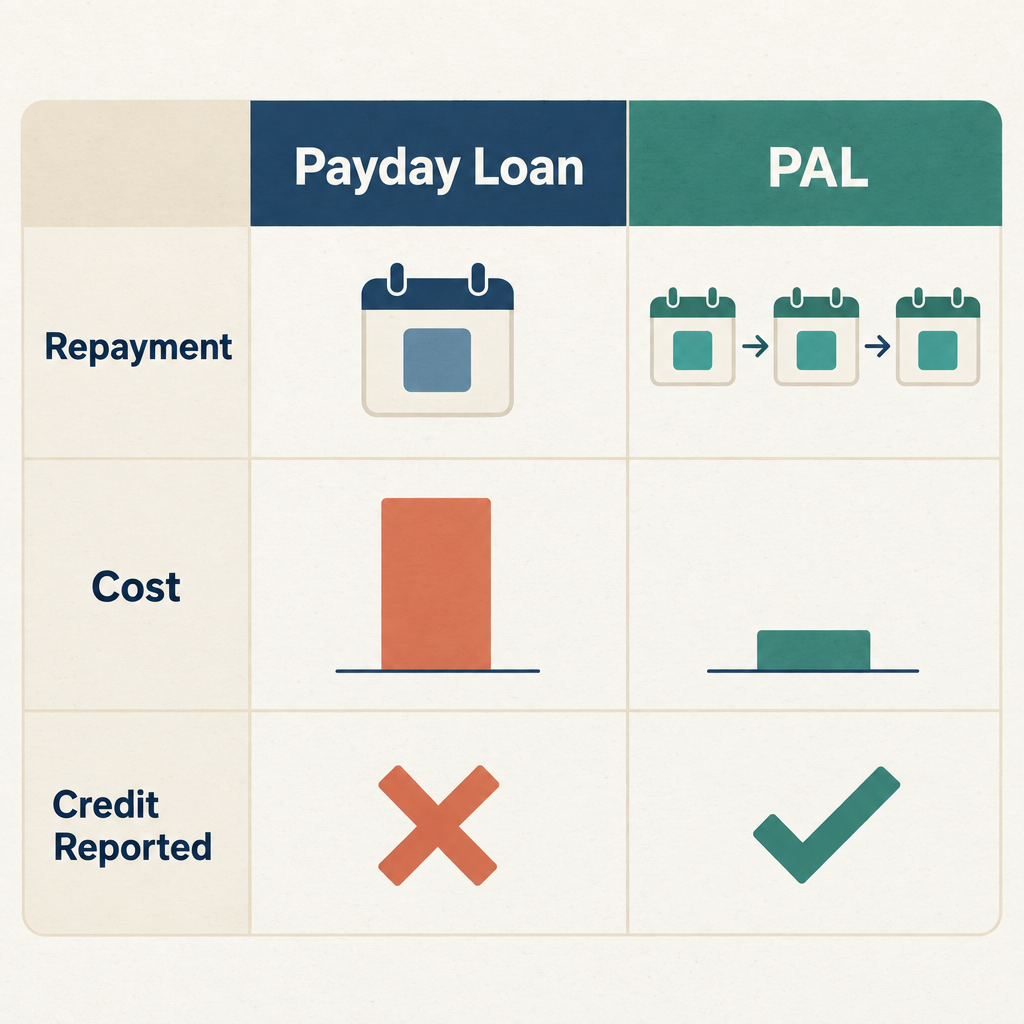
    Two-column comparison diagram contrasting a payday loan and a credit union payday alternative loan across repayment structure, cost level, and credit reporting

    “Small loan” covers a wide price range. The table compares the main ways Americans borrow a few hundred dollars, using typical terms. Exact costs depend on your state and the lender’s own disclosure.

    Product Typical size Typical cost Repayment Credit reported?
    Payday loan $100 to $500 $10 to $30 per $100, 300% to 700% APR One lump sum in 2 to 4 weeks Rarely, unless you default
    High-cost installment loan $500 to $5,000 100% to 300% APR in many states Monthly payments over months or years Often
    Auto title loan $100 to $5,000 About 25% per month, around 300% APR Lump sum in 30 days; car is collateral Rarely
    Pawn loan $20 to a few hundred Monthly fee set by state, often 20% to 25% Redeem item or forfeit it Never
    Credit card cash advance Up to your cash limit 3% to 5% fee plus around 30% APR from day one Minimum monthly payments Yes
    Cash advance app $20 to $750 $0 to $15 in tips and express fees Debited next payday Usually not
    Credit union payday alternative loan (PAL) $200 to $2,000 28% APR cap, up to $20 application fee 1 to 12 monthly payments Yes

    Installment loans

    An installment loan spreads repayment over fixed monthly payments. That structure is easier to manage than a lump sum, but many payday lenders also sell installment loans at triple-digit APRs. A longer term at a high rate can cost more in total dollars than a single payday loan paid off on time. Compare the total repaid, not the monthly payment.

    Auto title loans

    Title loans use your car as collateral. Costs run close to payday rates, and the lender can repossess the vehicle if you miss the balloon payment. Losing the car you drive to work turns a $500 problem into a lost job.

    Pawn loans

    Pawn shops lend against an item you leave with them. If you cannot repay, you lose the item and nothing else. There is no debt collection, no bank debit and no credit damage, which makes pawn one of the lower-risk high-cost options even though the fees are steep.

    Credit card cash advances

    A cash advance on a card you already hold charges a 3% to 5% fee and interest from the day you withdraw, with no grace period. On a $500 advance held for a month at a 30% APR, the interest comes to about $12, so you repay roughly $512. Expensive by credit card standards, far cheaper than a payday loan.

    Cash advance apps

    Apps such as EarnIn, Dave and Brigit advance small amounts against your next paycheck and ask for optional tips or charge express delivery fees. A $5 fee on a $100 advance due in two weeks is a 130% APR, and the CFPB has found that most users do pay something. Still, the dollar cost is usually a fraction of a payday loan, and the apps generally cannot send you to collections.

    Payday alternative loans from credit unions

    Federal credit unions can offer PALs under NCUA rules (12 CFR 701.21). A PAL I runs $200 to $1,000 for one to six months; a PAL II runs up to $2,000 for up to 12 months. Both cap the APR at 28% and the application fee at $20. A $500 PAL repaid over six months at the 28% cap costs about $69 in interest, roughly $570 total before the application fee, against $575 for a two-week payday loan that you may need to roll over.

    Where payday loans are legal

    Availability depends entirely on your state. Around 20 states and the District of Columbia either ban payday lending outright or cap small-loan rates near 36% APR, which makes the two-week model unprofitable. That group includes New York, New Jersey, Pennsylvania, North Carolina, Georgia, Massachusetts, Connecticut, Maryland, Arizona, Arkansas, West Virginia, Vermont and Montana, plus states that voted or legislated caps more recently: South Dakota (2016), Colorado (2018), Nebraska (2020), Illinois (2021), New Mexico (2023) and Minnesota (2023).

    Other states allow the product with limits. California’s Deferred Deposit Transaction Law caps loans at $300 face value, fees at 15% of that amount (so $45 on a $300 check, leaving you $255 in cash), and terms at 31 days, with lenders licensed by the Department of Financial Protection and Innovation. Ohio’s 2018 Fairness in Lending Act restructured payday lending into installment loans with a minimum 91-day term. Texas lets “credit access businesses” arrange loans with fees state law does not cap, which is why Texas borrowers routinely see APRs above 500%.

    An online lender advertising nationwide “cash loans payday advance” does not override your state’s law. If your state bans payday loans, a loan made to you there is generally void or unenforceable, and the lender is operating illegally. Tribal lenders and offshore sites claim exemptions; state attorneys general and the CFPB have repeatedly sued them.

    Who a payday loan can make sense for

    We will be direct: the list is short. A payday loan can be a defensible choice only when all of these are true. You face a specific cost of overdraft fees, a utility shutoff or a late fee that is larger than the payday fee. You are certain the next paycheck covers the full repayment plus your normal bills. You have already ruled out the cheaper options below. And you will borrow once, not roll over.

    CFPB research from its own supervisory data found that more than 80% of payday loans are rolled over or followed by a new loan within 14 days. Most borrowers do not fit the one-time profile, however they feel at the counter.

    Why rollovers trap borrowers

    The lump-sum structure is the problem. Someone borrowing $500 because they came up $500 short this month is unlikely to have $575 spare two weeks later. Paying the $75 fee to defer feels manageable. Doing it ten times over the year costs $750 and leaves the $500 unpaid.

    Because the lender holds a check or ACH authorization, a missed payment also triggers bank consequences. Each failed debit can cost you an overdraft or returned-item fee from your bank on top of the lender’s returned-check fee. The CFPB’s payday lending rule, in effect since March 30, 2025, now bars lenders from attempting a third withdrawal after two consecutive failures without fresh authorization from you.

    Payday loans also do nothing for your credit score. Most lenders do not report on-time payments to the three big bureaus, so repaying faithfully builds nothing. Defaults, on the other hand, are often sold to collectors who do report.

    Cheaper options first

    Ask your employer about a paycheck advance, or use a cash advance app with the free standard delivery option.
    Check a local credit union for a payday alternative loan at 28% APR or a small personal loan.
    Call the biller: utilities, landlords and medical offices often set up payment plans at no cost.
    Call 211 or a nonprofit credit counselor approved by the National Foundation for Credit Counseling before borrowing at triple digits.

    Several large banks now offer small-dollar loans of $100 to $1,000 to existing checking customers, repaid over three or four months for a flat fee far below payday pricing. Your own bank’s app is worth checking before a payday store.

    Your rights as a payday borrower

    Federal and state law gives you more protection than most storefronts mention.

    The Truth in Lending Act and Regulation Z require written disclosure of the APR, the finance charge, the amount financed and the total of payments before you sign. The APR must be stated as a yearly rate even for a 14-day loan.

    The Military Lending Act (32 CFR 232) caps the Military Annual Percentage Rate at 36% for active-duty servicemembers and their dependents and bans mandatory arbitration in their loan contracts. A payday loan above 36% made to a covered borrower is void.

    The Electronic Fund Transfer Act and Regulation E (12 CFR 1005.10(e)) say a lender cannot require repayment by preauthorized electronic transfer as a condition of the loan. You can also revoke an ACH authorization by notifying the lender and your bank, which stops future debits, though it does not cancel the debt.

    The Fair Debt Collection Practices Act covers third-party collectors who buy or service defaulted payday debt. They cannot threaten arrest, call before 8 a.m. or after 9 p.m., or contact your employer about the debt. Bouncing a post-dated check to a payday lender is a civil matter, not a crime, in the vast majority of cases, and threatening criminal charges is a common illegal collection tactic.

    The Fair Credit Reporting Act lets you dispute a payday collection account on your credit report if it is inaccurate or unverifiable.

    State law adds limits on loan size, fees, rollovers and the number of loans you can hold, plus licensing requirements. In many states a loan from an unlicensed lender is unenforceable.

    How to check a payday lender

    1. Search the lender’s name on NMLS Consumer Access to see its license and the states it is licensed in.
    2. Confirm the license with your state regulator’s lookup, such as California’s DFPI or Texas’s OCCC.
    3. Read the Regulation Z disclosure and find the APR before you sign anything.
    4. Search the CFPB complaint database for the lender’s complaint record.
    5. Report illegal fees, threats or unlicensed lending to the CFPB complaint portal, FTC ReportFraud or your state attorney general.

    FAQ

    How much can you borrow with a payday loan?

    Most payday loans are $500 or less, and state caps vary. California limits the check amount to $300. Some states allow up to $1,000, and a handful set no dollar cap at all.

    Does a payday loan check your credit?

    Most payday lenders skip the three major bureaus, which is why they advertise “no credit check.” They often use specialty databases such as Clarity or FactorTrust and state-mandated loan databases instead, so “no credit check” does not mean no screening.

    Do payday loans build credit?

    Almost never. On-time payments usually go unreported. Unpaid loans sold to collectors frequently do show up and hurt your score.

    What happens if I cannot repay a payday loan?

    The lender will try to cash your check or debit your account, which can trigger bank fees. Federal rules stop a third attempt after two consecutive failures. The debt may go to collections, and the lender can sue in civil court, but you cannot be jailed for owing a payday loan.

    Can I cancel a payday loan after signing?

    Many states give you until the end of the next business day to return the money fee-free. Check your contract and your state regulator’s rules for the exact window.

    Are online payday loans different from storefront loans?

    The product is the same, but online lenders are more likely to operate without a state license, charge higher fees and rely on ACH debits. Verifying the license on NMLS Consumer Access matters even more online.

    What is the difference between a payday loan and a cash advance?

    Many lenders use the terms interchangeably. A credit card cash advance, by contrast, is a separate product with a 3% to 5% fee plus card interest, usually far cheaper than a payday loan. Cash advance apps are a third category with small fees and no lender collection rights.

  • Debt collectors and what they can and cannot do

    Debt collectors and what they can and cannot do

    A debt collector can call you, write to you, report the account to the credit bureaus and, in many cases, sue you. A collector cannot threaten you, lie about what you owe, call at odd hours or keep calling after you tell them in writing to stop. The Fair Debt Collection Practices Act and the CFPB’s Regulation F (12 CFR 1006) draw those lines, and this guide walks through where they fall.

    Main federal lawFair Debt Collection Practices Act
    RulebookRegulation F, 12 CFR 1006
    Call window8 a.m. to 9 p.m. your time
    Call limit7 attempts in 7 days per debt
    Dispute window30 days after validation notice
    Statutory damagesup to $1,000 per lawsuit

    What a debt collector actually is

    Under the Fair Debt Collection Practices Act (15 U.S.C. 1692a), a debt collector is any business whose main purpose is collecting debts, or that regularly collects debts owed to someone else. That covers collection agencies, debt buyers and law firms that regularly sue consumers. It does not usually cover the original creditor, meaning the bank, card issuer or hospital you first owed the money to.

    That distinction matters more than most people realize. Your card issuer calling about a late payment is a creditor, and the federal act’s conduct rules do not bind it. The same account sent to an outside agency, or sold to a debt buyer, is now in the hands of a debt collector who must follow every rule below. Some states close that gap: California’s Rosenthal Fair Debt Collection Practices Act extends most protections to original creditors as well.

    Here is how the players differ.

    Who is contacting you Do they own the debt? Covered by the FDCPA? What they typically want
    Original creditor (bank, card issuer, utility) Yes Generally no, unless using another name Payment to bring the account current
    Collection agency (contingency collector) No, works on commission for the creditor Yes Payment sent to them on the creditor’s behalf
    Debt buyer Yes, bought the account outright Yes Payment, often willing to settle for less
    Collection law firm Sometimes, usually represents a buyer or creditor Yes, if it regularly collects Payment or a court judgment

    Debt buyers deserve a closer look. They purchase charged-off accounts in bulk for a fraction of face value. The Federal Trade Commission’s 2013 study of the nine largest debt buyers found they paid an average of about 4 cents per dollar of the balance owed. A buyer holding a $5,000 account may have paid $200 for it, which explains why buyers are often open to settling well below the balance. It also explains why documentation can be thin: the FTC found buyers often received little more than a spreadsheet of names and balances.

    How an account ends up in collections

    Flow diagram showing five stages from missed payment through charge-off to debt sale to lawsuit to judgment

    Collection follows a fairly predictable timeline, and knowing where you are on it helps you plan.

    1. Delinquency. Most lenders start late fees after the due date and report a late payment to the credit bureaus once you are 30 days behind.
    2. Internal collections. For roughly the first 90 to 180 days, the creditor’s own staff call and write. These calls are not covered by the federal act.
    3. Charge-off. Credit card issuers write off the balance as a loss at about 180 days past due. Charge-off does not cancel the debt. You still owe it.
    4. Placement or sale. The creditor either hires an agency on commission or sells the account to a debt buyer. The account can be resold several times over the years.
    5. Lawsuit. If the balance justifies the cost, the collector may file suit before the state statute of limitations expires. A judgment opens the door to wage garnishment and bank levies in most states.

    What a debt collector can do

    Collectors have real tools, and ignoring them does not make those tools go away.

    • Contact you by phone, letter, email, text message and even private social media message. Regulation F, which took effect November 30, 2021, expressly allowed electronic contact as long as every message includes a simple way to opt out.
    • Call between 8 a.m. and 9 p.m. in your local time zone. Calls outside that window are presumed inconvenient and unlawful unless you agreed to them.
    • Leave a limited-content voicemail that states the caller’s name, asks you to call back and gives a number, without mentioning the debt.
    • Contact other people once to find your address or phone number. They cannot say you owe money or that they are collecting a debt.
    • Report the account to credit bureaus, but only after they have contacted you first. Regulation F (12 CFR 1006.30) bars “passive” collection, where a collector reports a debt without ever reaching out, and gives a 14-day safe harbor after sending a validation notice.
    • Charge interest and fees, but only if the original contract or state law allows them. A collector cannot invent a “collection fee” that the contract never authorized.
    • Sue you within the statute of limitations and, after winning a judgment, garnish wages or levy bank accounts within state and federal limits.

    What a debt collector cannot do

    The federal act lists prohibited practices under three headings: harassment (15 U.S.C. 1692d), false or misleading statements (1692e) and unfair practices (1692f). In plain terms, a collector cannot:

    • Call you more than seven times in seven days about one debt, or call again within seven days of having spoken with you about it. Regulation F treats more than that as presumptively harassing.
    • Call you at work after you say your employer does not allow it.
    • Contact you at all once you have sent a written request to stop, except to confirm they are stopping or to tell you they intend to take a specific action such as filing suit.
    • Contact you directly if they know a lawyer represents you on the debt.
    • Threaten arrest, jail, violence or harm to your reputation. Nonpayment of consumer debt is not a crime.
    • Threaten a lawsuit or wage garnishment they do not intend to pursue or legally cannot.
    • Claim to be a government agency, a law firm or a credit bureau when they are not.
    • Misstate the amount, add unauthorized interest or fees, or tell you a debt is yours when it is not.
    • Tell your family, friends, neighbors or coworkers about the debt.
    • Send mail with words or symbols on the envelope that reveal it comes from a collector.
    • Publish or threaten to publish a list of people who owe money.
    • Sue or threaten to sue on a debt that is past the statute of limitations. Regulation F (12 CFR 1006.26) made that an explicit violation even when the collector did not know the debt was too old.
    • Deposit a post-dated check early or accept one without proper notice.

    Contact limits at a glance

    Rule What Regulation F says
    Calling hours 8 a.m. to 9 p.m. in your local time, unless you consent otherwise
    Call frequency No more than 7 call attempts per debt in 7 consecutive days
    After a conversation No further calls about that debt for 7 days
    Email and text Allowed, must include an opt-out method, cannot use a work email they know is employer-provided
    Third parties One contact each, location information only, no mention of the debt
    Written cease request Collector must stop all contact except limited legal notices
    Attorney representation Collector must deal with the attorney, not you

    The frequency limit applies per debt. If one collector handles three of your accounts, the math allows more total calls than people expect, so track them.

    The validation notice: your 30-day window

    Within five days of first contacting you, a collector must send a validation notice. Regulation F (12 CFR 1006.34) spells out what it has to contain: the collector’s name and mailing address, the creditor’s name, an itemization date, the balance on that date, every interest, fee, payment and credit since, the current amount, your dispute rights and a tear-off response form. The CFPB publishes a model form, and most collectors now use it.

    You then have 30 days to dispute the debt or ask for the name of the original creditor. Do it in writing. If you dispute within the window, the collector must stop collecting until it mails you verification. Disputing after 30 days still has value, but the collector is not required to pause.

    What to do when a collector first contacts you

    1. Get the caller’s name, company, mailing address and phone number. Do not confirm your Social Security number or bank details.
    2. Ask for the validation notice if you have not received one. Do not pay anything until you have it.
    3. Compare the itemization with your own records. Check the creditor name, the balance and the dates.
    4. Send a written dispute within 30 days if anything looks wrong, and keep a copy with proof of mailing.
    5. Check your state’s statute of limitations before paying or promising to pay anything on an old debt.
    6. If the debt is valid, decide between full payment, a payment plan or a lump-sum settlement, and get any deal in writing before sending money.

    Time-barred debt and the statute of limitations

    Every state sets a deadline for suing over an unpaid debt. Once it passes, the debt is “time-barred.” The debt does not vanish, and a collector can still ask you to pay, but it cannot sue or threaten to sue. Typical ranges run from three to ten years, measured in most states from your last payment or last activity on the account.

    State Written contract or credit card (years) Note
    New York 3 Consumer credit transactions, since April 2022
    California 4 Code of Civil Procedure 337
    Texas 4 Civil Practice and Remedies Code 16.004
    Pennsylvania 4 Garnishment for most consumer debt is also barred
    Florida 5 Florida Statutes 95.11
    Ohio 6 Reduced from 8 years in 2021
    Illinois 5 to 10 Depends on whether the court treats the account as written or oral
    Kentucky 10 Written contracts signed after July 2014

    Check your state attorney general’s site for the current figure, because legislatures change these periods and courts sometimes classify credit cards differently.

    One trap deserves its own warning. In a number of states, a partial payment or a written promise to pay restarts the clock. A collector who asks for “just $25 to show good faith” on a nine-year-old account may be trying to revive the right to sue. Ask whether the debt is time-barred before you send anything.

    What a collection account can cost you

    A debt in collections is not a loan, but how you handle it changes the final cost dramatically. The table below walks through four ways a $5,000 charged-off credit card balance can play out. The numbers are illustrative; your contract, state law and tax situation set the real figures.

    Path What you pay Added costs Total out of pocket Other effects
    Pay in full $5,000 None, if the contract added no post-charge-off interest $5,000 Collection stays on report up to 7 years, shows paid
    Negotiate a 40% lump sum yourself $2,000 $3,000 forgiven; taxable as income unless insolvent, roughly $660 at a 22% rate About $2,660 Account shows settled; forgiven amount may bring a Form 1099-C
    Debt settlement company, 50% settlement $2,500 to collector Company fee of about 20% of the $5,000 enrolled ($1,000), plus roughly $550 tax on $2,500 forgiven About $4,050 Months of nonpayment while saving, extra credit damage, program often takes 2 to 4 years
    Ignore it and lose a lawsuit $5,000 judgment Court costs and contract attorney fees of perhaps $800, plus post-judgment interest at state rate (10% in California) Around $6,300 after a year, rising monthly Wage garnishment up to 25% of disposable pay in most states, judgment can be renewed

    The APR concept does not apply once a debt is charged off, but the judgment path behaves like a high-interest loan you never agreed to. California’s post-judgment rate is 10% a year, and some states let creditors renew judgments for a decade or longer.

    Canceled debt of $600 or more usually triggers a Form 1099-C, and the IRS treats the forgiven amount as ordinary income. IRS Publication 4681 explains the insolvency exclusion: if your debts exceeded your assets at the time of cancellation, you can exclude some or all of it using Form 982. Many people in collections qualify and never claim it.

    Before you pay or promise anything

    The biggest mistake is paying a collector before you have a validation notice, a written settlement agreement and a check of your state’s statute of limitations. A small “good faith” payment can restart the clock on a time-barred debt and give the collector the right to sue.

    Cheaper options first

    A nonprofit credit counseling agency (look for NFCC or FCAA members) can set up a debt management plan for a modest monthly fee, usually capped by state law.
    Negotiating directly with the collector costs nothing and avoids the 15% to 25% fees settlement companies charge.
    If a hardship caused the default, ask the original creditor about a hardship or re-aging program before the account is sold.

    Collections and your credit score

    Under the Fair Credit Reporting Act (15 U.S.C. 1681c), a collection account can stay on your credit report for seven years from the date the original account first went delinquent, plus 180 days. Paying it does not remove it early, though the account will show a zero balance.

    Scoring models treat paid collections differently. FICO 9, FICO 10 and VantageScore 3.0 and 4.0 ignore paid collections entirely. The older FICO 8 model, still used by many lenders, does not, though it ignores any collection with an original balance under $100.

    Medical collections follow their own path. The three nationwide bureaus removed paid medical collections, medical collections under $500 and medical collections less than a year old from reports in 2022 and 2023. The CFPB finalized a rule in January 2025 to remove the rest, but a federal court in Texas vacated that rule in July 2025. As a result, unpaid medical collections of $500 or more can still appear.

    What a collector can take after a judgment

    A judgment lets a collector ask the court for garnishment, a bank levy or a lien, depending on the state. Federal law sets a floor: Title III of the Consumer Credit Protection Act (15 U.S.C. 1673) limits garnishment for ordinary consumer debt to the lesser of 25% of your disposable earnings or the amount by which weekly disposable earnings exceed 30 times the federal minimum wage, which works out to $217.50 a week.

    States can go further. Texas, Pennsylvania, North Carolina and South Carolina bar wage garnishment for most consumer debts. Many others exempt a larger share of pay.

    Federal benefits are shielded. Social Security, SSI, VA, federal retirement and similar payments cannot be garnished for private consumer debt, and under 31 CFR Part 212 a bank must automatically protect two months’ worth of directly deposited federal benefits when it receives a garnishment order.

    State licensing and where collectors must register

    Federal law does not license collectors, but many states and some cities do. California’s Debt Collection Licensing Act, enforced by the Department of Financial Protection and Innovation, has required a license since January 1, 2022, with applications handled through NMLS. New York City requires a license from the Department of Consumer and Worker Protection. Texas requires collectors to file a surety bond with the Secretary of State. Massachusetts licenses agencies through its Division of Banks.

    You can check a company on NMLS Consumer Access, which lists state licenses for many collectors, or search your state regulator’s license lookup. A collector that is required to hold a license and does not is often barred from collecting in that state at all, which is a powerful defense if you are sued.

    “Account services” calls and collection scams

    Calls from a vague name like “account services,” “legal processing” or “resolution department” are a known pattern. Some are legitimate collectors using a trade name. Many are scammers working from leaked or purchased data. The CFPB consistently ranks debt collection among its most complained-about categories, and a large share of those complaints involve debts the consumer says they never owed.

    Red flags that point to a scam or a lawbreaking collector:

    • Refuses to mail a validation notice or give a physical address.
    • Demands payment by gift card, wire transfer, cryptocurrency or a payment app.
    • Threatens arrest, a warrant or deportation.
    • Pressures you to pay “today” to avoid a lawsuit that has supposedly already been filed.
    • Knows your name but cannot name the original creditor or the account’s open date.
    • Asks you to “confirm” your full Social Security number or bank login.

    To verify a caller, hang up and contact the original creditor using the number on an old statement to ask who holds the account. Pull your free credit reports from AnnualCreditReport.com to see whether the collector is listed. Search the company on NMLS Consumer Access and your state’s license lookup.

    Your rights and how to enforce them

    The Fair Debt Collection Practices Act gives you a private right of action. Under 15 U.S.C. 1692k, you can sue a collector within one year of a violation for actual damages, statutory damages of up to $1,000 per lawsuit, and your attorney’s fees and court costs. Because the law pays the lawyer’s fees, many consumer attorneys take these cases at no upfront cost, and the National Association of Consumer Advocates maintains a directory.

    Keep evidence. Save voicemails, screenshots of texts and emails, envelopes and letters. Log every call with the date, time, caller name and what was said. Several states let you record calls without telling the other party, while others require consent, so check your state’s rule before recording.

    Where to complain:

    • CFPB complaint portal. The bureau forwards complaints to the company, which must respond, and uses the data for enforcement.
    • FTC ReportFraud. Especially for scam collectors and fake debts.
    • Your state attorney general and, where the collector is licensed, the state licensing regulator.
    • FBI IC3 if the “collector” obtained money through fraud.

    If you are on active military duty, the Servicemembers Civil Relief Act adds protections, including a cap on interest for debts incurred before service and the right to seek a stay of civil proceedings.

    FAQ

    Can a debt collector call my family or my employer?

    A collector may contact other people only to locate you, once each, and cannot mention the debt. Calls to your employer must stop once you say the employer forbids them. Repeated calls to relatives, or any disclosure of the debt to them, violate the federal act.

    Does a debt collector have to prove I owe the money?

    After a timely written dispute, the collector must stop collecting until it sends verification, which is usually a copy of a statement or the signed agreement. In court, the burden is on the collector to prove ownership and the amount. Debt buyers with thin records sometimes drop cases when a consumer insists on proof.

    What happens if I never respond to a debt collector?

    The collector can keep contacting you within the legal limits, report the account and sue before the statute of limitations runs out. If you ignore a lawsuit, the court will usually enter a default judgment for the full amount plus costs. Responding, even just to dispute, is almost always better than silence.

    Can a debt collector contact me on social media?

    Yes, by private message only, and the message must identify the sender as a collector and include a way to opt out. Public posts, comments and friend requests that reveal the debt are prohibited under Regulation F.

    Will paying a collection remove it from my credit report?

    No. The account stays for up to seven years from the original delinquency but will show a zero balance. Some collectors agree to “pay for delete,” though the bureaus discourage the practice and the CFPB has not endorsed it. Newer FICO and VantageScore models ignore paid collections, which lessens the damage.

    Is a creditor the same as a debt collector?

    No. The creditor is the company you originally owed. A debt collector is a third party collecting on the creditor’s behalf or a buyer that purchased the account. Federal collection rules apply to the collector, not the original creditor, though several states, including California, cover both.