
General information, not legal advice. Laws change, so confirm with the official statute, your state regulator or a licensed attorney before you act.
Payday lending at triple-digit rates is not legal in Pennsylvania, from a storefront or from a website. Lenders without a state license cannot charge more than 6% a year in total interest and fees on small consumer loans. Licensed consumer discount companies can charge more, roughly 24% a year on loans of $25,000 or less. The caps apply to any lender that lends to Pennsylvania residents, wherever the lender is based. Last reviewed November 19, 2026.
WARNINGRelated consumer alert, Nov 12, 2026
Pennsylvania AG warns veterans who paid Trajector to consider bankruptcy claimsRun the numbers
Key takeaways
- A lender without a Pennsylvania license cannot charge more than 6% a year, and fees count toward that cap.
- Online, out-of-state and app-based lenders that lend to Pennsylvanians must follow these caps.
- Pennsylvania does not allow garnishing wages for ordinary consumer debts such as payday loans.
- You can revoke automatic withdrawals in writing to the lender and your bank.
- Complaints go to the Department of Banking and Securities (1-800-722-2657), the Attorney General and the CFPB.
Fact-checked
We checked these key facts against the sources named, on November 19, 2026:
- A $5 fee on a $100 advance repaid in seven days works out to about 261% APR (source: financer.com)
- A licensed lender offering a $1,000 installment loan cannot go past about 24% (source: dobs.pa.gov)
- In the 2025-26 season, cash grants ranged from $200 to $1,000, and crisis grants covered emergencies (source: pa.gov)
- Licensed consumer discount companies can charge more, roughly 24% a year on loans of $25,000 or less (source: legis.state.pa.us)
- According to NCSL’s most recent summary (February 2023), 37 states have statutes allowing payday lending (source: ncsl.org)
Are payday loans legal in Pennsylvania? The short answer
No, not at payday-loan prices. Pennsylvania has never passed a law that allows payday lending. Its general rate caps make a typical payday loan illegal: the general usury limit is 6% a year, and the Consumer Discount Company Act allows qualifying licensees to charge up to about 24% on covered loans. Exemptions and federal preemption can change the limit for some lenders. These limits cover internet lenders with no Pennsylvania office, as the Pennsylvania Supreme Court confirmed in 2010.
Payday loan sites still turn up when you search from Pennsylvania. Some are lead-generation pages that pass your details on to unlicensed lenders. Others are tribal or offshore lenders that say state law does not apply to them. State regulators and courts have rejected that argument again and again, as the enforcement history below shows.
The laws that ban payday lending in PA
Payday lending is effectively banned because three things fit together: a strict usury cap, a licensing law with a higher ceiling for licensed lenders, and two state Supreme Court rulings that close the gaps. The Check Casher Licensing Act (63 P.S. § 2301 and following) is often named as “the payday ban.” In fact it regulates check cashing, and the rate caps do most of the work.
| Who is lending | Law | Maximum rate | Loan size covered | Source |
|---|---|---|---|---|
| Unlicensed lender, including online and out-of-state | Loan Interest and Protection Law (Act 6), 41 P.S. § 201(a) | 6% a year simple interest | $50,000 or less | Statute |
| Unlicensed lender making small loans | Consumer Discount Company Act, 7 P.S. § 6201 and following | 6% a year, all fees included | $25,000 or less | PA Supreme Court, NCAS of Delaware (2008) |
| Licensed consumer discount company | Consumer Discount Company Act, 7 P.S. §§ 6203, 6213 | About 24% a year | $25,000 or less | DoBS interpretive guidance |
| Federal credit union (PAL I or PAL II) | NCUA rule, 12 CFR 701.21 | 28% a year | Up to $1,000 (PAL I) or $2,000 (PAL II) | NCUA |
| Active-duty service member or dependent, any lender | Military Lending Act, 10 U.S.C. § 987 | 36% Military APR | Most consumer credit | Federal law |
Consumer Discount Company Act (7 P.S. § 6201 and following)
The Consumer Discount Company Act (CDCA) is the licensing law for nonbank lenders that make consumer loans of $25,000 or less at more than the usury rate. The Pennsylvania Department of Banking and Securities (DoBS) issues the license and examines licensees. Its guidance describes the ceiling for licensed lenders as an annual rate of up to 24% on loans of $25,000 or less. Section 6213 of the Act sets out the permitted charges, including some pass-through government recording fees. A lender that makes these loans without a license is generally limited to the 6% rate, although statutory exemptions and federal preemption can allow some lenders to charge more.
Loan Interest and Protection Law (Act 6) and the 6% cap
The Loan Interest and Protection Law, known as Act 6, sets Pennsylvania’s basic usury limit. Under 41 P.S. § 201(a), the maximum lawful rate on loans of $50,000 or less is 6% a year, unless another statute, such as the CDCA, allows more. Payday lenders do not hold a license that allows payday rates, because no such license exists in Pennsylvania. That leaves them at 6%.
NCAS of Delaware (2008): fees count as interest
In Pennsylvania Department of Banking v. NCAS of Delaware (2008), the Pennsylvania Supreme Court looked at a lender that charged a small nominal interest rate plus a monthly “participation fee.” The court held that the fee counted toward the cap. An unlicensed lender cannot charge interest and fees adding up to more than 6% a year in simple interest on a loan of $25,000 or less.
Did you know?
In NCAS of Delaware, the Pennsylvania Supreme Court held that a monthly “participation fee” counted as interest under the 6% cap. A charge is not exempt just because the lender gives it a different name.
Cash America Net of Nevada (2010): online lenders are covered
Two years later, in Cash America Net of Nevada v. Commonwealth, the same court backed DoBS’s position that the CDCA applies to internet lenders that lend to Pennsylvanians, even if they have no Pennsylvania office. This ruling is why an online lender based in Nevada, Delaware or offshore cannot avoid Pennsylvania’s caps just by being located somewhere else.
Why “participation fees,” “tips” and “membership fees” can still count as interest
Courts look at what a charge does. Its label does not decide the question. If you pay a fee because you received credit, it can be treated as a finance charge under the federal Truth in Lending Act and as interest under Pennsylvania usury law. That reasoning sits behind the current earned wage access litigation against EarnIn, covered below.
What a payday loan would cost you: the math
A typical payday loan is about $375 with a $56.25 fee, which Community Legal Services of Philadelphia calculates at 391% APR for a two-week loan. The APR math works like this: $56.25 divided by $375 is 15% for 14 days. There are about 26 two-week periods in a year (365 ÷ 14 = 26.07), and 15% × 26.07 comes to roughly 391%. At $17 per $100, the same loan reaches about 443% APR.
| Option | Rate cap | Cost on $375 | Term | Total repaid |
|---|---|---|---|---|
| Typical payday loan ($15 per $100) | None legal in PA | $56.25 fee (391% APR) | 2 weeks | $431.25 |
| Payday loan at $17 per $100 | None legal in PA | $63.75 fee (about 443% APR) | 2 weeks | $438.75 |
| Unlicensed lender at the legal 6% | 6% a year | About $0.86 | 2 weeks | About $375.86 |
| Licensed consumer discount company | About 24% a year | About $7.50 | 1 month | About $382.50 |
| Federal credit union PAL I | 28% a year plus up to $20 fee | About $8.75 interest, up to $28.75 with fee | 1 month | Up to about $403.75 |
These figures are simple-interest estimates paid in one lump sum. A loan repaid in installments costs a little less, because the balance shrinks with each payment.
The fee on one loan is only part of the cost. The Consumer Financial Protection Bureau’s 2014 research on payday lending found that four of five payday loans were rolled over or renewed within 14 days. Each renewal adds a new fee without reducing the principal, so a $56.25 fee repeated over five pay cycles comes to $281.25 on a loan of $375.
Car title loans in Pennsylvania
Car title loans are not legal in Pennsylvania at the rates title lenders charge. The same caps apply: 6% for unlicensed lenders, about 24% for CDCA licensees. In 2016, after a Commonwealth Court order, DoBS told consumers that Sovereign Lending Solutions, Car Loan LLC and Autoloans LLC had to stop lending in the state. The department said these companies could not legally collect more money from Pennsylvania borrowers or repossess their cars. Later that year the court directed PennDOT to remove the liens these lenders had placed on borrowers’ vehicle titles.
The Pennsylvania Office of Attorney General has pursued title lenders since then. In 2022 it reached settlements with CashPoint and Approved Financial that cancelled debts for thousands of Pennsylvanians. A settlement with Auto Equity Loans of DE in 2023 included a commitment to stop repossessing vehicles under Pennsylvania title loans. If a title lender threatens to take your car, contact DoBS and the Attorney General before you pay anything more.
Installment and personal loans in PA
Installment loans are legal in Pennsylvania when a licensed lender makes them within the CDCA limits. That means about 24% a year on loans of $25,000 or less, from a company holding a DoBS consumer discount company license. People searching for personal loans in PA with bad credit will mostly find two kinds of lawful lender: these licensees and credit unions. Banks set their own underwriting standards.
Some lenders advertise “no credit check” or “guaranteed approval.” In practice these lenders usually still check you, through a soft inquiry, bank-account data or other alternative data, and then charge more to cover the risk. In Pennsylvania there is a firm limit on how much more. A licensed lender offering a $1,000 installment loan cannot go past about 24%. An offer at 99% or 199% APR is well above the 24% limit for covered loans, but how the law treats it depends on the lender, the loan and any exemption or federal preemption that applies.
Banks are the main exception. A bank chartered in another state can, under federal law, charge the rate its home state allows. Some high-cost online lenders partner with such banks, an arrangement often called “rent-a-bank.” Pennsylvania enforcement actions have targeted these structures by asking which company is the true lender.
Online, tribal and “rent-a-bank” lenders that still lend to Pennsylvanians
Online lenders that charge payday rates to Pennsylvanians are breaking state law unless a valid federal exemption applies, and courts and regulators have repeatedly rejected the usual claimed exemptions. They reach Pennsylvania residents in three main ways. They operate offshore or out of state and ignore Pennsylvania law. They say tribal sovereign immunity protects them. Or they partner with a bank and say the bank is the lender.
Warning signs include:
- An APR above 24%, or a fee quoted “per $100” for a two-week loan.
- No Pennsylvania license number, or a lender name you cannot find on NMLS Consumer Access.
- A claim that the lender is “governed by tribal law” or the law of another country.
- A requirement to share your online banking login or to authorize repeated debits before you see the full terms.
- Pressure to borrow again to “refinance” a loan you have not finished paying.
How to verify a lender in 2 minutes
How to check a lender
- Find the lender’s full legal name in its loan agreement or website footer.
- Search that name on NMLS Consumer Access and check for an active Pennsylvania consumer discount company license.
- Review any enforcement actions listed against the company.
- If you cannot find a license, call DoBS at 1-800-PA-BANKS (1-800-722-2657) to confirm.
Check before you share bank details
Look up any lender on NMLS Consumer Access before giving it your bank login or routing number. If it has no Pennsylvania license, the 6% limit generally applies, unless an exemption or federal preemption covers the lender or loan.
Enforcement cases that voided loans
| Year | Case or action | Outcome for borrowers | Source |
|---|---|---|---|
| 2008 | PA Dept. of Banking v. NCAS of Delaware | Fees count toward the 6% cap | PA Supreme Court |
| 2010 | Cash America Net of Nevada v. Commonwealth | Internet lenders without a PA office are covered by the CDCA | PA Supreme Court |
| 2015 | DoBS order against an unlicensed payday lender | Lender ordered to refund fees | DoBS |
| 2016 | Commonwealth Court order on auto title lenders | No more collection or repossession; liens later removed | DoBS, PennDOT |
| 2019 | AG settlement with Think Finance and Victory Park Capital | Remaining balances voided; refund fund for overpayments | PA Attorney General |
| 2022 | AG settlements with CashPoint and Approved Financial | Title loan debts cancelled for thousands | PA Attorney General |
| 2025 | Usury complaint filed in a Philadelphia court | Alleges 500% to 1,000% APRs; case filed, outcome not yet known | Court filing as reported |
The Think Finance case shows what enforcement can achieve. The Attorney General sued in late 2014 over an alleged $133 million online lending scheme that reached as many as 80,000 Pennsylvanians. The July 2019 settlement voided remaining balances. Borrowers who had already repaid more than principal plus 6% could claim a share of a settlement fund.
Did you know?
According to the Pennsylvania Office of Attorney General, the 2019 Think Finance settlement voided remaining loan balances for as many as 80,000 Pennsylvanians who borrowed through an alleged $133 million online lending scheme.
Already took an illegal payday loan? What to do, step by step
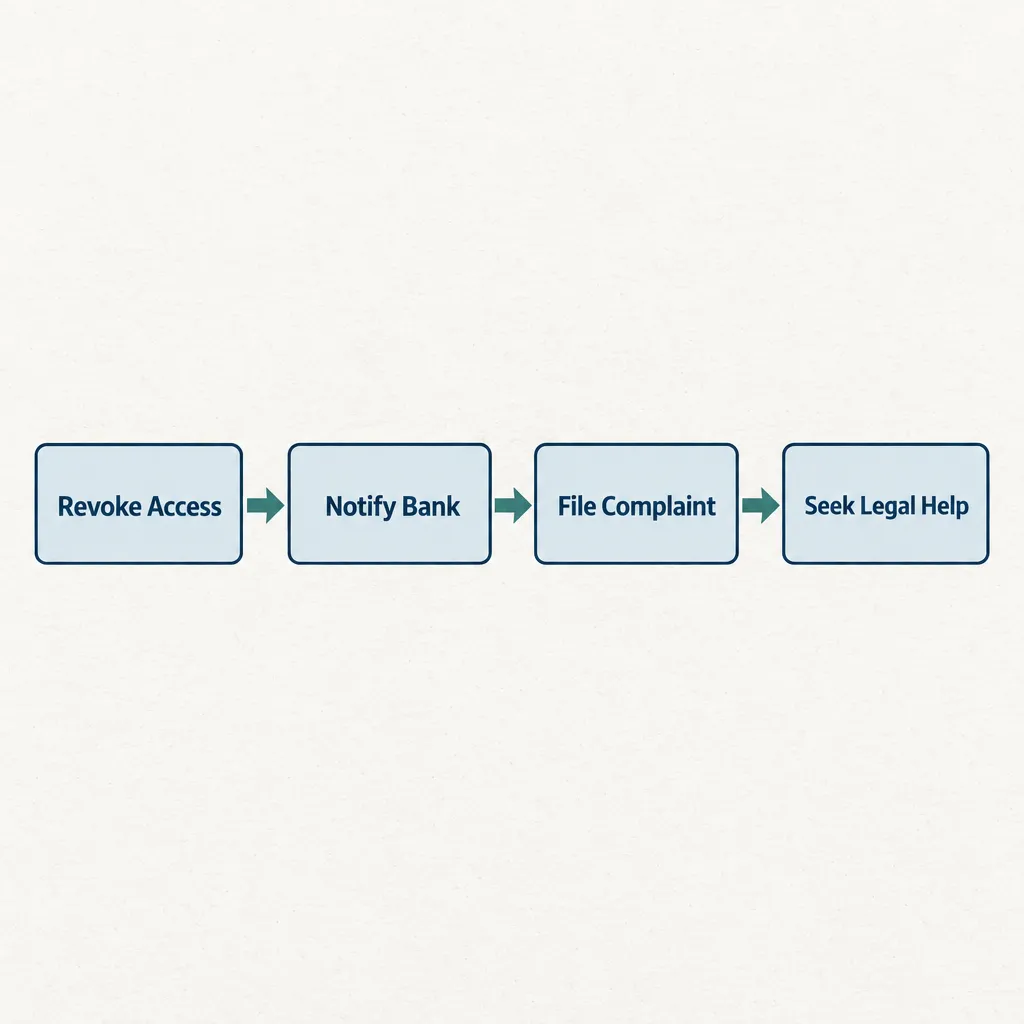
If you already have a loan from an unlicensed lender, act early and keep a record of everything. These steps follow the routes Pennsylvania regulators and legal aid groups use:
- Stay calm and do not take out a new loan to pay off the old one. Repeat borrowing is how a $375 loan turns into hundreds of dollars in fees.
- Gather documents. Save the loan agreement, emails, texts, screenshots of the website and bank statements that show each withdrawal. Legal aid offices ask for this paperwork at intake.
- Check the license. Search the lender on NMLS Consumer Access. No Pennsylvania license means it was limited to 6%.
- Revoke debit authorization in writing to the lender, then notify your bank. Keep copies of both.
- File complaints with DoBS, the Attorney General’s Bureau of Consumer Protection and the CFPB.
- Contact legal aid before you agree to any settlement or payment plan.
Do you have to pay it back?
There is no blanket rule that cancels these loans, but you are not required to pay usurious interest and fees to an unlicensed lender. In the Think Finance case, the Attorney General treated principal plus 6% as the most the lender could keep. Balances were voided, and borrowers who had paid more than that could share in refunds. That outcome came from a settlement in one case, so it does not automatically apply to your loan. How much you owe, if anything, depends on the facts and on any enforcement action. Ask legal aid before sending more money.
Stopping automatic withdrawals from your bank account
You have the right to stop lender debits. Write to the lender to revoke your authorization, then tell your bank in writing that you have revoked it and ask it to block further debits from that company. Under the Electronic Fund Transfer Act and Regulation E (12 CFR 1005), you can stop preauthorized transfers from your account. You can also dispute unauthorized debits with your bank.
The CFPB’s payday rule adds a backstop for covered loans. After two consecutive withdrawal attempts fail for insufficient funds, the lender must stop trying unless you give a new authorization.
Put the revocation in writing
Send the revocation to the lender and give a copy to your bank, then keep both copies with dates. Written proof makes a bank dispute far easier if debits keep coming.
If a debt collector calls or you get sued
A debt collector must follow the federal Fair Debt Collection Practices Act and Pennsylvania’s Fair Credit Extension Uniformity Act (73 P.S. § 2270.1 and following). In February 2024 the Third Circuit Court of Appeals held that the CDCA does not apply to debt collectors that buy debts. A collector does not need a CDCA license to collect, but the federal and state collection laws still apply. Under those laws, a collector cannot misstate the amount you owe, threaten action it cannot legally take, or harass you. You can ask the collector in writing to validate the debt.
The 4-year statute of limitations and why you must raise it
Under 42 Pa.C.S. § 5525, a lawsuit on a written contract generally has to be filed within four years. If you are sued on an older debt, the deadline is a defense you have to raise yourself. If you do not plead it in your court answer, you lose it. Many people lose time-barred cases simply because they never respond. Always answer a lawsuit by the deadline on the papers.
Can you get in trouble for not paying a payday loan?
No, you cannot be arrested in Pennsylvania just for failing to repay a loan, because unpaid debt is a civil matter. A lender’s real options are to try collecting or to file a civil lawsuit. The Fair Debt Collection Practices Act (15 U.S.C. § 1692e) bars collectors from threatening arrest or criminal charges they cannot lawfully bring. A caller who threatens jail or a “fraud charge” over a payday loan is showing a warning sign of a scam or an illegal collector, and you should report the call.
If a lender sues and wins, it gets a judgment. Pennsylvania’s rules then help you more than most states’ rules do. Under 42 Pa.C.S. § 8127, wages held by an employer are generally exempt from garnishment for ordinary consumer debts, including payday loans. The exceptions include support orders, certain residential lease judgments and a few other categories. Money already in a bank account can be at risk after a judgment, although federal benefits paid by direct deposit have their own protections. If you are served, call legal aid right away.
Cash advance and earned wage access apps in Pennsylvania
Pennsylvania has no earned wage access statute, so cash advance apps work without a dedicated state framework. NCSL’s 2025 summary of earned wage access legislation lists no Pennsylvania bill. Whether an app’s fees count as interest under Pennsylvania usury law is being decided in court.
In Golubiewski v. Activehours in the U.S. District Court for the Middle District of Pennsylvania, a borrower argues that EarnIn’s advances are credit. The court dismissed the case in September 2024. On August 28, 2025, it ruled that the plaintiff had plausibly alleged that EarnIn advances are credit under the Truth in Lending Act and Pennsylvania usury statutes, because the tips were incident to the credit. The case continues, and no final ruling has been reported.
The National Consumer Law Center’s January 2026 report, Picking Workers’ Pockets: Unfair, Deceptive and Abusive Practices, argues that “voluntary” tips and fast-funding fees can make small advances very expensive when you work them out as an APR. Before you use an app, compare the expedite fee plus any tip with the amount advanced and the days until repayment. A $5 fee on a $100 advance repaid in seven days works out to about 261% APR.
The federal layer: CFPB payday rule status in 2026
The CFPB Payday Lending Rule (12 CFR part 1041) now covers only payment practices, and Pennsylvania’s rate caps protect residents far more. The rule’s underwriting, or ability-to-repay, provisions were revoked. The payment provisions have a compliance date of March 30, 2025. They require payment notices and stop withdrawal attempts after two consecutive failures. Two days before that date, the CFPB said it would not prioritize enforcement of penalties under the rule. Its 2026 regulatory agenda, released in July 2026, lists a planned proposed rule to reconsider the remaining provisions, including compliance dates, and labels it deregulatory.
Three other federal laws apply nationwide:
- Truth in Lending Act and Regulation Z (12 CFR 1026): lenders must disclose the APR and finance charge before you sign.
- Military Lending Act: caps the Military Annual Percentage Rate at 36% on most consumer credit for active-duty service members and their dependents.
- Fair Debt Collection Practices Act: limits what third-party collectors can say and do.
Legal ways to borrow small amounts in PA
The cheapest lawful options are federal credit union payday alternative loans and assistance programs that do not have to be repaid. Licensed installment lenders come after those. The comparisons below are neutral and are not recommendations.
Cheaper options first
Ask a credit union about a PAL loan, capped at 28% a year.
Call your utility or creditor about a hardship plan before you borrow.
Dial 211 for local emergency aid in Pennsylvania.
Credit union payday alternative loans (PAL I and PAL II)
Payday alternative loans are small loans from federal credit unions, governed by the National Credit Union Administration. Both kinds are capped at 28% interest. PAL II, in effect since December 2, 2019, allows larger loans and has no membership waiting period.
| Feature | PAL I | PAL II |
|---|---|---|
| Loan amount | $200 to $1,000 | Up to $2,000, no minimum |
| Term | 1 to 6 months | 1 to 12 months |
| Maximum interest | 28% a year | 28% a year |
| Application fee | Up to $20 | Up to $20 |
| Membership wait | At least 1 month | None |
| Loans at once | One at a time | One at a time |
Licensed installment lenders: how to check the license
A CDCA licensee can lend lawfully at up to about 24% a year. Confirm the license on NMLS Consumer Access and read the Truth in Lending disclosure for the APR and the total of payments before you sign. A lawful 24% loan still costs money, so borrow only what your budget can repay on schedule.
Non-loan help: LIHEAP, utility shutoff protections, 211
Pennsylvania financial assistance that you do not have to repay is often the best first call:
- LIHEAP: The Pennsylvania Department of Human Services runs the Low Income Home Energy Assistance Program. In the 2025-26 season, cash grants ranged from $200 to $1,000, and crisis grants covered emergencies. Season dates depend on federal funding. The 2025-26 season opened December 3, 2025, after a delay caused by the federal shutdown.
- Utility hardship plans: Pennsylvania’s large utilities offer customer assistance programs. The Public Utility Commission’s winter rules limit heating shutoffs for many low-income households.
- PA 211: connects you with county rental, food and emergency cash programs.
- Debt relief programs in Pennsylvania: Nonprofit credit counseling agencies can set up debt management plans. Debt management and debt settlement companies that serve Pennsylvanians must be licensed by DoBS. The FTC’s Telemarketing Sales Rule bars debt settlement firms from collecting fees before they settle a debt.
Where to complain and get free legal help
DoBS is the main regulator for lenders, and the Attorney General’s office handles consumer fraud. You can file with both, and also with the CFPB.
| Agency or group | What it handles | How to reach it |
|---|---|---|
| PA Department of Banking and Securities, Consumer Help Center | Unlicensed lenders, license checks | 1-800-PA-BANKS (1-800-722-2657), [email protected] |
| PA Office of Attorney General, Bureau of Consumer Protection | Fraud, illegal lending, collection abuse | Consumer protection hotline 1-800-441-2555 |
| Consumer Financial Protection Bureau | Lenders, collectors, banks, apps | Online complaint portal |
| Community Legal Services of Philadelphia | Payday loan help for Philadelphia residents | 215-981-3700 |
| Philadelphia Legal Assistance | Consumer cases in Philadelphia | 215-981-3800 |
| Pennsylvania Legal Aid Network | Statewide finder for county legal aid offices | Online Find Legal Help intake |
| PA SeniorLAW Helpline | Residents 60 and older | 1-877-727-7529 |
Community Legal Services announced on November 17, 2026 that it is moving offices, so confirm the address before you visit.
Save everything first
Before you file, save every loan document, screenshot, email and bank statement. DoBS investigators and legal aid lawyers both need them.
Which states ban payday loans?
Pennsylvania is one of a small group of states with no payday lending statute that lets lenders charge payday rates. According to NCSL’s most recent summary (February 2023), 37 states have statutes allowing payday lending. Connecticut, Maryland, Massachusetts, New Jersey, New York, Pennsylvania, Vermont and West Virginia have no specific payday provisions or require lenders to follow general consumer loan rate caps. Georgia prohibits payday lending through its racketeering law, and Arkansas ended it in 2011.
| State | Payday statute? | How it compares with PA |
|---|---|---|
| Pennsylvania | No | 6% unlicensed, about 24% licensed |
| New Jersey | No | Rate caps bar payday lending |
| New York | No | Rate caps bar payday lending |
| Maryland | No | Rate caps bar payday lending |
| West Virginia | No | Rate caps bar payday lending |
| Ohio | Yes | Licensed short-term loans allowed under its own law |
| Delaware | Yes | Licensed short-term loans allowed under its own law |
Our guides to New Jersey payday loan laws and Maryland payday loan laws explain those states’ caps in detail, and our pages on Indiana, Michigan and Illinois payday loan laws cover states that license payday lenders.
Before you borrow
The biggest risk in Pennsylvania is an unlicensed online lender that takes repeated debits from your bank account at rates many times the 6% legal limit. Check the license on NMLS Consumer Access before you share any bank details, and use a credit union PAL or a hardship plan first.
FAQ
Are payday loans legal in Pennsylvania?
No. No Pennsylvania law authorizes payday lending. The Loan Interest and Protection Law caps unlicensed lenders at 6% a year, and the Consumer Discount Company Act caps licensed lenders at about 24% on loans of $25,000 or less. A loan at 391% APR breaks both caps.
Are online payday loans legal in PA?
No. In Cash America Net of Nevada v. Commonwealth (2010), the Pennsylvania Supreme Court held that the CDCA applies to internet lenders that lend to Pennsylvanians, even if they have no office in the state. Websites that approve Pennsylvania residents are either unlicensed or claiming an exemption that regulators reject.
I took an online payday loan and just found out they’re illegal in PA. Do I still have to pay it back?
You are not required to pay usurious interest and fees to an unlicensed lender. In the 2019 Think Finance settlement, balances were voided and borrowers who had paid more than principal plus 6% could get refunds. That result came from one settlement, so file with DoBS and the Attorney General and talk to legal aid before you pay more.
A collector says I’ll be arrested or charged with fraud for not paying. Is that true?
No. Unpaid loans are civil debts in Pennsylvania. The Fair Debt Collection Practices Act bars collectors from threatening arrest or charges they cannot lawfully bring, so report the call to the CFPB and the Attorney General.
Can they garnish my wages in Pennsylvania over a payday loan?
Generally no. Under 42 Pa.C.S. § 8127, wages are exempt from garnishment for ordinary consumer debts. Exceptions cover things like support orders and certain residential lease judgments. Bank accounts can face other collection steps after a court judgment.
Is EarnIn or Dave basically a payday loan? Are the tips legal in PA?
Pennsylvania has no earned wage access law, and the question is still in court. In August 2025, a federal court in the Middle District of Pennsylvania ruled that a borrower had plausibly alleged EarnIn’s advances are credit under the Truth in Lending Act and state usury law. The case has not been decided. Work out the APR of any fee or tip before you use an app.
Next step if you are short on cash
If you need money now, call your credit union about a PAL loan and dial 211 for local emergency aid before you consider any lender. If an unlicensed lender is already taking money from your account, revoke the authorization in writing today and report the lender to DoBS at 1-800-722-2657. Many of the case outcomes above began with borrower complaints to these regulators.
Laws and regulations referenced
- Pennsylvania Consumer Discount Company Act (Act 66 of 1937)
- Pennsylvania Loan Interest and Protection Law (Act 6 of 1974, usury law)
- Truth in Lending Act, 15 U.S.C. 1601
- Regulation Z, 12 CFR Part 1026
- Fair Debt Collection Practices Act, 15 U.S.C. 1692
- Electronic Fund Transfer Act, 15 U.S.C. 1693
- Regulation E (electronic transfers), 12 CFR Part 1005
- Military Lending Act, 10 U.S.C. 987
- CFPB payday lending rule, 12 CFR Part 1041
Links go to the official text on government sites.
Check, verify or complain
Sources
- DoBS interpretive letter: Maximum Interest Rate dobs.pa.gov · official source
- Consumer Discount Company Act (DoBS) dobs.pa.gov · official source
- PA Attorney General: Think Finance and Victory Park Capital settlement attorneygeneral.gov · official source
- NCUA PAL II final rule, Federal Register govinfo.gov · official source
- PA DoBS Consumer Help Center pa.gov · official source
- PA AG: Settlements with CashPoint and Approved Financial result in debt cancellation attorneygeneral.gov · official source
- PA DHS: Apply for LIHEAP pa.gov · official source
- PA Aging: Older Pennsylvanians Legal Assistance pa.gov · official source
- Pennsylvania Department of Banking v. NCAS of Delaware, LLC (2008) summary studicata.com
- Cash America Net of Nevada v. Commonwealth (2010) case-law.vlex.com
- Third Circuit finds Pennsylvania's CDCA does not apply to debt collectors consumerfinancialserviceslawmonitor.com
- Philadelphia court receives usury claim against payday loan company infobytes.orrick.com
- NCLC: Successful challenges to earned wage payday loans library.nclc.org
- NCLC: Picking Workers' Pockets (January 2026) nclc.org
- NCSL: Earned Wage Access 2025 Legislation ncsl.org
- American Banker: CFPB will not enforce payday lending rule americanbanker.com
- CFPB 2026 regulatory agenda and payday rule reconsideration natlawreview.com
- NAFCU: PAL I loans nafcu.org
- Community Legal Services: Payday Loans clsphila.org
- DoBS advises consumers about illegal auto title loans following court decision prnewswire.com

Elena writes about getting through a money emergency, assistance programs, budgeting on a tight income, banking basics and borrower rights. Her guides list the cheaper options first and link the agency or program that can actually help.
Ruth is US Financer's standards editor. Every article goes through her checks before and after it is published: each rate, fee, cap, deadline and rule is matched against its primary source, every law named is linked to its official text, and anything that cannot be…
What changed
- Nov 19, 2026 First published.
Comments are closed