

We are not a credit repair, debt relief or debt collection company and offer no services. Rules differ by state, so confirm with the agency or a nonprofit counselor before you act.
A credit report dispute letter is a written notice to Equifax, Experian or TransUnion, or to the company that reported the item. It names each error on your report and asks for a correction or deletion. Under the Fair Credit Reporting Act, the bureau then generally has 30 days to investigate. Send your letter as soon as you find an error, and well before any loan, apartment or job application. The table after the key takeaways shows which copy-ready letter you need and where to find it.
Key takeaways
- A dispute can fix or remove information that is wrong, incomplete or can’t be verified. Accurate, current negative items stay on your report.
- Send a separate letter to each bureau that shows the error, and a matching letter to the creditor or collector that reported it.
- For identity theft, send a Section 605B block request with your FTC report. That route is faster than an ordinary dispute.
- The 30-day clock starts when the bureau receives your letter. Results are due within 5 business days after the investigation ends.
- Disputing is free and doesn’t lower your credit score.
Fact-checked
We checked these key facts against the sources named, on November 13, 2026:
- For willful violations, you can recover actual damages or statutory damages of $100 to $1,000, plus attorney’s fees and costs (source: uscode.house.gov)
- One legal reason to always include the bureau: you can generally sue a furnisher over its investigation only after disputing through a credit bureau (15 U.S.C (source: law.cornell.edu)
- Equifax, Experian and TransUnion don’t report paid medical collections or medical collections under $500, and they wait a year before a medical collection can appear (source: equifax.com)
- Under Regulation V, 12 CFR 1022.43, a furnisher must investigate direct disputes about your liability for an account, its terms, your payment history and other details of your relationship with it (source: ecfr.gov)
- A correction at one bureau doesn’t automatically fix the others. :::tip One error, one bureau, one letter Write a separate letter for each bureau and dispute only the errors on that bureau’s report (source: consumerfinance.gov)
Which letter you need
Pick the letter that matches your problem, then go to the section named in the right-hand column. Every template is copy-ready: fill in the brackets, print it and sign it.
| Your situation | Letter to use | Section |
|---|---|---|
| Wrong late payment, balance, status or date on a bureau report | Bureau dispute letter | Sample credit report dispute letter |
| A collection that is paid, settled, listed twice or not yours | Bureau letter, collection version | Letter to remove an inaccurate collection |
| Wrong name, address, birth date or employer | Bureau letter, personal information version | Letter to correct personal information |
| You want the creditor or collector to fix its own records | Creditor or collector letter | Sample letter to the creditor or collector |
| Accounts opened by an identity thief | Identity theft block request | Identity theft block request letter |
| A “verified” or “frivolous” result, or no answer at all | Follow-up letter | Follow-up letter template |
Credit report dispute letter: the short answer
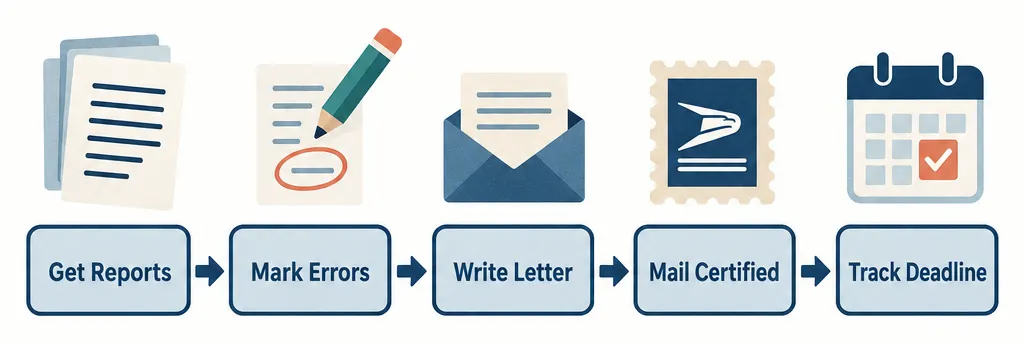
The process has five steps: get your reports, mark each error, write one letter per bureau, mail it with copies of your proof, and track the deadlines. Disputes exist to correct mistakes. They don’t erase accurate history.
- Get all three reports. They are free every week at AnnualCreditReport.com.
- Mark every error. Note the report number, the furnisher’s name and the last four digits of each account.
- Write one letter per bureau. Only include the errors that appear on that bureau’s report.
- Mail it certified with a return receipt. Enclose copies of your proof, never originals.
- Track the clock. Count 30 days from the delivery date, or 45 days in the cases explained below. Write down the date results arrive.
The federal regulators publish their own model letters. The CFPB has free samples at consumerfinance.gov, one for disputing with a credit reporting company and one for disputing with the company that supplied the information. The FTC has matching samples on its consumer site. According to the FTC, a dispute letter should identify each item, explain why it is wrong, ask for removal or correction, and include copies (not originals) of supporting documents. The templates below follow that structure. They also add what the agency samples leave out: collection and personal-information versions, an identity theft block request and a follow-up letter.
What you can dispute (and what you can’t)
You can dispute any information you believe is inaccurate or incomplete. The bureau must correct or delete anything that turns out to be wrong, incomplete or unverifiable, whichever company reported it. A dispute won’t remove a late payment or collection that really happened and is still within the reporting period.
Errors that qualify
These errors justify a letter:
- Wrong personal information: a misspelled name, a wrong address, the wrong date of birth or an employer you never worked for
- Accounts that aren’t yours: often a sign of a mixed file (someone else’s data merged into yours) or of identity theft
- Wrong balance, credit limit or status: for example, a paid-off loan still showing a balance, or a closed card shown as open
- False late payments: a payment marked 30 days late when your bank statement shows it posted on time
- Duplicate accounts: the same debt listed twice, or a collection shown with a balance while the original creditor also reports it as owed
- Outdated negative items: most negative information must come off after 7 years, and most bankruptcies after 10. For collections and charge-offs, the 7 years start 180 days after the original delinquency (15 U.S.C. 1681c(c)).
- Wrong collection details: the wrong amount, the wrong original creditor, or a debt that was settled or discharged in bankruptcy
This table matches common errors with the evidence that usually works for each.
| Error | Example | Evidence to enclose | Send to |
|---|---|---|---|
| False late payment | Card reported 30 days late in June | Bank statement showing the payment date, creditor’s payment confirmation | Bureau and creditor |
| Wrong balance | Paid-off auto loan shows $2,140 owed | Payoff letter, lien release or title | Bureau and lender |
| Account not yours | Store card you never opened | FTC identity theft report from IdentityTheft.gov, ID copy | Bureau (block request) and creditor |
| Duplicate debt | Same medical bill listed by two collectors | Both report pages with the items circled | Bureau and both collectors |
| Settled debt shown as unpaid | Collection still shows full balance | Settlement letter and proof of payment | Bureau and collector |
| Debt discharged in bankruptcy | Account shows past due after discharge | Discharge order and the schedule listing the debt | Bureau and creditor |
| Wrong personal data | Unknown address or wrong birth date | Driver’s license, utility bill | Bureau only |
| Too old to report | Charge-off older than 7 years | Report page showing the date of first delinquency | Bureau |
Items a dispute won’t remove
A dispute won’t delete accurate information. If a late payment really happened, the creditor can verify it and the bureau can keep reporting it. Disputing it anyway risks having your later, legitimate disputes treated as frivolous.
For accurate items, your options are slower but real. You can ask the creditor for a goodwill adjustment, which it is free to refuse. You can pay down balances, or wait for the item to age off. If a collector is involved, a debt validation letter sent within the validation period requires the collector to show what it claims you owe before you decide anything.
Identity theft and mixed files: a different route
Identity theft has its own, faster legal tool. Under FCRA Section 605B (15 U.S.C. 1681c-2), a bureau must block information that resulted from identity theft no later than 4 business days after it receives four things:
- proof of your identity
- a copy of an identity theft report
- your list of the fraudulent items
- your statement that the information doesn’t relate to any transaction you made
The bureau can decline or rescind a block in limited cases, such as an error or misrepresentation in the request, or if you received goods or services from the blocked transaction. Most fraud victims get the block, but it isn’t guaranteed.
Start by filing your report at IdentityTheft.gov, the FTC’s official site. Then send each bureau the block request letter below, with that report attached, instead of an ordinary dispute letter.
In a mixed file, the bureau has merged someone else’s accounts into yours, often because your names or Social Security numbers are similar. Dispute the wrong personal details (addresses, name variations) along with the accounts. If the personal data stays wrong, the accounts tend to come back.
Before you write: get all three reports and gather proof
Your letter should cite the exact report and the exact item. Every report is free each week, and the documents you enclose matter more than how you word the letter.
Where to get your free reports
AnnualCreditReport.com is the only federally authorized source of free reports from all three nationwide bureaus, and it offers them weekly. Each report shows a report or confirmation number near the top. Quote it in your letter.
For each error, write down:
- The furnisher’s name as printed (for example, “MIDLAND CREDIT MGMT” rather than the original store name)
- The account number as shown, which is usually partly masked
- The specific field that is wrong: balance, status, date opened, or the payment history for a given month
- Which bureaus show it, because the same account can appear differently on each report
Evidence that actually helps
The bureau passes your dispute to the furnisher, which compares it with its own records. Documents that contradict those records give the furnisher a concrete reason to change them. Useful proof includes:
- Bank or card statements showing payment dates and amounts
- Payoff letters, paid-in-full letters, settlement agreements and lien releases
- Court records, such as a bankruptcy discharge order or a dismissed judgment
- Your FTC identity theft report, for fraudulent accounts
- A copy of the report page with the error circled or highlighted
Make every enclosure easy to check
Circle or highlight each error on a copy of your report and enclose that copy. Number your enclosures and refer to those numbers in the letter. Always send copies of your proof, never originals.
What you need before you start:
- your report number
- your full legal name
- your current address and any other addresses from the past two years
- your date of birth
- your Social Security number
- a copy of a government-issued ID
- a recent utility bill or bank statement showing your address
The bureaus use these to match your letter to the right file. A mismatched file is a common reason disputes stall.
Sample credit report dispute letter (to Equifax, Experian or TransUnion)
The letter below follows the structure of the CFPB and FTC samples: who you are, what is wrong, why, what you want done, and what you’ve enclosed. Replace everything in square brackets. Keep it factual and brief.
Copy-ready letter
[Your full name]
[Street address]
[City, state ZIP]
Date of birth: [MM/DD/YYYY]
Social Security number: [XXX-XX-XXXX]
Report or confirmation number: [Number from your report][Date]
[Bureau name]
[Dispute address from your report or the table below]Re: Dispute of inaccurate information under the Fair Credit Reporting Act, 15 U.S.C. 1681i
To whom it may concern:
I am writing to dispute the following information in my credit file. The items are circled on the enclosed copy of my credit report dated [Report date].
- [Furnisher name], account ending in [Last 4 digits]. The report shows [What it says, e.g., “a 30-day late payment for June 2026”]. This is inaccurate because [Why, e.g., “my payment posted on June 12, 2026, before the June 15 due date”]. Please [The fix, e.g., “remove the late payment and report the June payment as on time”]. See Enclosure 2.
- [Furnisher name], account ending in [Last 4 digits]. The report shows [What it says]. This is inaccurate because [Why]. Please [The fix]. See Enclosure 3.
Under 15 U.S.C. 1681i, please conduct a reasonable reinvestigation, forward all relevant information I have provided to the furnisher, and delete or correct any information that is inaccurate, incomplete or cannot be verified. Please send me written results and an updated copy of my credit report when the reinvestigation is complete.
Enclosures (copies only):
1. Copy of my credit report with disputed items circled
2. [Document, e.g., “Bank statement for June 2026 showing payment on June 12”]
3. [Document]
4. Copy of my driver’s license and a utility bill showing my current addressSincerely,
[Signature]
[Printed name]
Short version for one error. If you’re disputing one item, keep the identification block and the closing, and use a single paragraph:
I dispute the [Furnisher name] account ending in [Last 4 digits], which shows [What it says]. This is wrong because [Why]. Please [Correct it to / delete it]. A copy of my report with the item circled and [Your proof] are enclosed.
Letter to remove an inaccurate collection
You can dispute a collection when something about it is factually wrong: it was paid or settled and the report doesn’t say so, it appears twice, it’s too old, or it isn’t yours. A collection that is accurate and current can stay for up to 7 years plus 180 days from the original delinquency, even after you pay it. Paying changes its status to paid, but the entry itself remains.
Medical collections are the exception. Under the bureaus’ voluntary policies, paid medical collections and medical collections under $500 shouldn’t appear at all.
To dispute a collection, use the copy-ready letter above and swap in the paragraph that fits your case.
Paid or settled but shown as unpaid:
[Collector name], account ending in [Last 4 digits], original creditor [Name]. The report shows a balance of $[Amount] and a status of [Status]. This is inaccurate because I [Paid it in full / settled it] on [Date]. Please update the balance to $0 and the status to [Paid / settled]. See Enclosure 2 (settlement letter) and Enclosure 3 (proof of payment).
Duplicate listing:
[Collector name], account ending in [Last 4 digits]. This is the same debt reported by [Original creditor or second collector], account ending in [Last 4 digits], with the same original creditor and delinquency date. Both show a balance owed, which counts one debt twice. Please delete the duplicate or report a $0 balance on the entry that no longer owns the debt. See Enclosure 2, where both entries are circled.
Not yours:
[Collector name], account ending in [Last 4 digits], original creditor [Name]. I have never had an account with [Original creditor] and do not owe this debt. Please delete this item if it cannot be verified as mine. [If fraud: “This account resulted from identity theft; my FTC Identity Theft Report is enclosed.”]
Paid medical collection or medical collection under $500:
[Collector name], account ending in [Last 4 digits], is a medical collection [Paid on [Date] / with A balance of $[Amount], under $500]. Please delete it. See Enclosure 2.
Send a matching direct dispute to the collector, using the furnisher letter below. If you don’t recognize the debt and the collector contacted you recently, a debt validation letter can go out alongside the dispute. If identity theft caused the collection, use the block request letter instead.
Letter to correct personal information
Wrong names, addresses and birth dates go to the bureau only. Under 12 CFR 1022.43, furnishers don’t have to investigate direct disputes about identifying information. Fixing these details matters most in a mixed-file case, because a stray address or name variant can pull someone else’s accounts back into your file.
Use the copy-ready letter above with this paragraph:
The personal information in my file contains the following errors: [LIST, e.g., “the address 412 Oak St., Dayton, OH, where I have never lived”; “the name variation ‘J. R. Smyth'”; “the date of birth 04/12/1979; my correct date of birth is 04/21/1979”]. Please delete the incorrect entries and keep only my correct information as shown on the enclosed driver’s license and utility bill. If any accounts in my file are linked to these incorrect details, please review whether they belong to another consumer.
Enclose your ID and one or two documents that show your correct address. Use a recent bill or bank statement for the address, not a document that is several years old.
How to describe each error so it isn’t labeled frivolous
A bureau can refuse to investigate a dispute it reasonably decides is “frivolous or irrelevant.” This usually happens when a dispute repeats an earlier one without new information, or doesn’t give enough detail to investigate. Being specific prevents it.
- Put one error in each numbered paragraph: the account name, the last four digits, what is wrong, what it should say, and which enclosure proves it
- Use plain facts, such as “paid on June 12,” instead of conclusions like “this is illegal reporting”
- Ask for one specific outcome per item
- Don’t dispute again without new evidence
Wording matters for a practical reason. Bureaus send disputes to furnishers through e-OSCAR, an industry system that turns them into codes and short summaries. The statute requires the bureau to pass along all relevant information you provide. A clear paragraph with labeled documents is harder to reduce to a meaningless code.
Mistakes that weaken a letter
- Disputing every negative item at once, accurate or not
- Using a template that cites the wrong law, such as a “609 letter”
- Leaving out the report number or the account details
- Sending your only copy of a settlement letter or court order
- Mailing one combined letter to all three bureaus
- Using angry or threatening language in place of facts
Sample letter to the creditor or collector (the furnisher)
You can also dispute directly with the company that reported the item. Doing so alongside your bureau dispute adds pressure. Under Regulation V, 12 CFR 1022.43, a furnisher must investigate direct disputes about your liability for an account, its terms, your payment history and other details of your relationship with it. It must finish in the same time a bureau would have.
The rule has limits. Furnishers don’t have to investigate direct disputes about your identifying details (name, address, birth date), inquiries or fraud alerts. They also don’t have to investigate disputes submitted or prepared by a credit repair organization. Send yours yourself.
FCRA Section 1681s-2 also applies. If a furnisher keeps reporting information you have disputed with it, it must tell the bureau the item is disputed.
Did you know?
According to the FTC, if a creditor keeps reporting an item you have disputed with it directly, it must tell the credit bureau the item is in dispute, and the bureau must note that on your report.
Send the letter to the dispute address the furnisher gives you, such as one printed on its statements or on your credit report. If it hasn’t given one, any business address will do.
[Your full name]
[Street address]
[City, state ZIP][Date]
[Furnisher name]
[Furnisher’s dispute address]Re: Direct dispute, account ending in [Last 4 digits], under 15 U.S.C. 1681s-2 and 12 CFR 1022.43
To whom it may concern:
You are reporting the following inaccurate information about this account to [Equifax / Experian / TransUnion]: [What is reported]. This is inaccurate because [Why]. Enclosed are copies of [Your proof] and the relevant page of my credit report.
Please investigate, correct the information with every credit reporting company you report to, and send me written confirmation of the result. While this dispute is open, please report the account as disputed by the consumer.
Enclosures (copies only):
1. [Document]
2. Credit report page with the item circledSincerely,
[Signature]
[Printed name]
Bureau first or furnisher first? If you can, do both at once. One legal reason to always include the bureau: you can generally sue a furnisher over its investigation only after disputing through a credit bureau (15 U.S.C. 1681s-2(b)). A direct dispute alone doesn’t give you that right.
Identity theft block request letter (FCRA Section 605B)
If an identity thief opened accounts or ran up debts in your name, ask each bureau to block that information under 15 U.S.C. 1681c-2 rather than send an ordinary dispute. A complete request must be honored within 4 business days, compared with 30 days for a dispute. The bureau must also notify the furnisher that the information may come from identity theft.
Before you write, file your report at IdentityTheft.gov and download your FTC Identity Theft Report. Mark every fraudulent account, inquiry and address on each bureau’s report. Then send this letter to each bureau that shows fraud.
[Your full name]
[Street address]
[City, state ZIP]
Date of birth: [MM/DD/YYYY]
Social Security number: [XXX-XX-XXXX]
Report or confirmation number: [Number from your report][Date]
[Bureau name]
[Dispute address from your report or the table below]Re: Request to block information resulting from identity theft under 15 U.S.C. 1681c-2 (FCRA Section 605B)
To whom it may concern:
I am a victim of identity theft. The following information in my file resulted from identity theft and does not relate to any transaction I made or authorized:
- [Creditor or collector name], account ending in [Last 4 digits], opened [Date], balance $[Amount]
- [Creditor name], hard inquiry dated [Date]
- Address: [Address I have never lived at]
Under 15 U.S.C. 1681c-2, please block this information from my file within 4 business days of receiving this request and notify each furnisher that the information may be the result of identity theft. Please send me written confirmation of the block and an updated copy of my credit report.
Enclosures (copies only):
1. My FTC Identity Theft Report, report number [Number], dated [Date]
2. Copy of my driver’s license or other government-issued ID
3. Proof of my current address: [Utility bill / bank statement]
4. Copy of my credit report with the fraudulent items circledSincerely,
[Signature]
[Printed name]
Send a copy of your identity theft report to each creditor or collector on the list as well. Under 15 U.S.C. 1681s-2(a)(6), a furnisher that receives an identity theft report at the address it designates generally can’t keep reporting the fraudulent information.
Lock things down while the block goes through
While you wait for the block, place a free fraud alert or a free credit freeze. A fraud alert placed with one bureau is passed on to the other two. A freeze has to be set at each bureau separately.
Where to send your dispute letter
Mail each bureau’s letter to the dispute address printed on your credit report or on that bureau’s dispute form. The CFPB gives the same advice, because bureaus sometimes change P.O. boxes. The addresses below come from the FTC’s dispute page. The phone numbers are the ones the CFPB lists for each bureau.
| Bureau | Dispute mailing address | Phone (questions) | Online dispute page | Note |
|---|---|---|---|---|
| Equifax | Equifax Information Services LLC, P.O. Box 740256, Atlanta, GA 30374 | (866) 349-5191 | Dispute center at equifax.com | Report requests go to a different P.O. box, so don’t mix them up |
| Experian | Experian, P.O. Box 4500, Allen, TX 75013 | (888) 397-3742 | Dispute center at experian.com | Experian’s own pages have listed more than one box, so check your report |
| TransUnion | TransUnion LLC Consumer Dispute Center, P.O. Box 2000, Chester, PA 19016-2000 | (800) 916-8800 | Dispute center at transunion.com | The FTC suggests mailing TransUnion’s dispute form with your letter |
Addresses come from the FTC’s dispute guidance, and phone numbers from the CFPB’s bureau contact page. Verify the phone number and address on current bureau guidance before mailing. If your report prints a different number, use that one. Calling is fine for questions, but put the dispute itself in writing.
Should you write to all three? Send a letter only to the bureaus that show the error. Furnishers don’t always report to all three, and the same account can carry different data on each report. A correction at one bureau doesn’t automatically fix the others.
One error, one bureau, one letter
Write a separate letter for each bureau and dispute only the errors on that bureau’s report. Keep a copy of each signed letter and its enclosures in its own folder.
Certified mail vs. online vs. phone
All three methods are valid. What differs is the proof you keep and, online, the terms you agree to. The FTC recommends certified mail with return receipt so you can document what the bureau received and when. That delivery date starts your 30-day clock.
| Method | Strengths | Weaknesses | Best for |
|---|---|---|---|
| USPS Certified Mail with Return Receipt | Proof of delivery date, full control over wording and enclosures, no online terms to accept | Slower, and USPS fees on top of postage | Complex disputes, anything you might escalate or sue over |
| Online dispute center | Fast, instant confirmation number, file uploads | Limited text boxes, preset reason menus, a thinner record of what you sent, account terms that can include arbitration | Simple errors such as a wrong address |
| Phone | Quick | Hardest to prove what you said | Questions, not disputes |
The legal risk of disputing online. To dispute online, you usually create an account and accept the bureau’s Terms of Use. The Terms of Use pages on equifax.com, experian.com and transunion.com have included mandatory individual arbitration clauses and class-action waivers. Courts have enforced Experian’s version, for example in Williams v. Experian, where the court sent the consumer’s claims to arbitration based on the 2016 terms. Some versions exclude FCRA disputes about your report. Some let you opt out by written notice within a short window, often 30 days after you accept. Read the current terms, including the arbitration and opt-out sections, before you click through. If the error has cost you a loan, a job or housing and you may want to sue, dispute by certified mail.
If you do dispute online, take a screenshot of every screen before you submit, save the confirmation number and download the files you uploaded.
What happens after you mail it: the FCRA timeline
Once the bureau receives your letter, the FCRA sets the steps and deadlines. In practice, the bureau notifies the furnisher within days, the furnisher reviews its records, and you get a written result in a little over a month.
| Step | Who acts | Deadline | Legal basis |
|---|---|---|---|
| Block identity theft information (complete 605B request) | Bureau | Within 4 business days | 15 U.S.C. 1681c-2(a) |
| Notify the furnisher and pass on your information | Bureau | Within 5 business days of receiving your dispute | 15 U.S.C. 1681i(a)(2) |
| Investigate the dispute | Furnisher | Within the bureau’s investigation period | 15 U.S.C. 1681s-2(b) |
| Complete the reinvestigation | Bureau | 30 days from receipt | 15 U.S.C. 1681i(a)(1)(A) |
| Extension if you send more relevant information during the 30 days | Bureau | Up to 15 more days (45 total) | 15 U.S.C. 1681i(a)(1)(B) |
| Dispute filed after a free annual report | Bureau | 45 days | 15 U.S.C. 1681j(a)(3) |
| Notice that a dispute is frivolous, with reasons | Bureau | Within 5 business days of that decision | 15 U.S.C. 1681i(a)(3) |
| Written results to you | Bureau | Within 5 business days after completion | 15 U.S.C. 1681i(a)(6) |
| Description of how it investigated, if you ask | Bureau | Within 15 days of your request | 15 U.S.C. 1681i(a)(7) |
| Notice if a deleted item is put back | Bureau | Within 5 business days of reinsertion | 15 U.S.C. 1681i(a)(5)(B) |
The 30- and 45-day deadlines
Day one is the day the bureau receives your letter, not the day you mail it. That’s why the return receipt matters. The extension applies when you send relevant new information during the first 30 days. It doesn’t apply if the bureau has already found the item inaccurate or unverifiable within those 30 days.
Send everything at once
Sending extra documents partway through can stretch the deadline to 45 days. If an application is coming up, put all your proof in the first letter.
Use a simple tracker like this one. The first row is an example. Fill in a row for each letter you send.
| Letter | Sent | Tracking number | Delivered | Day 30 | Day 45 | Response received | Result |
|---|---|---|---|---|---|---|---|
| Example: Experian, late payment | March 1 | From your receipt | March 4 | April 3 | April 18 | April 2 | Corrected |
| Equifax | |||||||
| Experian | |||||||
| TransUnion | |||||||
| Furnisher |
What the results letter will say
The bureau’s written results must tell you the investigation is finished and include a copy of your report if it changed. They must also tell you that you can ask for a description of how the bureau investigated, add a statement to your file, and request that corrections go to recent recipients of your report.
That last right helps when an error has already hurt you. If an item was deleted or changed, you can ask the bureau to notify anyone who received your report in the past six months, or in the past two years for employment purposes (15 U.S.C. 1681i(d)).
If the bureau says ‘verified’ or ‘frivolous’
“Verified” means the furnisher told the bureau its information matches its own records. It doesn’t mean anyone checked your documents carefully. “Frivolous” means the bureau declined to investigate, and it must tell you why in writing. Each answer has a specific next step.
| Response | What it means | Your next move | Letter to use |
|---|---|---|---|
| Deleted | Item removed | Check all three reports and watch for reinsertion | None |
| Corrected or updated | Item changed | Confirm the change is the one you asked for | Re-dispute if only partly fixed |
| Verified as accurate | Furnisher confirmed its data | Ask how it was verified, dispute with the furnisher, add new evidence | Follow-up letter below |
| Frivolous or irrelevant | No investigation done | Supply the information the notice says is missing | New dispute with that information |
| No response after 30 or 45 days | Possible FCRA violation | Send a follow-up with proof of delivery and file a CFPB complaint | Follow-up letter, then complaint |
How can something wrong be “verified”?
Readers ask this often. Verification usually means the furnisher checked its own records and confirmed they match what it reported. If those records are wrong, they will match the wrong report. Sending proof straight to the furnisher and asking the bureau to describe its process can move a stuck dispute. If you think nobody looked at your documents, a consumer attorney can tell you whether that counts as an unreasonable investigation.
Follow-up letter template
Use this letter after a “verified” result, after a “frivolous” notice, or when the deadline passes with no answer.
[Your full name]
[Street address]
[City, state ZIP]
Report or confirmation number: [Number][Date]
[Bureau name]
[Dispute address]Re: Follow-up on my dispute received [Date of delivery], certified mail number [Tracking number]
To whom it may concern:
On [Date] you received my dispute of the [Furnisher name] account ending in [Last 4 digits]. [Choose one: “On [Date] you reported the item as verified.” / “On [Date] you told me the dispute was frivolous because [Reason given].” / “As of today I have received no results, and the deadline under 15 U.S.C. 1681i(a)(1) has passed.”]
Under 15 U.S.C. 1681i(a)(6)(B)(iii) and (a)(7), please send me a description of the procedure used to determine the accuracy of this information, including the business name, address and telephone number of any furnisher you contacted.
I am also providing new information not included in my first dispute: [New evidence]. Please reinvestigate using this information and correct or delete the item if it cannot be verified as accurate.
Enclosures (copies only):
1. Copy of my original dispute and the certified mail receipt
2. Your response dated [Date]
3. [New document]Sincerely,
[Signature]
[Printed name]
If your dispute was marked frivolous, the notice must say what information the bureau needs to investigate. Your next letter should supply exactly that.
Did you know?
Under 15 U.S.C. 1681i(a)(3), a bureau that labels your dispute “frivolous or irrelevant” can’t simply ignore you. It has to give you its reasons in writing within 5 business days, including what information it would need to investigate.
Adding a statement of dispute
If the investigation doesn’t resolve the problem, you can add a brief statement to your file explaining your side. The bureau may limit it to 100 words if it helps you write a clear summary. The statement, or a summary of it, then appears on future reports that include the item. The FTC confirms you can ask the bureau to send it to anyone who recently received your report, though you may have to pay a fee.
A statement doesn’t change your score. It gives context to a person reviewing your file, such as a landlord or a loan officer.
Escalating: CFPB complaints, state regulators and FCRA lawyers
If a bureau or furnisher misses a deadline, ignores your evidence, or puts a deleted item back without notice, file a complaint and consider legal help. Both are free to start.
CFPB complaint. File at consumerfinance.gov/complaint. The CFPB sends your complaint to the company, which is expected to respond, and you can reply to its answer. Attach your letters, receipts and responses.
The complaint numbers show how stretched the bureaus are. The CFPB’s 2025 Consumer Response Annual Report, released March 31, 2026, shows the agency received more than 6.6 million complaints in 2025:
- About 5.8 million (88%) were about credit or consumer reporting.
- About 5.1 million were about Equifax, Experian and TransUnion.
- Credit reporting complaints ran 182% above the monthly average of the prior two years.
- Companies responded to 99.9% of the credit reporting complaints sent to them.
So filing gets a response, but with volume like this you should keep your paper trail tight and expect to follow up.
FTC. Report problems at ReportFraud.ftc.gov. The FTC doesn’t resolve individual disputes, but it uses reports in law enforcement.
Your state attorney general. Most attorneys general accept consumer complaints, and some states have their own credit reporting laws.
A consumer attorney or legal aid office. Under 15 U.S.C. 1681n and 1681o, you can recover actual damages for negligent violations. For willful violations, you can recover actual damages or statutory damages of $100 to $1,000, plus attorney’s fees and costs. Because a losing defendant can be ordered to pay fees, many FCRA lawyers take strong cases with little or no upfront cost. Read the fee agreement before you sign. You generally have two years from discovering a violation to sue, and no more than five years from the violation itself (15 U.S.C. 1681p). A lawyer helps most when an error cost you a loan, a job or housing, when a bureau verified something your documents disprove, or when a deleted item came back. This article is general information, not legal advice.
Do credit dispute letters work? Myths about ‘609 letters’ and ‘letters that work’
Dispute letters work for real errors backed by evidence. No wording, legal citation or “secret” template removes accurate information, and paid shortcuts often make things worse.
- “609 letters.” FCRA Section 609 (15 U.S.C. 1681g) gives you the right to see the information in your file and, in many cases, its sources. It doesn’t require a bureau to produce your original signed contract, and it doesn’t require deletion if the bureau can’t. Disputes belong under Section 611 (15 U.S.C. 1681i).
- Copy-paste “letters that work.” Generic templates that dispute every item at once are the disputes most likely to be ruled frivolous. A bureau can also treat such a letter as coming from a third party rather than from you.
- Mass disputes of accurate items. Accurate items can be verified, so they stay. Repeat disputes without new information can be refused.
- Paying credit repair companies. Anything a credit repair company does in a dispute, you can do for free. The Credit Repair Organizations Act bars these companies from charging before they’ve fully performed the promised services. Under 12 CFR 1022.43, furnishers can also ignore direct disputes prepared by credit repair organizations.
A template that promises deletion, a score jump or “guaranteed” results is making a marketing claim. No law provides any of those.
Medical debt on your report in 2026
The federal rule meant to remove medical debt from credit reports never took effect. On July 11, 2025, the U.S. District Court for the Eastern District of Texas vacated the CFPB’s January 2025 medical debt rule and found that the FCRA allows properly coded medical debt to be reported.
What still protects you are the bureaus’ voluntary policies. Equifax, Experian and TransUnion don’t report paid medical collections or medical collections under $500, and they wait a year before a medical collection can appear. If one of these shows up on your report, dispute it with proof of payment or with the report page showing the amount. The bureau can check those facts.
State protections are under legal pressure. The National Consumer Law Center counts about 15 states plus Washington, D.C., with laws that bar or limit medical debt reporting. They include Colorado, Maine (LD 558, signed June 2025), Minnesota, New York, Oregon, Vermont and Washington. In October 2025, the CFPB issued an interpretive rule saying the FCRA generally preempts state laws that bar whole categories of information from credit reports. Interpretive rules aren’t binding law.
The courts are split:
- Texas. On August 10, 2026, in Consumer Data Industry Association v. Paxton, the U.S. District Court for the Western District of Texas held that the FCRA preempts a Texas law barring the reporting of out-of-network (surprise) medical bills. It permanently barred the Texas attorney general from enforcing that law. The court rejected the industry’s broadest argument, that the FCRA preempts every state law about report contents, but still struck down the Texas provision.
- Maine. In an earlier case over Maine’s law, Consumer Data Industry Association v. Frey, the U.S. Court of Appeals for the First Circuit read the FCRA’s preemption clause narrowly and found no preemption of state medical debt reporting rules.
If you live in a state with a medical debt law, check with your state attorney general’s office on how it is being enforced. The bureaus’ $500 and paid-collection policies apply nationwide either way.
When an application is coming up soon
If an error is blocking an apartment, a job or a loan in the next few weeks, a 30-day investigation may take too long. You still have options.
- Dispute online for speed and by certified mail for proof, with every document in the first round. Read the online terms first, as explained above.
- Send the furnisher a direct dispute the same day, and ask for a written letter confirming the error that you can show the landlord or lender.
- Tell the landlord, employer or lender about the error in writing and show them your dispute. Employers must give you a copy of the report and a summary of your rights before taking action based on it.
- If you were turned down, the adverse action notice names the bureau used, and you’re entitled to a free report from that bureau.
- If the error is fraud, the 605B block request is your fastest tool, with a 4-business-day deadline once the bureau has a complete request.
Under that kind of pressure, lenders advertising guaranteed approval or “no credit check” loans can look like a way out. They usually cost far more. A local credit union may review an application by hand once you explain the error, and joining one is often simple.
Before you pay anyone to fix your credit
No company can legally remove accurate, current negative information, and disputing errors with the bureaus costs nothing. Be wary of anyone who charges upfront, tells you to dispute everything, or suggests creating a new credit identity. Those are red flags for credit repair scams.
FAQ
How long does a credit bureau have to respond to a dispute letter?
Generally 30 days from the date it receives your letter. The deadline can stretch to 45 days if you send more relevant information during the investigation, or if you dispute after getting a free annual report. Written results are due within 5 business days after the investigation ends. If nothing arrives, send the follow-up letter with your delivery proof and file a CFPB complaint.
Is it better to dispute online or by mail?
Certified mail with return receipt gives you the strongest proof of what you sent and when the bureau received it. It also avoids accepting online account terms that can include an arbitration clause and a class-action waiver. Online disputes are faster for simple errors such as an old address. If you dispute online, read the terms first and save screenshots and the confirmation number.
Can I dispute by phone?
You can call the bureau (Equifax at (866) 349-5191, Experian at (888) 397-3742, TransUnion at (800) 916-8800, as listed by the CFPB), but a phone call leaves no proof of what you disputed. Use the phone for questions and status checks, and put the dispute itself in writing.
Do I need to include my SSN and a copy of my ID?
The bureaus need enough information to find your file: your full name, current and recent addresses, date of birth and Social Security number. A copy of a government ID and a recent utility bill help them confirm your identity and address. Send these only to the official dispute address or the bureau’s own website.
Can I get a collection removed with a dispute letter?
Yes, if something about it is wrong: the amount, the owner, the dates, whether it’s yours, or whether it was paid or settled. Paid medical collections and medical collections under $500 should be removed entirely under the bureaus’ policies. An accurate non-medical collection can stay for 7 years plus 180 days from the original delinquency, even after payment. Use the collection version of the bureau letter and send a direct dispute to the collector. If you want the collector to stop contacting you while you sort it out, a cease and desist letter is a separate tool.
What’s the difference between a dispute and an identity theft block?
A dispute asks the bureau to investigate, which usually takes up to 30 days, and the furnisher can verify the item. A block under 15 U.S.C. 1681c-2 requires the bureau to block fraudulent information within 4 business days once it has your ID, an FTC identity theft report, your list of fraudulent items and your statement that they aren’t your transactions. Use the block request when the account isn’t yours because of fraud.
Does disputing hurt my credit score?
No. Filing a dispute doesn’t lower your score. Your score changes only if the item itself is corrected or deleted, and that usually helps. While a dispute is open, the item may carry a “disputed by consumer” note, and a mortgage lender may ask you about it.
What is the best credit dispute letter?
The best letter is specific and backed by proof: one numbered paragraph per error, the account’s last four digits, why it’s wrong, the fix you want, and labeled copies of your documents. The CFPB’s and FTC’s free samples use this structure. Fancy legal language adds nothing.
Start by pulling all three reports from AnnualCreditReport.com and marking each error. Then use the “Which letter you need” table at the top to match each error to the right template, and set up your tracker before you mail anything. Sending complete proof in the first letter avoids most follow-ups.
Laws and regulations referenced
Links go to the official text on government sites.
Check, verify or complain
Sources
- FTC: Disputing Errors on Your Credit Reports consumer.ftc.gov · official source
- FTC: Sample Letter to Credit Bureaus for Disputing Errors on Credit Reports consumer.ftc.gov · official source
- FTC: Sample Letter for Disputing Errors with the Business that Supplied the Information consumer.ftc.gov · official source
- CFPB: How do I dispute an error on my credit report? consumerfinance.gov · official source
- CFPB: Sample letter for disputing with a credit reporting company files.consumerfinance.gov · official source
- 12 CFR 1022.43 Direct disputes (Regulation V) consumerfinance.gov · official source
- 15 U.S.C. 1681i Procedure in case of disputed accuracy uscode.house.gov · official source
- 15 U.S.C. 1681c-2 Block of information resulting from identity theft govinfo.gov · official source
- CFPB 2025 Consumer Response Annual Report consumerfinance.gov · official source
- CFPB Annual report of credit and consumer reporting complaints (FCRA 611(e)), Dec 2025 files.consumerfinance.gov · official source
- PYMNTS: CFPB complaints show credit reporting system under pressure pymnts.com
- Orrick InfoBytes: CFPB reports complaint volume doubled in 2025 infobytes.orrick.com
- BankersOnline: CFPB issues 2025 Consumer Response Annual Report bankersonline.com
- Brownstein: Federal Court Vacates CFPB's Medical Debt Rule bhfs.com
- Consumer Attorneys: Medical debt credit reporting ruling consumerattorneys.com
- NCLC: The latest on keeping medical debt out of credit reports library.nclc.org
- ABA Banking Journal: CFPB says federal law preempts state law on credit reporting bankingjournal.aba.com
- Orrick InfoBytes: District court holds FCRA preempts Texas medical debt law infobytes.orrick.com
- Sacramento County Public Law Library: Free weekly credit reports saclaw.org
- Capital One: How to contact each of the credit bureaus capitalone.com
- How to Write a Dispute Letter to Credit Bureaus (competitor) flabizlaw.org
- Responding to Credit Bureau Rejections terms.law

Marcus covers credit scores, credit reports and getting out of debt: consolidation, nonprofit counseling, settlement and what debt collectors may and may not do. He works from the federal laws that apply, CFPB guidance and the credit bureaus' published rules.
Ruth is US Financer's standards editor. Every article goes through her checks before and after it is published: each rate, fee, cap, deadline and rule is matched against its primary source, every law named is linked to its official text, and anything that cannot be…
What changed
- Nov 13, 2026 First published.
Comments are closed