

We are not a credit repair, debt relief or debt collection company and offer no services. Rules differ by state, so confirm with the agency or a nonprofit counselor before you act.
You can’t cancel a car loan, and no federal rule lets you hand the car back and walk away. As of Q3 2026, Edmunds data shows 29.1% of trade-ins still carry a loan worth more than the car, by an average of $7,107, so most exits come with a real cost. This guide ranks the seven legal ways out from least to most damaging, shows the math for each, and sorts them by your situation: just bought, can still pay, can’t pay, upside down, or the car is broken.
Run the numbers
Key takeaways
- A car loan ends in one of three ways: someone pays it off, someone else takes it over, or you default.
- Selling the car for at least your payoff amount is the cleanest exit. Refinancing is the best way to keep the car at a lower cost.
- Voluntary surrender still counts as a repossession on your credit report, and the auction shortfall is still your debt.
- No federal car loan forgiveness program exists. Companies that charge upfront fees to “reduce” your car payment fit a pattern the FTC has shut down before.
- Call your lender before the first missed payment. You have the most options at that point.
Before you walk away from a car loan
Giving the car back almost never ends the debt. The lender sells it at auction, and in December 2022 the CFPB found the average remaining balance after repossession was $11,340.
Fact-checked
We checked these key facts against the sources named, on November 12, 2026:
- It replaced an older 2-day cancellation option that buyers had to pay extra for (source: dcba.lacounty.gov)
- Nonprofit credit counseling and local assistance programs (dial 211) can free up money for the car payment (source: fcc.gov)
- California SB 766, the Combating Auto Retail Scams (CARS) Act, was signed on October 6, 2025 and took effect October 1, 2026 (source: consumerlaw.berkeley.edu)
- The lender sells it at auction, and in December 2022 the CFPB found the average remaining balance after repossession was $11,340 (source: files.consumerfinance.gov)
- The federal car loan interest deduction for tax years 2025 to 2028 can also make keeping a qualifying loan cheaper than it looks (source: irs.gov)
The short answer: 7 legal ways out of a car loan, ranked
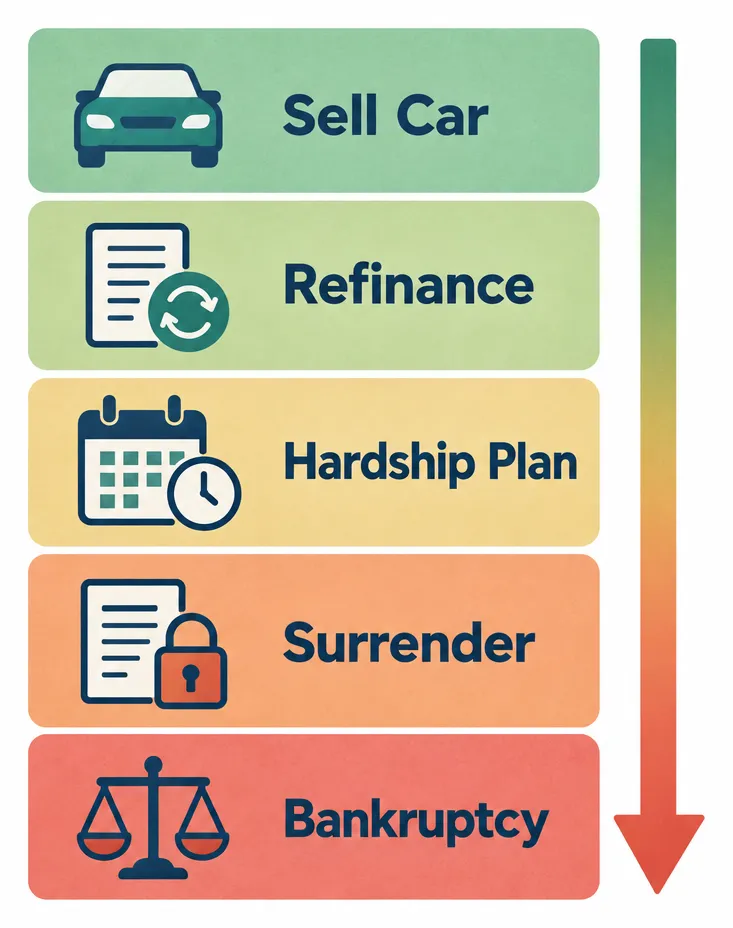
A car loan can’t be canceled once it’s signed. To get out of it, the loan has to be paid off in full (by you, by a buyer or by a new lender), transferred to someone the lender approves, or defaulted on through surrender, repossession or bankruptcy. The list below runs from least to most damaging. Selling the car for at least what you owe is the top pick when the numbers allow it.
- Sell or trade in the car for at least your payoff amount. The loan closes, there’s no credit damage, and you leave with cash or equity.
- Refinance into a lower rate or longer term. You keep the car with a lower payment. This needs fair credit and usually positive equity.
- Ask your lender for a hardship plan. A deferral, due-date change or term extension buys you time but adds interest.
- Transfer the loan, or let a co-borrower take it over. This is rare because the lender has to approve it, but it ends your liability cleanly.
- Sell and cover the gap with cash or a small credit union loan. This works when you’re underwater. You end up with a smaller, unsecured debt and no car.
- Voluntary surrender. It’s slightly less costly than a repossession, but it is reported almost the same way and usually leaves a deficiency balance.
- Bankruptcy. Chapter 7 or Chapter 13 can deal with the car and other debts, at a heavy credit cost. Treat it as a last resort.
How these exits were ranked
The ranking puts total dollar cost first, then credit damage, then whether the debt fully ends, then how long the exit takes. The weights come from published data (CFPB, Edmunds, Experian) and how each exit works under federal and state law. No lender paid for placement, and the list includes no lenders.
Can you just give the car back?
Yes, you can, but the debt doesn’t go with it. Dropping the car at the dealer or lender is a voluntary surrender. The lender auctions the car, subtracts the sale price from what you owe, adds repossession and sale costs, and bills you for the rest. Your credit report shows it as a repossession.
Which option fits your situation
| Your situation | Start with | Avoid |
|---|---|---|
| Signed in the last few days | Return rights (California) or the dealer’s written policy | Assuming a 3-day rule exists |
| Can pay, want a cheaper payment | Refinance | Stretching to 84 months without checking total interest |
| Can pay, want the car gone, have equity | Sell privately or take an instant offer | Accepting the first trade-in bid |
| Can’t make next month’s payment | Call the lender for a hardship plan | Skipping payments with no contact |
| Upside down, payment unaffordable | Sell and cover the gap, or keep paying until above water | Rolling the gap into another loan |
| Car broken, loan still due | Warranty or lemon law claim, then a repair-vs-sell decision | Stopping payments because the car doesn’t run |
| Ex-partner or cosigner on the loan | Refinance into one name | Relying on a divorce decree alone |
Ways out of a car loan compared
| Option | Works best when | Upfront cost | Credit impact | Debt fully ends? | Time to complete |
|---|---|---|---|---|---|
| Sell or trade in | Car is worth more than payoff | Low (listing, detailing) | None if paid in full | Yes | 1 to 4 weeks |
| Refinance | Credit improved or rates fell | Title, registration fees | Small hard inquiry | No (new loan) | 1 to 3 weeks |
| Hardship plan | Short-term income drop | Extra interest | Usually none if arranged before a missed payment | No | Days |
| Loan transfer | Approved buyer with good credit | Fees vary by lender | None for you once released | Yes, for you | 2 to 6 weeks |
| Sell and cover the gap | Underwater, need out | The gap in cash or a new loan | Small (new inquiry) | Car loan yes, gap debt remains | 2 to 4 weeks |
| Voluntary surrender | No other route works | Fees plus deficiency | Severe, up to 7 years | Rarely | 1 to 3 months plus collection |
| Bankruptcy | Many debts, not just the car | Attorney and court fees | Severe, 7 to 10 years | Often, by court order | 4 months (Ch. 7) to 5 years (Ch. 13) |
Step 1: Find your three numbers before you call anyone
Three numbers decide which exit works: your payoff amount, what the car will actually sell for, and the gap between them. Without them, you can’t judge a refinance offer, a trade-in bid or a hardship plan.
Payoff amount vs. balance
The balance on your statement isn’t what it costs to close the loan. A payoff quote adds interest that accrues daily up to a set date, plus any fees, and it’s usually good for about 10 days. Ask the lender for a written payoff quote with a “good through” date. Most lenders show it in the app or will mail or email one.
Get the real numbers in writing
Ask for a written 10-day payoff quote, not your statement balance. Then collect at least two real instant-cash offers alongside Kelley Blue Book and Edmunds values. A price someone will actually pay you matters more than a guide value.
What your car is really worth
Guide values from Kelley Blue Book and Edmunds give you a range, but they don’t commit anyone to buy at that price. Firm instant offers from online buyers and dealer appraisals do. Get at least three numbers: one guide value, one firm online offer and one dealer appraisal. Private-party sales usually bring more than trade-ins, though you have to handle the paperwork and the lien payoff.
Are you upside down? The math
You’re upside down (in negative equity) when the payoff is higher than the best real offer. The example below is a hypothetical borrower whose gap matches the Q3 2026 Edmunds average.
| Line item | Amount |
|---|---|
| Payoff quote (good for 10 days) | $31,400 |
| Best firm offer (instant-cash buyer) | $24,293 |
| Gap you must cover to sell | $7,107 |
| Prorated refund from canceled service contract | −$1,200 |
| Remaining gap after refund | $5,907 |
If the gap is negative (the offer beats the payoff), you have equity and selling is simple. If it’s a few hundred dollars, cash usually covers it. Once it reaches several thousand, read the upside-down section below before you do anything.
Add-ons you can cancel for a refund
Extended warranties, service contracts, tire-and-wheel plans and GAP coverage bought at the dealer are often refundable on a prorated basis when you cancel or pay off early. When the add-on was financed, the refund usually goes to the lender and lowers your payoff. The CFPB has cited auto servicers in its supervisory reports for failing to refund unearned add-on charges after early payoff or repossession. Ask the provider and the lender to confirm the refund amount in writing.
Hold on to GAP until the car is actually sold. If the car is totaled before then, GAP is what covers the difference between the insurance payout and the loan.
Just bought it? What your return rights really are
In most of the US, a signed car contract is final. No federal 3-day right exists. California is the main exception for used cars bought on or after October 1, 2026.
The 3-day cooling-off myth
The FTC Cooling-Off Rule gives buyers three days to cancel certain door-to-door and off-premises sales. Vehicles sold by a seller with at least one permanent place of business are exempt, which covers essentially every dealership sale. Regret alone won’t undo a dealership contract.
California’s new 3-day return right (Oct 2026)
California SB 766, the Combating Auto Retail Scams (CARS) Act, was signed on October 6, 2025 and took effect October 1, 2026. Used-car buyers who purchase the cancellation option now have three days to return a qualifying vehicle. The option applies to qualifying used cars priced under $40,000 that have been driven fewer than 250 miles after delivery, and the buyer must purchase the option. Dealers may charge a restocking fee of 1.5% of the price, with a $200 minimum and a $600 maximum. The law replaced the older contract-cancellation option, which California buyers had to pay extra for. Check the final terms against the enacted text or with the California Department of Motor Vehicles before you rely on a specific threshold.
Did you know?
According to the California legislature’s SB 766, used-car buyers in California can purchase a 3-day cancellation option on qualifying purchases, which took effect October 1, 2026. It replaced an older 2-day cancellation option that buyers had to pay extra for.
Other states and dealer return policies
Outside California, you can return a car only through the dealer’s own written return policy, which some large retailers offer, or through a state lemon law claim if serious defects appear. If the dealer let you drive off before your financing was final and the financing later falls through, state law and your contract decide what happens to the deal and your down payment.
| Situation | Right to return? | Limits | Source |
|---|---|---|---|
| Dealer sale, any state | No federal right | Vehicles from permanent locations exempt | FTC Cooling-Off Rule |
| Used car, California, bought on or after Oct 1, 2026 | Yes, 3 days, if the cancellation option is purchased | Under $40,000, fewer than 250 miles after delivery, 1.5% fee ($200 to $600) | California SB 766 |
| Dealer advertises a return policy | Only on its written terms | Mileage caps, fees, time limits | Your contract |
| New car with repeated unfixed defects | Possibly, via buyback | Repair attempts and time limits vary by state | State lemon law |
If you can still make payments but want out
When you’re current on the loan, you have the widest choice: refinance to keep the car for less, or sell it and close the loan. Both work best before any late payment shows up on your credit report.
Refinance
Refinancing replaces your loan with a new one, ideally at a lower rate. Experian’s Q2 2026 data put the average refinance rate at 7.97%, against 10.40% on the original loans, which saved refinancers about $83 a month on average. It works when your credit score has risen since you bought the car, when you financed at the dealer at a marked-up rate, or when market rates have fallen.
It usually fails when you owe much more than the car is worth, because lenders cap loan-to-value. It also fails when the car is old or high-mileage, or when your credit has slipped. A credit union is often the first place to ask.
Here is a refinance on a hypothetical $25,000 balance, using Experian’s Q2 2026 averages:
| Scenario | Amount | APR | Term | Monthly payment | Total repaid |
|---|---|---|---|---|---|
| Keep current loan | $25,000 | 10.40% | 48 months | $639 | $30,664 |
| Refinance, same term | $25,000 | 7.97% | 48 months | $610 | $29,279 |
| Refinance, longer term | $25,000 | 7.97% | 60 months | $507 | $30,392 |
APR is the yearly cost of borrowing, interest plus required finance charges, as a percentage. At 10.40%, each month’s interest is roughly 10.40% ÷ 12 = 0.87% of the remaining balance. The longer refinance cuts the payment by $132 a month, but it saves only $272 overall and adds a year of payments. Title transfer and registration fees, which vary by state, come out of those savings.
Sell privately or get instant offers
When the car is worth more than the payoff, a sale ends the loan cleanly. In a private sale, the buyer’s money goes to the lender first, the lender releases the lien, and the title goes to the buyer. Many buyers prefer to close at your lender’s branch or through an escrow service. Instant-offer buyers and dealers handle the lien payoff themselves, which is simpler but usually pays less.
Trade in without rolling over debt
A trade-in is fine when you have equity. When you don’t, the dealer will offer to “pay off your loan.” What usually happens is that the unpaid gap gets added to your new loan. Make the dealer show the trade-in value, the payoff and any negative equity as separate lines on the buyer’s order.
Pay it off early: watch for prepayment penalties
Most simple-interest auto loans let you pay early without a penalty, but check the contract for a prepayment clause or a precomputed interest method. Federal law (15 U.S.C. 1615) bans the Rule of 78s on precomputed consumer loans longer than 61 months, and some states restrict it on shorter ones. Paying off early ends the debt with no credit damage, though closing an installment account can nudge some scores briefly.
If you can’t afford the payment anymore
If you can’t afford your car payment, call your lender before you miss a payment and ask what hardship options it offers. The CFPB advises reaching out as soon as you know you’ll fall short. Lenders have the most room to help before an account goes delinquent.
Payment deferral and due-date changes
A deferral (also called an extension) moves one or more payments to the end of the loan. Interest keeps building in the meantime, so the total cost rises and the loan runs longer. Many lenders limit how many deferrals you can get, and some won’t offer one if you’re already behind. A due-date change costs little and helps when the problem is timing, such as a payday that falls after the due date.
Loan modification or term extension
Some lenders will restructure the loan, usually by extending the term so the monthly payment drops, if you can document a hardship such as job loss, illness or a cut in hours. Interest-only periods or principal deferrals are less common and mostly temporary. Ask for the new payment, the new end date and the total extra interest before you agree.
What to say to your lender
How to call your lender before a missed payment
- Have your account number, payoff quote and a one-line reason ready (for example, “my hours were cut from 40 to 25 a week”).
- Say: “I can’t make my payment due on [date]. What hardship options do you have, and what will each cost in added interest?”
- Ask whether the account will be reported as late during the plan.
- Ask whether missed payments go to the end of the loan or come due all at once.
- Ask for the agreement in writing before the due date and save every confirmation.
- Write down the date, the representative’s name and what was promised.
Free help: nonprofit credit counseling and legal aid
Nonprofit credit counseling agencies can review your whole budget for free or at low cost. Car loans usually can’t go into a debt management plan the way credit cards can, but freeing up money elsewhere can save the car. Local legal aid offices handle repossession and deficiency cases. Under the Servicemembers Civil Relief Act, servicemembers with car loans taken out before active duty can ask for interest capped at 6%, and the lender generally needs a court order to repossess if a payment was made before service began.
Cheaper options first
Ask your lender for a hardship plan before taking on any new borrowing.
For a small gap or a missed payment, credit union payday alternative loans (capped at 28% APR) cost far less than a payday loan.
Nonprofit credit counseling and local assistance programs (dial 211) can free up money for the car payment.
If you owe more than the car is worth
When you’re upside down, you can cover the gap now, keep paying until you’re above water, or roll the gap into your next loan. Rolling it over is the most expensive of the three.
Covering the gap in a sale
Use savings for the gap if you can. If you can’t, a small personal loan from a credit union for the gap alone turns a large secured car debt into a much smaller unsecured one. Federal credit union payday alternative loans go up to $1,000 under PAL I and up to $2,000 under PAL II, which can cover a small gap. Before you sell, cancel refundable add-ons and make any extra principal payments you can afford.
| Way to cover a $7,107 gap | Amount | APR | Term | Monthly payment | Total repaid |
|---|---|---|---|---|---|
| Credit union personal loan (example rate) | $7,107 | 12.0% | 36 months | $236 | $8,498 |
| Rolled into the next car loan (Edmunds avg. rate) | $7,107 | 8.1% | 84 months | $111 | $9,335 |
The rollover has the lower APR and still costs about $837 more, because the debt runs four extra years. It also leaves your next car underwater from the day you buy it.
Why rolling it over keeps you trapped
Edmunds’ Q3 2026 data shows buyers who rolled negative equity into a new loan financed $57,235 on average at 8.1% APR. Of those contracts, 91.2% ran longer than 72 months. Long terms mean the balance falls more slowly than the car loses value, so the next trade-in is often underwater again.
Did you know?
According to Edmunds’ Q3 2026 negative equity report, buyers who rolled old car debt into a new loan averaged a $952 monthly payment and are on track to pay about $16,610 in interest.
When keeping the car is the cheaper move
If you can still afford the payment, even barely, keeping the car until the loan drops below its value is often the cheapest option. Each payment shrinks the gap. For readers who are $8,000 underwater and asking whether to trade in or keep the car: if the car runs reliably and a hardship plan or a budget cut makes the payment work, keeping it usually costs less than any trade-in that carries the $8,000 into a bigger loan.
The federal car loan interest deduction for tax years 2025 to 2028 can also make keeping a qualifying loan cheaper than it looks. It covers up to $10,000 a year of interest on loans taken out after 2024 for new personal-use vehicles with final assembly in the US. Used cars and leases don’t qualify. The IRS says it phases out above $100,000 of modified adjusted gross income ($200,000 for joint filers), shrinking by $200 for each $1,000 over, and you can claim it without itemizing. On $2,500 of interest in the 22% bracket, it saves about $550 in federal tax.
Transfer the loan or remove a co-borrower
Few auto lenders allow a straight loan assumption, and those that do run a full credit check on the new borrower. More often, the new owner refinances the car in their own name, which pays off your loan and moves the title. The state DMV then issues a new title and registration. Never hand the car to someone who “promises to keep up the payments” while the loan stays in your name. You stay liable, and their late payments land on your credit report.
If your ex is on the loan and won’t pay, a divorce decree tells the two of you who pays, but it doesn’t bind the lender. Both borrowers stay fully liable until the loan is refinanced in one name or the car is sold. Ask the lender whether it offers a cosigner release. Some do after a set number of on-time payments, but most require a refinance. The CFPB notes that a cosigner can be pursued for the full debt, sometimes before the main borrower.
Last resorts: voluntary surrender, repossession and bankruptcy
These exits end your possession of the car, but rarely the debt. Use them only once selling, refinancing, hardship plans and covering the gap have all been ruled out.
Voluntary surrender step by step
- Tell the lender in writing that you’re surrendering the car, and ask where and when to return it.
- Remove personal belongings and take photos of the car’s condition and the odometer.
- Cancel refundable add-ons so the refunds lower your balance.
- Get a receipt when you hand over the car.
- Watch for the lender’s notice of sale, which state law requires before an auction. You may have a right to redeem the car before it is sold.
Surrender avoids tow and storage fees and the stress of a surprise repossession. On a credit report, it looks almost the same as an involuntary repo.
The deficiency balance: what you still owe
After the auction, you owe the deficiency: the payoff, plus repossession, storage and sale costs, minus the auction price. Auction prices usually come in below private-sale values. The CFPB’s January 2025 repossession report found the average deficiency was $11,340 in December 2022, up from $7,971 a year earlier. Lenders can sue for that amount and, after a court judgment, may be able to garnish wages or levy bank accounts where state law allows. A few states limit deficiency claims, so check with legal aid. If the debt goes to a debt collector, the Fair Debt Collection Practices Act limits what it can do.
Did you know?
The CFPB’s January 2025 report on repossession found the average deficiency after a repossession reached $11,340 in December 2022. Giving the car back often still leaves a five-figure debt.
What happens if you just stop paying
Late fees start first, then late payments get reported, usually once you’re 30 days behind. In many states the lender can repossess without a court order soon after default, as long as the repo agent doesn’t “breach the peace.” That rules out things like breaking into a locked garage or taking the car over your objection. Under the Fair Credit Reporting Act, late payments and the repossession can stay on your credit reports for seven years from the first delinquency. You still owe the deficiency, and you can’t get your personal belongings back if you never ask for them.
Bankruptcy and your car
Bankruptcy triggers an automatic stay that pauses repossession. In Chapter 7 bankruptcy, you can surrender the car and have any deficiency discharged, reaffirm the loan to keep the car, or redeem it by paying its current value in one lump sum. Chapter 13 bankruptcy and how repayment plans work let you catch up on missed payments over three to five years. For cars bought more than 910 days before filing, Chapter 13 may let you reduce the secured balance to the car’s value (a “cramdown”). Bankruptcy stays on credit reports for 7 to 10 years. Talk to a bankruptcy attorney or legal aid office first.
If the car is broken or totaled
The loan stays due whether or not the car runs. Stopping payments because of a breakdown leads to repossession and a deficiency, and you still have the broken car’s problems on top.
For readers whose engine died with $15,000 still owed: start with the warranty. New-car and certified pre-owned warranties, and service contracts you bought, may cover the repair. Federal law (the Magnuson-Moss Warranty Act) governs written warranties, and state lemon laws can require a buyback or replacement when a new car has a serious defect that the dealer fails to fix after repeated attempts. If nothing covers it, get a repair quote and compare it with the car’s value after the repair and the payoff. A $4,000 repair on a car worth $18,000 running is usually cheaper than selling it as-is for $6,000 and covering a $9,000 gap.
If the car is totaled, insurance pays its actual cash value to the lender. GAP coverage pays all or most of the difference between that payout and the loan balance. Many GAP contracts exclude past-due payments, late fees and deductibles. Without GAP, you owe the shortfall.
Is there a car loan forgiveness program?
No. No federal or state car loan forgiveness program exists, and anyone who calls with an “auto loan relief” offer is almost certainly running a scam. The real options come from your own lender, at no charge.
The FTC has banned auto loan modification operators who charged $200 to $500 upfront, promised 30% to 50% cuts in monthly car payments and protection from repossession, and in some cases told people to stop paying their lender. Some of those customers had their cars repossessed.
Red flags:
- An upfront fee before anything changes on your loan
- Promises to cut your payment by a set percentage or to stop a repossession
- Advice to stop paying or stop talking to your lender
- Claims of a government program or a special relationship with lenders
- Pressure to decide on the first call
Report these companies to the FTC at ReportFraud.ftc.gov, to the CFPB complaint portal and to your state attorney general.
Credit impact of each exit, compared
Paying the loan in full through a sale or refinance does little or no harm to your credit. Default-based exits do lasting damage. Here’s how each option shows up.
| Exit | What appears on your report | Typical duration |
|---|---|---|
| Sale or payoff | Account closed, paid as agreed | Positive history can remain up to 10 years |
| Refinance | Hard inquiry, new account, old one closed | Inquiry counts against you about 1 year, visible 2 |
| Hardship plan arranged before a missed payment | Often reported as current; confirm in writing | n/a |
| Late payments | 30, 60, 90+ days late marks | 7 years |
| Voluntary surrender or repossession | Repossession, possible collection account | 7 years from first delinquency |
| Deficiency judgment | Collection account; court records may be public | 7 years on credit reports |
| Chapter 7 / Chapter 13 | Bankruptcy public record | 10 / 7 years |
To limit the damage, get any hardship plan in writing and keep paying everything else on time. If you’re shopping for a refinance, do all your rate checks within about two weeks so scoring models count them as a single inquiry.
Why so many borrowers are stuck right now
Car debt is at a record and longer loans are now common, which leaves more borrowers owing more than their cars are worth for longer.
| Metric | Figure | Period | Source |
|---|---|---|---|
| US auto loan debt | $1.734 trillion | Q3 2026 | Federal Reserve Bank of New York Household Debt and Credit Report |
| Household debt in some stage of delinquency | 5.0% (up from 4.7%) | Q3 2026 | Federal Reserve Bank of New York |
| Subprime auto ABS 60+ day delinquency | 6.90% record, then 6.80% | Jan and Feb 2026 | Fitch Ratings |
| Trade-ins with negative equity | 29.1% | Q3 2026 | Edmunds |
| Average negative equity | $7,107 | Q3 2026 | Edmunds |
| Average APR, new / used | 6.35% / 11.19% | Q2 2026 | Experian State of the Automotive Finance Market |
| Average monthly payment, new / used | $765 / $542 | Q2 2026 | Experian |
| Loans longer than 72 months | About 1 in 3 | Q2 2026 | Experian |
With an average used-car payment of $542 at 11.19%, losing a few hours of work a week can push a payment out of reach. That’s why the call to your lender, and the three numbers from Step 1, matter more than any single product.
Your next step this week
Get your 10-day payoff quote and two firm offers on the car before you do anything else. Those three numbers tell you whether you can sell cleanly, refinance or need a hardship plan, and they keep a dealer or a “relief” caller from choosing for you.
FAQ
How can I legally get out of a car loan?
You can pay it off by selling, trading in, refinancing or using savings. You can also have a qualified buyer take it over with the lender’s approval, or surrender the car. Only paying in full or a lender-approved transfer ends the debt with no credit damage.
How do I get out of a car loan I can’t afford anymore?
Call your lender before you miss a payment and ask about deferral, a due-date change or a term extension. If those won’t fix the budget, get your payoff and real offers, then sell and cover any gap with cash or a small credit union loan.
Can I cancel my car finance and give the car back?
You can’t cancel it, but you can surrender the car. The lender sells it, and you owe the difference plus fees. California buyers of qualifying used cars on or after October 1, 2026 can purchase a 3-day cancellation option with limits.
Is there a car loan forgiveness program?
No. No such federal program exists. Companies charging upfront fees to cut your payment or stop repossession fit a scam pattern the FTC has sued over.
How do I get out of a car loan without ruining my credit?
Pay it off in full through a sale, a refinance or savings while your account is current. If money is tight, arrange a hardship plan before any missed payment and get its reporting terms in writing.
Can you get out of a car loan within 30 days?
Only through a sale, a refinance or a dealer’s written return policy, except in California, where used-car buyers can purchase a 3-day cancellation option under the CARS Act. No federal 30-day or 3-day return right exists.
Can I return a car I just bought in California?
If it’s a used car bought on or after October 1, 2026, priced under $40,000, you purchased the cancellation option, and you return it within three days having driven fewer than 250 miles after delivery, yes. A restocking fee of 1.5% applies, reported at $200 to $600. New cars aren’t covered.
How do I get out of a car loan when the car is broken?
Keep paying while you pursue warranty, service contract or lemon law claims. Then compare the repair cost with what the car would sell for repaired versus as-is, measured against your payoff.
How do I get out of a car loan without a penalty?
Check the contract for a prepayment penalty clause. Most simple-interest auto loans have none, and federal law bars Rule of 78s interest on precomputed loans longer than 61 months. Selling or refinancing then closes the loan without a penalty.
What happens if I just stop paying my car loan?
Late fees and credit reporting start, then repossession, often without a court order. After the auction you owe the deficiency, which averaged $11,340 in the CFPB’s December 2022 data, and the lender can sue and may garnish wages where state law allows.
Laws and regulations referenced
- Fair Debt Collection Practices Act, 15 U.S.C. 1692
- Fair Credit Reporting Act, 15 U.S.C. 1681
- Servicemembers Civil Relief Act, 50 U.S.C. 3901
- Bankruptcy Code, Chapter 7, 11 U.S.C. 701
- Bankruptcy Code, Chapter 13, 11 U.S.C. 1301
Links go to the official text on government sites.
Check, verify or complain
Sources
- CFPB report: Repossession in auto finance (Jan 2025) files.consumerfinance.gov · primary source
- CFPB: Four tips to get back on track if you're behind on your auto loan consumerfinance.gov · primary source
- CFPB: Worried about making your auto loan payments? Your lender may have options consumerfinance.gov · primary source
- CFPB: What is a co-signer consumerfinance.gov · primary source
- IRS Publication 6126 irs.gov · primary source
- FTC: Auto loan modification enforcement action ftc.gov · primary source
- Senator Allen Delivers Consumer Protections for Car Shoppers - SB 766 sd24.senate.ca.gov · primary source
- Federal Reserve Bank of New York: Household Debt and Credit Report Q3 2026 newyorkfed.org
- Edmunds Q3 2026 negative equity report edmunds.com
- CBT News: Edmunds Q3 2026 negative equity coverage cbtnews.com
- Negative equity pushes monthly payment average to $952 news.dealershipguy.com
- Experian: Average auto loan rates and financing experian.com
- Auto Remarketing: Experian sees refinancing continue to ripen in Q2 autoremarketing.com
- Trading Economics: US car loan delinquency (Fitch subprime index) tradingeconomics.com
- CarPro: California CARS Act coming soon carpro.com
- SlashGear: New California law changes car buying slashgear.com
- Berkeley Center for Consumer Law: CARS Act (SB 766) consumerlaw.berkeley.edu
- Kiplinger: The 3-day grace period is just a myth kiplinger.com
- Kiplinger: New car loan interest deduction kiplinger.com

Marcus covers credit scores, credit reports and getting out of debt: consolidation, nonprofit counseling, settlement and what debt collectors may and may not do. He works from the federal laws that apply, CFPB guidance and the credit bureaus' published rules.
Ruth is US Financer's standards editor. Every article goes through her checks before and after it is published: each rate, fee, cap, deadline and rule is matched against its primary source, every law named is linked to its official text, and anything that cannot be…
Comments are closed