

We are not a credit repair, debt relief or debt collection company and offer no services. Rules differ by state, so confirm with the agency or a nonprofit counselor before you act.
Chapter 13 is the part of the federal Bankruptcy Code that lets you keep property, such as a house or car, while you repay some or all of your debts through a court-approved plan that lasts three to five years. You make one monthly payment to a trustee, most collection stops the day you file, and whatever qualifying unsecured debt is left when you finish the plan is usually discharged. Courts often call it a “reorganization” or a wage earner’s plan, because it only works for people with steady income.
Run the numbers
What Chapter 13 bankruptcy is
People search for it many ways (“chapter 13 bk,” “what is bankruptcy 13”), but the legal source is the same: Chapter 13 of Title 11 of the U.S. Code, sections 1301 to 1330. It is a federal law, so the core rules apply in every state, and cases are filed in federal bankruptcy court.
The key difference from Chapter 7 is what happens to your property. Chapter 7 is a liquidation: a trustee can sell assets that aren’t protected by exemptions, and the case usually ends in a few months. Chapter 13 lets you keep your property. In exchange, you pay creditors from your future income for years.
Who can file under Chapter 13
Under 11 U.S.C. § 109(e), you can file if all of these are true:
- You’re an individual with regular income. Wages, self-employment income, Social Security, pensions and steady support payments can all count. Corporations and partnerships cannot file Chapter 13, though a sole proprietor can.
- Your debts are under the limits. As of the April 1, 2025 inflation adjustment, these are $526,700 in unsecured debt and $1,580,125 in secured debt. A temporary combined limit of $2.75 million expired in June 2024.
- You completed credit counseling. You need a session from an agency approved by the U.S. Trustee Program within 180 days before filing.
- You haven’t had a recent discharge. Under § 1328(f), you can’t get a Chapter 13 discharge if you received a Chapter 7 discharge in a case filed in the previous four years, or a Chapter 13 discharge in a case filed in the previous two years. You can still file in some of these situations, which people sometimes do to stop a foreclosure, but no discharge comes at the end.
How a Chapter 13 repayment plan works
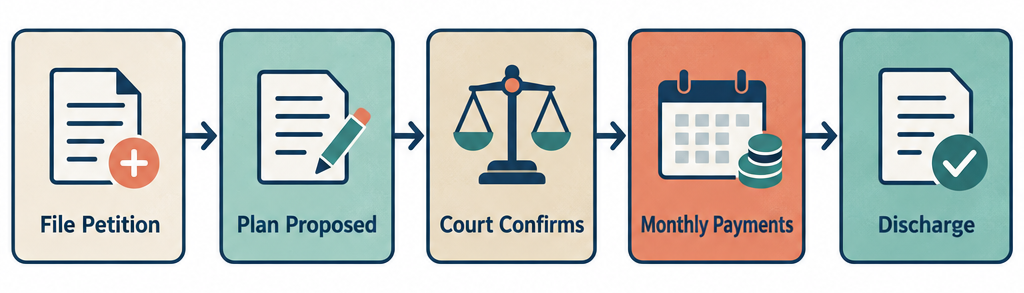
You propose the plan. Your creditors can object, and the judge decides whether to confirm it. You don’t get to pick a payment that merely feels comfortable, though. The Code sets minimums.
How your monthly payment is set
The plan length depends on your income. If your household income is below your state’s median for your household size, the plan can run three years. If it’s above the median, the plan generally must run five years. No plan can exceed five years.
You must commit all of your “projected disposable income” to the plan. That is roughly your income minus allowed living expenses, calculated on Official Form 122C. Above-median filers must use IRS expense standards, which can be tighter than what you actually spend.
Unsecured creditors must also receive at least what they would have received if you had filed Chapter 7 instead. This is called the “best interest of creditors” test in § 1325(a)(4). If you have a lot of equity that your state’s exemptions don’t protect, your payment rises to cover it.
What the plan has to pay
| Type of debt | Examples | How the plan treats it |
|---|---|---|
| Priority debts | Child support, alimony, most recent income taxes | Paid in full over the plan |
| Secured debts you’re behind on | Mortgage arrears, car loan arrears | Past-due amount spread over the plan |
| Secured debts you keep | Ongoing mortgage, car payment | Must stay current |
| General unsecured debts | Credit cards, medical bills, personal loans | Share whatever money is left, often a fraction |
Mortgage and car rules
You can catch up on missed mortgage payments over the life of the plan, which is why many people file Chapter 13 to stop a foreclosure. Section 1322(b)(2) bars you from reducing the principal on a mortgage secured only by your main home.
Car loans have more room. If you bought the vehicle more than 910 days before filing, the plan can often reduce the secured balance to the car’s current value, a move known as a “cramdown.” The rest becomes unsecured debt.
How a Chapter 13 case moves through court
- Complete credit counseling with an approved agency.
- File the petition, schedules and the court fee.
- File your plan, with the petition or within 14 days.
- Start plan payments within 30 days of filing.
- Attend the meeting of creditors with the trustee.
- Attend the confirmation hearing, where the judge approves or rejects the plan.
- Make every payment and finish a debtor education course.
- Receive your discharge after the final payment.
What a Chapter 13 plan costs: a worked example
Chapter 13 isn’t a loan, so it has no APR. It does have real costs: the court filing fee, the trustee’s commission and attorney fees. The trustee’s percentage is set in each district but cannot exceed 10% of payments under 28 U.S.C. § 586(e). Attorney fees vary widely by district, and part of the fee is often paid through the plan.
The example below uses assumptions, not quotes. It shows a five-year plan for a household with $35,000 in credit card debt, $6,000 in missed mortgage payments and $2,400 in back income taxes.
| Item | Amount | Fee or rate | Term | Total paid |
|---|---|---|---|---|
| Plan payment to trustee | $450/month | None | 60 months | $27,000 |
| Trustee commission (inside the $27,000) | $2,160 | 8% assumed | Over plan | Included |
| Attorney fee through plan | $4,000 | Assumed, varies | Over plan | Included |
| Mortgage arrears and back taxes | $8,400 | Paid in full | Over plan | Included |
| Court filing fee | $313 | Flat | At filing | $313 |
| Total out of pocket | $27,313 |
Here’s the math in plain words. After the trustee, the lawyer, the arrears and the taxes are paid, $12,440 is left for card issuers. That is about 36 cents on each dollar of the $35,000. The other $22,560 is discharged when the plan is complete. You must still make your regular mortgage payment every month on top of this.
Now compare that with paying the cards yourself. At an assumed 22% APR, paying $700 a month on $35,000 takes about 137 months, more than 11 years, and costs roughly $95,800, because about $640 of the first payment goes to interest alone. Our guide to how credit card APR and interest work explains why the balance moves so slowly.
Before you file
Missing plan payments can get your case dismissed. If that happens, the automatic stay ends, your debts come back with interest, and the money you paid to the trustee and your lawyer stays spent.
Who Chapter 13 can make sense for
The fit is narrow but real. Chapter 13 tends to suit people who:
- Are behind on a mortgage or car loan and want to keep the property
- Earn too much to pass the Chapter 7 means test
- Have nonexempt assets they would lose in Chapter 7
- Owe priority debts like back taxes or support that need a structured payoff
- Have a co-signer they want to protect, since § 1301 extends the stay to co-debtors on consumer debts
It is a poor fit if your income is unstable or your budget has no margin. A five-year plan has no slack for job loss, illness or a broken-down car unless you go back to court.
The risks, and why some people say “Chapter 13 ruined my life”
That phrase is a common search for a reason. Research on court data has long found that a large share of Chapter 13 cases end in dismissal rather than discharge. People in that group pay for months or years and walk away with their debts intact.
Other pressures are less visible:
- A strict budget for up to 60 months. The plan assumes you live on IRS-standard expenses.
- Limits on new credit. You generally need trustee or court permission to take on new debt, including a car loan.
- Windfalls can go to creditors. Raises, bonuses and in some districts tax refunds may have to go into the plan.
- Credit damage. The Fair Credit Reporting Act allows a bankruptcy to be reported for up to 10 years. The three major credit bureaus say they remove a Chapter 13 case seven years after the filing date.
- Repeat filings get weaker protection. If you had a case dismissed within the past year, the automatic stay may last only 30 days unless the court extends it.
Expect offers for no credit check loans after you file. They target people with a bankruptcy on their report and usually charge very high rates, and borrowing during your plan without permission can put the case at risk.
Cheaper options to try first
Cheaper options first
Ask your mortgage servicer about loss mitigation, a forbearance or a loan modification.
A nonprofit credit counseling agency can set up a debt management plan with lower card rates.
Legal aid offices often handle bankruptcy for free if your income qualifies.
Chapter 7 is also worth comparing if you pass the means test and have little nonexempt property. It usually ends in about four months and costs less. You can convert a Chapter 13 case to Chapter 7 later under § 1307(a). If spending habits are part of what got you here, the support program at Debtors Anonymous is free and runs alongside any legal option.
State rules: what changes where you live
Chapter 13 is available in every state, but several pieces depend on location:
- Exemptions. Your state decides what property is protected, which feeds the best-interest test. Some states let you choose the federal exemption list instead.
- Median income. The U.S. Trustee Program publishes state medians by household size. Those figures decide whether you file a three- or five-year plan.
- Local practice. Districts set their own plan forms, presumptive attorney fees and rules on tax refunds.
- Oversight. Alabama and North Carolina use bankruptcy administrators instead of the U.S. Trustee Program.
Your rights during and after a Chapter 13 case
- The automatic stay. Under 11 U.S.C. § 362, filing stops most lawsuits, wage garnishments, foreclosures, repossessions and collection calls.
- Collector limits. A debt collector who keeps trying to collect a debt covered by the stay can face sanctions in bankruptcy court and claims under the Fair Debt Collection Practices Act. Our guide to debt collectors explains what they can and cannot do.
- Protection from discrimination. Section 525 bars government units from denying licenses and bars private employers from firing you solely for filing.
- Plan changes. Under § 1329, you can ask the court to modify your plan if your income drops.
- Hardship discharge. If you can’t finish for reasons beyond your control, § 1328(b) allows a discharge in some cases.
- Lawyer disclosures. Bankruptcy attorneys count as “debt relief agencies” under §§ 526 to 528 and must give you a written contract and specific disclosures.
- Accurate credit reporting. Under the Fair Credit Reporting Act, you can dispute accounts that still show a balance after discharge.
Report bankruptcy fraud or abuse to the U.S. Trustee Program. Report creditors or collectors who ignore the stay to the CFPB complaint portal. Report bankruptcy-related scams to the FTC at ReportFraud.
FAQ
How long does Chapter 13 stay on my credit report?
The Fair Credit Reporting Act allows up to 10 years. The major bureaus say they remove Chapter 13 cases seven years from the filing date, whether or not the plan was completed.
Can I keep my house in Chapter 13?
Usually, if you can keep up with your regular mortgage payments and repay the arrears through the plan. You can’t reduce the principal on a loan secured only by your primary home.
What happens if I miss a plan payment?
The trustee can ask the court to dismiss your case. Contact your attorney or the trustee quickly. Many districts allow a plan modification or a short catch-up period.
Are student loans discharged in Chapter 13?
Not automatically. You must prove “undue hardship” in a separate proceeding. Child support, alimony and most recent taxes are also not discharged, which is why the plan pays them in full.
Is Chapter 13 better than Chapter 7?
Neither is better in general. Chapter 7 is faster and cheaper but can cost you nonexempt property. Chapter 13 protects property and can stop foreclosure but requires years of payments. A bankruptcy attorney or legal aid office can run both scenarios on your actual numbers.
Laws and regulations referenced
- Fair Debt Collection Practices Act, 15 U.S.C. 1692
- Fair Credit Reporting Act, 15 U.S.C. 1681
- Bankruptcy Code, Chapter 13, 11 U.S.C. 1301
Links go to the official text on government sites.
Check, verify or complain
Sources
- cob.uscourts.gov › sites › default › files › opinions › 12 12906.65.pdf cob.uscourts.gov · primary source
- bankruptcysoapbox.com › chapter 13 debt limits bankruptcysoapbox.com
- filebankruptcyagain.com filebankruptcyagain.com
- nolo.com › legal encyclopedia › how bankruptcy trustee paid nolo.com
- fedlaws.org › who can file chapter 13 bankruptcy debt limits and income rules fedlaws.org
- nolo.com › legal encyclopedia › multiple bankruptcy filings when file again nolo.com

Marcus covers credit scores, credit reports and getting out of debt: consolidation, nonprofit counseling, settlement and what debt collectors may and may not do. He works from the federal laws that apply, CFPB guidance and the credit bureaus' published rules.

Ruth is US Financer's standards editor. Every article goes through her checks before and after it is published: each rate, fee, cap, deadline and rule is matched against its primary source, every law named is linked to its official text, and anything that cannot be…
Comments are closed