

General information, not legal advice. Laws change, so confirm with the official statute, your state regulator or a licensed attorney before you act.
Payday loans are legal in Iowa, but only from lenders licensed under Iowa Code Chapter 533D, the Delayed Deposit Services Licensing Act. The total face amount of checks a lender holds from you is capped at $500, and the fee cannot be more than $15 on the first $100 and $10 on each $100 after that. On a $500 check that means a $55 fee, $445 in cash and an APR of about 322% if the loan is due in two weeks.
Run the numbers
Your money, in brief
- The $500 limit counts the fee, so a $500 check puts $445 in your hand.
- A lender can hold no more than two of your checks at once, for no more than 31 days, and cannot roll a loan over.
- A licensed Iowa payday lender cannot threaten you with jail or criminal charges over an unpaid loan.
- Wages can be garnished only after a court judgment, and Iowa limits how much one creditor can take each year.
- Since July 1, 2026, regulated installment loans are capped at 36% a year. Federal credit union PALs top out at 28%.
Fact-checked
We checked these key facts against the sources named, on November 27, 2026:
- Federal credit union PALs top out at 28% (source: americascreditunions.org)
- Call 211 for Iowa emergency rent, utility and food help (source: unitedwaydm.org)
- A $400 PAL I repaid over three months at 28% costs about $19 in interest (source: ncua.gov)
- The Legal Hotline for Older Iowans (1-800-992-8161) serves people 60 and older (source: johnsoncountyiowa.gov)
- If the name does not appear, call the Division at 515-281-4014 before giving out any bank details (source: idob.iowa.gov)
Iowa payday loan rules at a glance (2026)
Iowa allows payday lending, which the law calls “delayed deposit services,” under strict dollar limits. Iowa has not capped the APR, though. Every rule below comes from Chapter 533D of the 2026 Iowa Code or from the Iowa Division of Banking’s rules in Iowa Administrative Code chapter 187—17, current as of November 2026.
| Rule | Iowa limit | Where it comes from |
|---|---|---|
| Who can lend | Licensed delayed deposit services businesses only | Iowa Code §533D.3 |
| Maximum amount | $500 total face amount of checks held from you | Iowa Code §533D.10 |
| Maximum fee | $15 on the first $100, $10 per additional $100 ($55 on $500) | Iowa Code §533D.9 |
| Maximum term | 31 days | Iowa Code §533D.10 |
| Loans at once | No more than two checks held from one borrower | Iowa Code §533D.10 |
| Rollovers | Renewals and extensions prohibited | Iowa Code §533D.10 |
| Same-day re-borrowing | No new loan on the day you pay one off | Iowa Admin. Code 187—17 |
| Returned-check fee | One fee of up to $15 | Iowa Code §533D.9 |
| Criminal threats | Prohibited | Iowa Code §533D.10 |
| Service members | 36% Military APR cap | Military Lending Act, 32 CFR part 232 |
The Iowa Division of Banking licenses and examines these lenders. After the state’s 2023 government realignment, the Division sits inside the Iowa Department of Insurance and Financial Services and still answers to the Superintendent of Banking.
How much a payday loan costs in Iowa
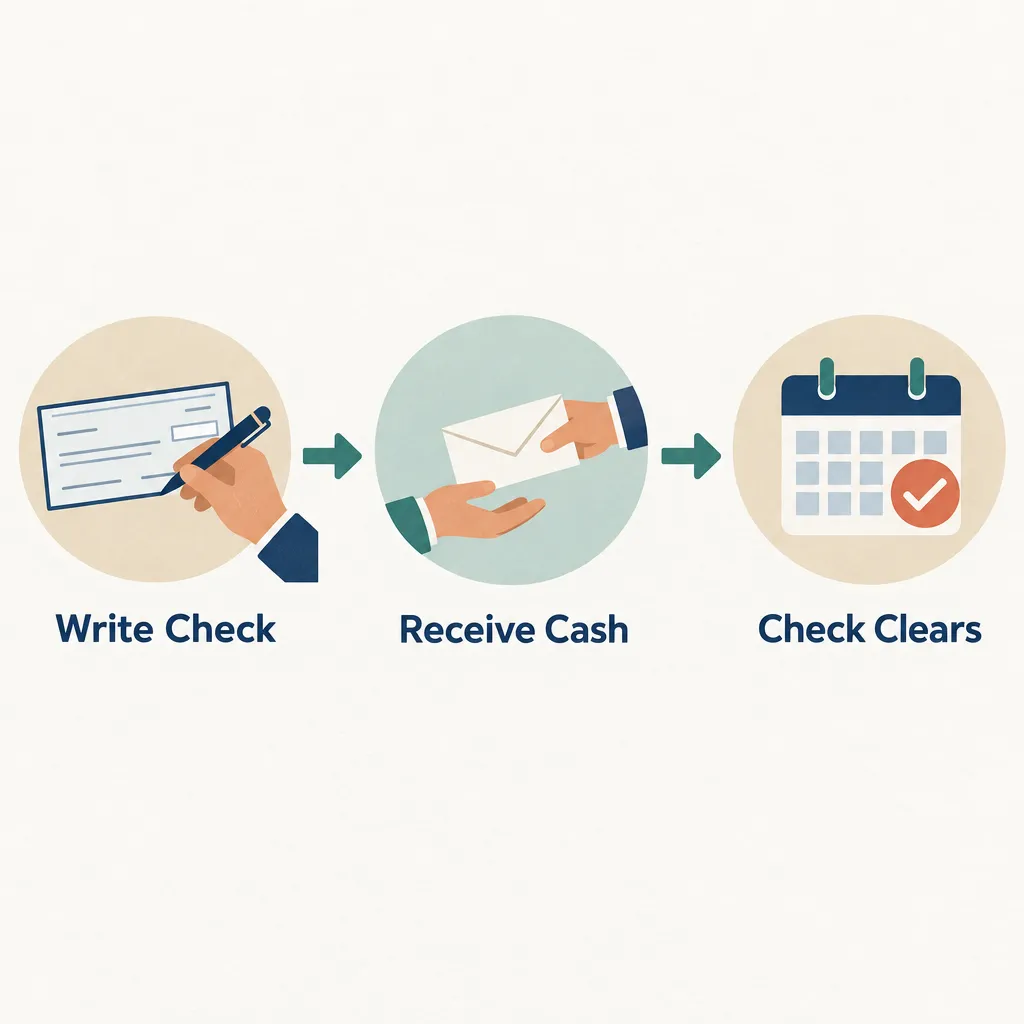
The fee is figured on the face amount of your check, which is the amount you owe. It is not figured on the cash you receive. Iowa Code §533D.9 allows up to $15 on the first $100 of face amount and up to $10 on each later $100. The most any single loan can cost in fees is $55.
The $15 + $10 fee schedule
Here is how it works in practice. You write a post-dated check, or authorize an electronic debit, for an amount that includes the fee. The lender gives you the face amount minus the fee and agrees not to deposit the check until your due date. Then, on that date, the check clears your account, or you come in and pay cash to get it back.
Because the fee tiers step down after the first $100, small loans cost the most per dollar. The table below shows the legal maximum at every $100 step.
| Check face amount | Maximum fee | Cash you receive | APR if due in 14 days | APR if due in 31 days |
|---|---|---|---|---|
| $100 | $15 | $85 | 460% | 208% |
| $200 | $25 | $175 | 372% | 168% |
| $300 | $35 | $265 | 344% | 156% |
| $400 | $45 | $355 | 330% | 149% |
| $500 | $55 | $445 | 322% | 146% |
Why “$500” really means $445 in your hand
Advertisements say payday loans of up to $500, but in Iowa that limit applies to what the lender holds from you, and that amount already includes the fee. If you need exactly $500 in cash, a single Iowa payday loan cannot cover it. You would need a second check, and the $500 limit applies to all checks one lender holds from you combined.
Did you know?
Under Iowa Code §533D.9, fees are charged on the check’s face amount, so the largest legal payday check of $500 carries a $55 fee and puts only $445 in your hand.
Read the check, not the ad
Before you sign, look at the face amount on the check or debit authorization. If it says $500, the fee is $55 and you will walk out with $445.
What the APR looks like at 14 vs 31 days
Lenders must state the APR under the Truth in Lending Act and Regulation Z (12 CFR 1026). The math is simple. Divide the fee by the cash you received, which gives the cost for one loan period. Then multiply by the number of those periods in a year.
Take the $500 check. $55 divided by $445 is 12.36% for the loan period. A 14-day loan fits into a year 26.07 times, so the APR is about 322%. Stretch the same loan to the full 31 days and it fits 11.77 times, so the APR falls to about 146%. The dollar fee is the same either way, so if you must borrow, the longest term you can get is the cheapest per day.
The real cost shows up when you repeat the loan. A borrower who takes a $500 check every two weeks for a year pays $55 × 26 = $1,430 in fees and still owes the last $500.
Limits on how many loans and how long
Iowa caps how much you can have out at once, but it does not cap how many loans you take in a year. There is no statewide database tracking borrowers across lenders. The limits below apply to each licensee separately.
Two loans at a time
Under Iowa Code §533D.10, a licensee may not hold more than two checks from one borrower at the same time. Their combined face amount still has to stay within $500. Two checks from two different companies would not show up in any shared system, which is how some borrowers end up owing several lenders.
No rollovers, but same-day re-borrowing is also restricted
Iowa bans renewing or extending a payday loan for another fee. The Division of Banking’s rules in chapter 187—17 also stop a lender from making you a new loan on the same day you pay off an old one.
In practice, many people still end up in a cycle. You pay off the loan on Friday, run short by Monday and come back for a new one. Each new loan is legal on its own, and each costs a new fee. That cycle is the pattern people describe as “taking a new loan every two weeks just to cover the last one.” To break it, you need a cheaper source of money for one cycle (see the lower-cost options below). One more payday loan will not do it.
Canceling a loan
Chapter 533D gives you until the end of the next business day to cancel a payday loan. You do this by returning the cash you received, and there is no fee for canceling.
Changed your mind?
Take the full cash amount back to the lender by the close of the next business day and ask for your check back. Keep the receipt showing the transaction was canceled.
What lenders must tell you
An Iowa payday lender must give you a written agreement before you take the money. Federal law also requires the finance charge and the APR in a standard format. Under the Truth in Lending Act, the “finance charge” (your fee) and the “annual percentage rate” must be shown clearly, along with the amount financed and the total of payments.
Chapter 533D and the Division’s rules add Iowa-specific requirements:
- A written contract in plain language, available in English and Spanish.
- The fee schedule, posted where you can see it.
- The lender’s name, license and contact information, including a toll-free number for questions or complaints.
- The license itself, displayed at the location.
If any of these is missing, or the APR on your paperwork does not match what the table above predicts for your loan, keep the paper and report it.
Car title loans in Iowa
The high-cost car title loans sold in many states are not legal in Iowa. Iowa Code §537.2403 caps the finance charge on a consumer loan secured by a motor vehicle at 21% a year. It also says a lender cannot get around the cap by dressing the deal up as a sale, a sale-and-repurchase, a lease, a pawn or a rental. Trying to do so is an unlawful practice under Iowa’s consumer fraud law, §714.16.
There is one exception. Lenders licensed under the Iowa Regulated Loan Act (Chapter 536) or the Industrial Loan Act (Chapter 536A) work under their own rate rules. Since July 1, 2026, the Regulated Loan Act rate is 36% a year. That is still a fraction of the 300% common for title loans elsewhere.
If an online or storefront business offers you a triple-digit loan against your car title as an Iowa resident, treat it as a red flag. Report it to the Iowa Attorney General’s Consumer Protection Division.
Installment loans and personal loans for bad credit in Iowa
Installment loans in Iowa, including the personal loans for bad credit that finance companies advertise, are mostly made under the Iowa Regulated Loan Act (Chapter 536). Lenders need a license from the Division of Banking. Since July 1, 2026, the rate cap is a flat 3% a month, or 36% a year.
HF 2329 replaced Iowa’s tiered rate brackets
House File 2329, signed by Governor Kim Reynolds on May 3, 2026, changed how regulated loans are priced. Under the old law, rates stepped down in brackets as the loan balance grew. The new law sets one rate, 3% a month, for regulated loans under $30,000. It also caps a one-time service charge at the lesser of 3% of the amount financed or $100.
The bill passed the House 62–29 on March 12, 2026 and the Senate on April 7. AARP Iowa registered against it. The American Fintech Council, an industry group, supported it. For larger balances that used to fall in lower brackets, the flat 36% means a higher allowed rate than before. For small loans, little changed.
HF 2329 does not apply to banks and credit unions, which do not need a Regulated Loan Act license. It also did not touch payday fees in Chapter 533D.
What 36% costs on a real loan
A 36% cap is far cheaper than a payday loan, but it still adds up for borrowers with weak credit. Here is a sample $1,000 loan at the maximum rate, repaid in equal monthly payments, before any service charge.
| Loan | Rate | Term | Approx. monthly payment | Approx. total repaid | Interest paid |
|---|---|---|---|---|---|
| $1,000 | 36% APR | 6 months | $185 | $1,110 | $110 |
| $1,000 | 36% APR | 12 months | $100 | $1,206 | $206 |
| $1,000 | 28% APR (credit union PAL) | 12 months | $96 | $1,157 | $157 |
Other consumer loans from lenders without a Chapter 536 license fall under the Iowa Consumer Credit Code (Chapter 537). For most of those loans, §537.2401 caps the finance charge at 21% a year.
“No credit check” and “guaranteed approval” are marketing phrases. Licensed lenders still check something, usually your income, bank account history or a soft credit pull. When a lender advertises easy approval, expect a rate near the legal maximum.
Online and tribal lenders
Iowa law applies to online lenders that lend to Iowans. A website that makes payday loans to Iowa residents needs the same Chapter 533D license as a storefront and must follow the same $500 limit and fee caps.
Some online lenders say they are owned by Native American tribes and claim that state law does not reach them. Courts and federal regulators have rejected that argument in several high-profile cases. Either way, you lose Iowa’s protections in practice if the lender ignores them. Warning signs include loans above $500, fees above the §533D.9 schedule, terms past 31 days, automatic renewals, and no Iowa license number anywhere on the site.
How to check a license
How to check an Iowa lender
- Get the lender’s full legal name and NMLS number from its website or contract.
- Search that name or number on NMLS Consumer Access and confirm it holds an active Iowa license of the right type (delayed deposit services for payday, regulated loan for installment).
- Cross-check with the Iowa Division of Banking’s licensee lookup on idob.iowa.gov.
- If the name does not appear, call the Division at 515-281-4014 before giving out any bank details.
Check before you share your bank login
Confirm the Iowa license before you hand over a routing number or debit card. An unlicensed lender with your account details can be very hard to stop.
What to do if you borrowed from an unlicensed lender
Stop further withdrawals first (the steps are below). Then file complaints with the Division of Banking, the Iowa Attorney General and the CFPB. Keep every email, text and payment record. Iowa Legal Aid can tell you whether the loan is enforceable at all, given that the lender broke state licensing law.
What happens if you can’t repay a payday loan in Iowa
If you can’t repay, the lender will try to collect the debt, but it cannot have you arrested or threaten criminal charges. It can sue you. Only after it wins a court judgment can it garnish your wages, and Iowa limits how much it can take.
Here is the usual sequence:
- The check or debit bounces. The lender deposits your check or runs the debit. If your account is short, your bank charges its own overdraft or NSF fee.
- The lender charges one returned-check fee. Iowa Code §533D.9 allows one fee of up to $15.
- Repeated withdrawal attempts are limited. Under the CFPB Payday Lending Rule (12 CFR part 1041), after two failed withdrawal attempts in a row, the lender needs your new authorization to try again.
- Collection calls and letters. The lender, or a collection agency it hires, contacts you.
- A possible lawsuit. Many payday debts are small enough for small claims court. If you are served, respond. Ignoring the case leads to a default judgment.
- Judgment and garnishment. With a judgment, the creditor can garnish wages or levy a bank account, within state and federal limits. Iowa Code §537.5105 bars garnishment before a judgment on consumer credit debts.
Can you go to jail or be charged with a felony?
No. Iowa does not jail people for owing money. Chapter 533D says a licensed lender may not threaten criminal prosecution to collect. Iowa’s debt collection rules in §537.7103 also bar collectors from threatening arrest or false criminal accusations. Iowa’s version applies to creditors collecting their own debts as well as to collection agencies. Under the federal Fair Debt Collection Practices Act, a third-party collector who threatens jail is also breaking the law.
A post-dated check that the lender knowingly agreed to hold is not a case of “writing a bad check.” The lender knew the money wasn’t there yet. The only time jail comes up is if you ignore a court order, such as an order to appear for a debtor’s exam.
If they threaten jail
Write down the date, the time, the caller’s name and the exact words. Report it to the Iowa Division of Banking and the CFPB. Iowa payday licensees may not threaten prosecution.
Will they garnish your paycheck or take your Social Security?
They can only garnish your wages after winning a judgment, and Iowa Code §642.21 caps what one creditor can take in a calendar year, based on your expected annual pay.
| Expected annual wages | Max garnished per creditor per year |
|---|---|
| Under $12,000 | $250 |
| $12,000 to under $16,000 | $400 |
| $16,000 to under $24,000 | $800 |
| $24,000 to under $35,000 | $1,500 |
| $35,000 to under $50,000 | $2,000 |
| $50,000 or more | 10% of expected annual wages |
Federal law adds a second ceiling. Under Title III of the Consumer Credit Protection Act, ordinary creditors cannot take more than 25% of your disposable earnings in a week. Social Security and SSI are protected from private creditors under 42 U.S.C. 407. If those benefits are directly deposited, federal rules at 31 CFR part 212 require your bank to protect two months’ worth from a garnishment order.
How long can a lender come after you?
In Iowa, a lender generally has 10 years to sue on a written contract and five years on an unwritten one, under Iowa Code §614.1. Payday agreements are written, so expect the 10-year period to apply. Under §614.11, a written acknowledgment of the debt or a new written promise to pay can restart that clock.
After the deadline passes, a collector can still ask you to pay, but it cannot sue and win if you raise the deadline as a defense. A judgment, once entered, lasts much longer.
Stopping automatic withdrawals
You can stop a lender from pulling money from your account. You still owe the debt afterward.
- Stop payment with your bank. Under the Electronic Fund Transfer Act and Regulation E (12 CFR 1005.10), you can stop a preauthorized electronic transfer by notifying your bank at least three business days before the scheduled date. The bank may ask for written confirmation within 14 days.
- Revoke the authorization with the lender. Send a written notice withdrawing your permission to debit your account, and keep a copy.
- Ask your bank about closing the account if an unlicensed lender keeps trying.
The CFPB’s payment provisions, which limit repeated failed withdrawals, took effect March 30, 2025. The ability-to-repay part of the rule had been rescinded earlier. The CFPB has since said it will not prioritize enforcing the payment provisions. Its 2026 regulatory agenda plans a proposal to reconsider them, though none had been published as of mid-October 2026. The rule is still law, so cite it if a lender keeps re-presenting a failed debit.
What changed in 2025 and 2026
Two things changed in Iowa’s lending rules in this period: a new 36% rate for regulated installment loans and a federal payment rule that is in force but loosely enforced. Payday fees did not change.
HF 2329: installment loans, not payday loans
As covered above, House File 2329 set a flat 3% monthly rate on Regulated Loan Act loans from July 1, 2026. Payday loans are licensed under Chapter 533D, a separate law, so the $15/$10 fee schedule, the $500 limit and the 31-day term all stayed the same.
Did you know?
Iowa’s 2026 law setting a 36% rate on regulated consumer installment loans, House File 2329, left payday loan fees under Chapter 533D unchanged, according to the enrolled bill text of the 91st General Assembly.
Bills that didn’t pass
House File 2039, introduced in the 91st General Assembly (2025–2026), would have capped payday APRs at 10%, calculated under the Truth in Lending Act. It would also have given borrowers an extended repayment option after more than four loans from one lender within two months. The bill was not enacted. A 10% cap would have effectively ended storefront payday lending in Iowa.
Local zoning ordinances
Iowa City, Des Moines, West Des Moines, Clive and Ames have adopted zoning rules that limit where payday lenders can open. According to Iowa Citizens for Community Improvement, a consumer advocacy group, these rules include 1,000-foot separations from churches, schools, parks and other lenders. They control only store locations. Loan terms everywhere in Iowa are set by state law.
Iowa payday lending by the numbers
According to the Division of Banking’s own reports, Iowa’s payday industry is shrinking but still handles hundreds of thousands of loans a year.
| Year | Metric | Figure | Source |
|---|---|---|---|
| 2017–2023 | Average amount financed in exam surveys | About $346 to $370 | Iowa Division of Banking |
| Year-end 2023 | Licensed delayed deposit businesses | 64 | Superintendent of Banking annual report |
| 2024 report | Delayed deposit loans made | 358,145 | 2024 Annual Report of the Superintendent of Banking |
| 2024 report | Total dollar volume | About $139.6 million (about $390 per loan) | 2024 Annual Report of the Superintendent of Banking |
| Calendar 2024 | Licensed delayed deposit businesses | 61, with 0 new licenses issued | 2025 Annual Report of the Superintendent of Banking |
An average loan near $390 suggests most borrowers take checks close to the $400 to $500 range. At $45 to $55 in fees per loan, the 358,145 loans in the 2024 report point to roughly $15 million to $20 million a year in fees paid by Iowans. That is an estimate from the Division’s figures, not a reported number.
How Iowa compares with neighboring states
Iowa is one of the more permissive states in its region. Three of its neighbors cap small-loan APRs at 36%, which has largely ended storefront payday lending there.
| State | Payday status | Main rule |
|---|---|---|
| Iowa | Allowed with limits | $500 face amount, $55 max fee, 31 days, no APR cap |
| Illinois | 36% APR cap | Predatory Loan Prevention Act (2021) |
| Nebraska | 36% APR cap | 2020 voter initiative |
| South Dakota | 36% APR cap | 2016 voter initiative |
| Minnesota | 36% all-in cap, limited path to 50% | 2023 law, effective 2024 |
| Missouri | Allowed | $500 max, fees and interest capped at 75% of the loan over its life |
| Wisconsin | Allowed, no rate cap | Up to $1,500 or 35% of gross monthly income |
If you live near a border, the protections that apply depend on where you live and where the loan is made. Moving across the state line does not change Iowa’s rules for a loan you took as an Iowa resident.
Lower-cost options in Iowa
Almost every alternative below costs less than a payday loan at Iowa’s legal maximum. Start at the top of the list.
Cheaper options first
Ask a federal credit union about a Payday Alternative Loan (28% APR cap).
Call the company you owe and ask for a payment plan before you borrow.
Call 211 for Iowa emergency rent, utility and food help.
| Product | Amount range | Term | Rate or fee cap | Law |
|---|---|---|---|---|
| Payday loan | Up to $500 face amount | Up to 31 days | $15 first $100, $10 each additional $100 | Iowa Code Ch. 533D |
| Regulated installment loan | Loans under $30,000 | Set by contract | 3% a month (36% a year) | Iowa Code Ch. 536, as amended by HF 2329 |
| Credit union PAL I | $200 to $1,000 | 1 to 6 months | 28% APR, application fee up to $20 | NCUA, 12 CFR 701.21 |
| Credit union PAL II | Up to $2,000 | 1 to 12 months | 28% APR, application fee up to $20 | NCUA, 12 CFR 701.21 |
- Credit union Payday Alternative Loans. Federal credit unions can offer PALs under NCUA rules. A $400 PAL I repaid over three months at 28% costs about $19 in interest. A $500 payday check costs $55 for one month.
- Payment plans. Utilities, landlords, hospitals and many lenders will agree to a payment schedule if you ask before the bill is past due. Ask for the plan in writing.
- Energy help. The Low Income Home Energy Assistance Program runs through local community action agencies under Iowa HHS. 211 Iowa can point you to rent, food and utility help in your county.
- Employer advances. Some employers offer pay advances with no fee. Ask payroll or HR.
- Free legal help. Iowa Legal Aid (1-800-532-1275) handles collection lawsuits and garnishment for eligible Iowans. The Legal Hotline for Older Iowans (1-800-992-8161) serves people 60 and older.
Credit counselor or debt relief company?
Start with a nonprofit credit counseling agency, ideally one that belongs to the National Foundation for Credit Counseling. A counselor reviews your budget for free or for a small fee and can set up a debt management plan with your creditors.
Debt settlement companies are different. They ask you to stop paying while they negotiate, which can lead to lawsuits and damaged credit. The FTC’s Telemarketing Sales Rule bars them from charging fees before they settle a debt when they sell by phone. If one asks for money up front, walk away.
Federal rules that apply everywhere
Federal law adds protections in Iowa on top of state law:
- Truth in Lending Act / Regulation Z: the lender must show the finance charge and APR before you sign.
- Military Lending Act (32 CFR part 232): active-duty service members and their dependents cannot be charged more than a 36% Military APR, including most fees. On a $500 Iowa payday check, the $55 fee alone breaks that cap, so payday loans to covered borrowers are effectively off the table.
- Fair Debt Collection Practices Act: third-party collectors cannot harass you, lie about the debt or threaten arrest.
- Electronic Fund Transfer Act / Regulation E: your right to stop preauthorized debits.
- Equal Credit Opportunity Act: lenders cannot treat you differently because of race, sex, age, marital status or receiving public assistance.
How to complain about a payday lender in Iowa
File with the Iowa Division of Banking for any licensed payday or installment lender, and with the CFPB at the same time. If the business is unlicensed or the problem involves fraud, add the Iowa Attorney General.
- Iowa Division of Banking: idob.iowa.gov; 1963 Bell Ave., Suite 201, Des Moines, IA 50315; 515-281-4014. It handles licensing, fee and term violations by payday and regulated lenders.
- CFPB complaint portal: consumerfinance.gov/complaint. The CFPB forwards your complaint to the company, which generally has 15 days to respond.
- Iowa Attorney General Consumer Protection Division: 515-281-5926 or [email protected]. It enforces the Iowa Consumer Credit Code and handles title-loan evasion and consumer fraud.
Keep these documents: the loan agreement, receipts, bank statements showing each debit, a log of collection calls with dates and words used, and copies of any stop-payment or revocation letters. If you are a service member, you can also contact your installation’s legal assistance office.
FAQ
Are payday loans legal in Iowa?
Yes. Payday loans are legal from businesses licensed by the Iowa Division of Banking under Iowa Code Chapter 533D. Lenders must keep the total face amount at $500 or less, charge no more than the §533D.9 fee schedule, and limit terms to 31 days.
What is the maximum payday loan amount in Iowa?
The total face amount of checks one lender holds from you is limited to $500, and that amount includes the fee. The most cash you can get on a $500 check is $445, because the maximum fee is $55.
How many payday loans can you have at once in Iowa?
One lender can hold no more than two of your checks at a time, and together they must stay within the $500 limit. Rollovers are banned, and a lender cannot give you a new loan on the same day you pay one off.
Can you get in trouble for not paying back a payday loan in Iowa?
You can face fees, collection calls, a lawsuit and, after a judgment, wage garnishment capped by Iowa Code §642.21. You cannot be jailed or charged with a crime for not repaying. An Iowa licensee that threatens prosecution is breaking Chapter 533D.
How do I stop them from pulling money out of my checking account?
Tell your bank at least three business days before the scheduled debit that you are stopping the payment, under Regulation E. Revoke the authorization with the lender in writing as well. The debt remains, so contact the lender about a repayment plan.
Are online payday loans legal in Iowa?
Only if the online lender holds an Iowa delayed deposit license and follows Iowa’s limits. Check NMLS Consumer Access or the Division of Banking’s lookup before you give out bank details. Online offers above $500 or over 31 days break Iowa law.
Before you borrow
At Iowa’s legal maximum, a $500 payday check puts $445 in your hand and costs $55 for as little as two weeks, an APR of about 322%. Repeating the loan every two weeks for a year costs $1,430 in fees, so plan how you will cover the next payday before you take the first one.
If you are already behind, your next step is a phone call. Call your lender and ask for a repayment plan, or call a federal credit union about a PAL. Do it before the due date, while you still have options.
Laws and regulations referenced
- Iowa Code Chapter 533D (Delayed Deposit Services)
- Iowa Code Chapter 536 (Regulated Loans)
- Truth in Lending Act, 15 U.S.C. 1601
- Regulation Z, 12 CFR Part 1026
- Fair Debt Collection Practices Act, 15 U.S.C. 1692
- Equal Credit Opportunity Act, 15 U.S.C. 1691
- Electronic Fund Transfer Act, 15 U.S.C. 1693
- Regulation E (electronic transfers), 12 CFR Part 1005
- Military Lending Act, 10 U.S.C. 987
- CFPB payday lending rule, 12 CFR Part 1041
Links go to the official text on government sites.
Check, verify or complain
Sources
- Iowa Code 2026, Chapter 533D Delayed Deposit Services legis.iowa.gov · official source
- Iowa Code 2026, §533D.9 Fees legis.iowa.gov · official source
- Iowa Code §533D.10 Prohibited acts by licensee legis.iowa.gov · official source
- Iowa Administrative Code 187—Chapter 17 Delayed Deposit Services legis.iowa.gov · official source
- Iowa Division of Banking Red Tape Review Rule Report (2025) idob.iowa.gov · official source
- Iowa Division of Banking delayed deposit survey data idob.iowa.gov · official source
- 2025 Annual Report of the Superintendent of Banking legis.iowa.gov · official source
- 2024 Annual Report of the Superintendent of Banking publications.iowa.gov · official source
- HF 2329 enrolled text, 91st General Assembly legis.iowa.gov · official source
- Gov. Reynolds signs list of bills into law, May 3, 2026 governor.iowa.gov · official source
- Iowa Legislature 2026 Enrolled Bills legis.iowa.gov · official source
- HF 2039 introduced text, 91st General Assembly legis.iowa.gov · official source
- Iowa Code 2026, Chapter 537 Consumer Credit Code legis.iowa.gov · official source
- Iowa Code §537.2403 Finance charge for consumer loans secured by a motor vehicle legis.iowa.gov · official source
- Iowa Code §537.5105 Limitation on garnishment legis.iowa.gov · official source
- Iowa Code §642.21 Garnishment exemptions legis.iowa.gov · official source
- Iowa Attorney General, Iowa Consumer Credit Code iowaattorneygeneral.gov · official source
- HF 2329 vote history iowaledger.com
- HF 2329 effect on banks and credit unions counselorlibrary.com
- NCLC: Rule on bounced payday and high-cost loan payments now in effect library.nclc.org
- CFPB 2026 regulatory agenda and the Payday Lending Rule natlawreview.com
- Iowa CCI: Iowa City payday lending ordinance iowacci.org
- Iowa Code §533D.10 (FindLaw) codes.findlaw.com
- Iowa Regulated Loan Rate Adjustment Replaces Tiered Brackets with 36% Rate Cap - Carleton carletoninc.com
- Legislature approves lifting Iowa's interest rate cap on consumer loans - Radio Iowa radioiowa.com
- CFPB Payday Rule Relief Is Not a Repeal fintechlaw.ai
- Payday Loans - a Convenience You Can't Afford! (Iowa Legal Aid) iowalegalaid.org
- Iowa Loan Rules - APR Caps & Limits (2026) flashmultiserviciosutah.com
- Iowa Payday Loan Laws and Regulations compacom.com

Elena writes about getting through a money emergency, assistance programs, budgeting on a tight income, banking basics and borrower rights. Her guides list the cheaper options first and link the agency or program that can actually help.
Ruth is US Financer's standards editor. Every article goes through her checks before and after it is published: each rate, fee, cap, deadline and rule is matched against its primary source, every law named is linked to its official text, and anything that cannot be…
What changed
- Nov 27, 2026 First published.
Comments are closed