

We do not lend money or arrange loans. Rates and rules change and differ by state, so check the lender's own disclosure before you sign.
Six of the nine apps compared here will give you $100 for $0 if you can wait a few days. That means most cash advance app fees pay for speed, subscriptions and tips rather than for the money itself. Repaid in 14 days, the same $100 costs $3.00 at Chime with instant delivery and $15.99 with a month of Brigit Premium. That is an APR of 78.2% at Chime and 416.9% at Brigit. The tables below show what each app charges, taken from each company’s own pages.
Run the numbers
Your money, in brief
- EarnIn, Chime, Current, Albert, MoneyLion and Cleo cost $0 if you take standard delivery and skip tips and subscriptions.
- Dave and Varo charge a fee on every advance, and Brigit’s published route needs a monthly membership.
- If you borrow a small amount once, a monthly membership often costs more than the instant fee.
- A typical $200 payday loan costs $30 over 14 days (391.1% APR), close to the 383% average the Center for Responsible Lending found for app advances.
- Federal rules let most apps skip an APR disclosure, so you need the formula on this page to see the real price.
On this page
1. Cash advance app fees at a glance
2. The five ways cash advance apps charge you
3. What a $100 advance costs in each app
4. What $250 and $500 advances cost, and why the repayment term changes the APR
5. Which cash advance app has the lowest fees?
6. The hidden costs: tips, forgotten subscriptions, outside accounts and overdrafts
7. How to keep the cost at $0
8. Does Cash App charge a fee for cash advances?
9. How much would a $1,000 cash advance cost?
10. Cash advance apps compared with other quick-cash options
11. The rules: federal law and state rules are still settling
12. How we calculated these costs
13. FAQ
14. Before you request your next advance
Fact-checked
We checked these key facts against the sources named, on November 27, 2026:
- As an APR, that’s $30 ÷ $200 × 365 ÷ 14 × 100 = 391.1% (source: consumerfinance.gov)
- Brigit Plus at $8.99 is 9% of a $100 advance ($8.99 ÷ $100) (source: help.hellobrigit.com)
- At 3% the fee would be $7.50, but the $5 maximum applies, so you pay $5 (source: chime.com)
- At the CFPB’s typical $15 per $100, you’d repay $230 after 14 days, a 391.1% APR (source: files.consumerfinance.gov)
- Spread the same $8.99 over a $500 advance and it drops to about 1.8% ($8.99 ÷ $500 = 0.018) (source: nerdwallet.com)
Cash advance app fees at a glance
Cash advance apps charge you in four main ways:
- A monthly membership: $0 to $15.99 in this table.
- A fee on each advance: Dave charges the greater of $5 or 5%, and Varo charges $1.60 to $100.
- An instant or express fee: Chime charges 3% capped at $5, and MoneyLion’s Turbo fee is 7.5%.
- Optional tips.
Standard delivery is free at most apps, so the cost comes from speed and subscriptions.
This page covers fees and the math behind them. For which app fits which situation, see the ranked list of the 9 apps in our cash advance app guide.
| App | Advance range | Required fee or membership | Free delivery | Instant or express fee | Fee source |
|---|---|---|---|---|---|
| EarnIn Cash Out | Up to $200 a day and $1,000 per pay period; limits vary by user | None. No mandatory fees, no interest, no credit check | Yes, 1 to 2 business days | Lightning Speed (minutes) from $3.99 | earnin.com |
| Chime MyPay | Up to $500, depending on your limit | None, but you need a Chime checking account with qualifying direct deposits | Yes | 3% of the amount, $2 minimum, $5 maximum | chime.com/mypay |
| Current Paycheck Advance | Up to $1,000; the maximum needs Eligible Payroll Deposits of $200 or more | None, but you need a Current account; no credit check | Yes, within 3 days | Instant Access Fee shown in the app, not published | current.com/advance |
| Albert Instant Advance | $25 to $1,000 subject to eligibility; few qualify for $1,000 | None. No interest, no late fees; optional plans cost $19.99 to $39.99 a month | Yes | Not published | albert.com/about |
| MoneyLion Instacash | Varies by account; not listed on the pricing page | $0 monthly fee, $0 interest; tips optional | Yes, to MoneyLion Spend, 1 to 5 business days | Turbo: 7.5% capped at $14.99 to Spend, or 9% to an outside account | moneylion.com/pricing |
| Varo Advance | $20 to $250 at first; up to $1,000 over time with direct deposits of $800 or more | One flat fee per advance, $1.60 to $100 by amount; needs a Varo bank account | No free route; every advance carries the flat fee | No separate instant fee listed | varomoney.com/borrowing |
| Dave ExtraCash | $25 to $500; few qualify for $500 | Greater of $5 or 5% per advance, plus membership up to $5 a month; needs Dave Checking and an ExtraCash account | No free route; the per-advance fee always applies | 1.5% to send money to an outside debit card | dave.com |
| Cleo | Plus $20 to $250 ($20 to $100 first time); Pro up to $250; Builder $150 to $500 | None required to request an advance; Plus $5.99, Pro $8.99, Builder $14.99 a month | Yes, standard can take up to 4 days | Express $4.49 to $14.99, based on the amount | web.meetcleo.com/pricing |
| Brigit | $25 to $500 ($25 to $250 in Maine) | Plus $8.99 a month or Premium $15.99 a month; Section 7.7 of its terms allows a no-membership request by email | Yes, standard delivery with Plus | Plus: Express fee shown before you confirm. Premium: Express included | help.hellobrigit.com |
Fees checked: November 27, 2026.
How to read the table
Start with the “Required fee or membership” column. If it says “None,” the app can cost you nothing. If it lists a fee or a membership, you pay that money even when you wait for free delivery. Dave and Varo are in that second group. So is Brigit’s standard route, because its published price needs a Plus membership.
The “Advance range” column is a ceiling, not an offer. Every app sets your limit from your deposits and history, which is why new users often get a low first offer. Varo’s cash advance page, checked in November 2026, puts its average advance at $195, well below its $500 top limit.
The five ways cash advance apps charge you
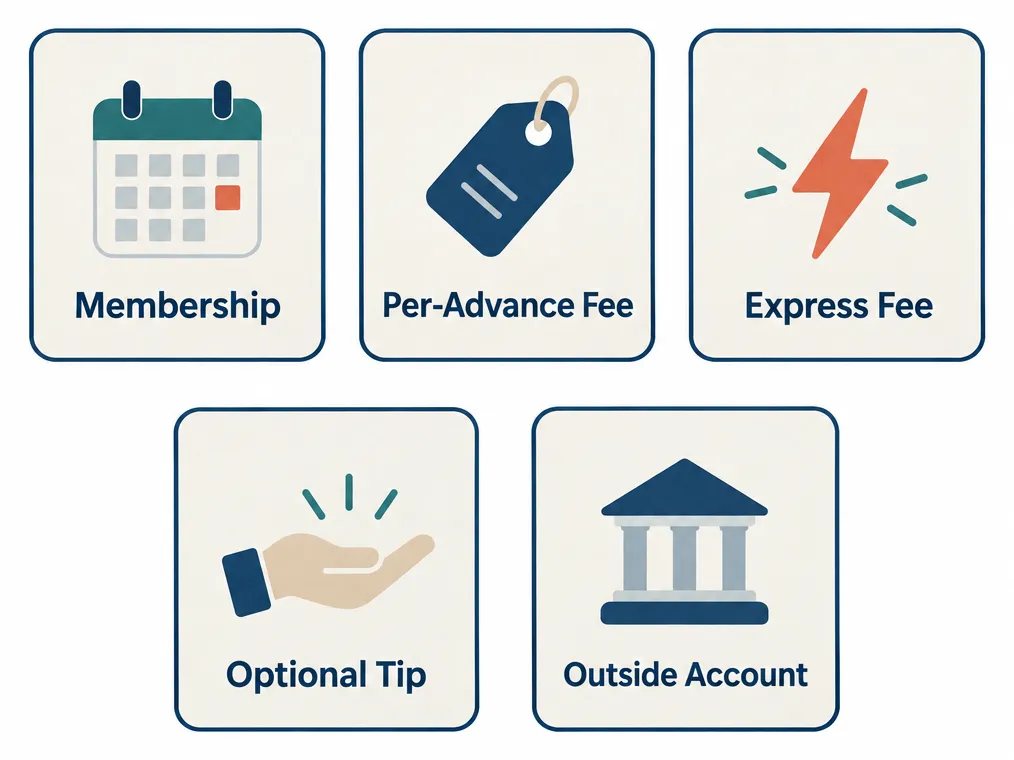
Every cost on this page fits one of five buckets: memberships, per-advance fees, instant fees, tips, and late or finance charges. Most apps use two or three of them. To know what you’ll pay, find out which buckets your app uses.
Monthly memberships
A membership is a flat monthly charge. The price is the same on a $25 advance or a $500 one, and you still pay it in a month when you don’t borrow. Brigit Plus costs $8.99 a month and Premium costs $15.99. Cleo’s tiers run $5.99 to $14.99, and Dave charges up to $5 a month.
Some memberships are optional. Cleo lets you request an advance without subscribing, and Albert says its $19.99 to $39.99 plans aren’t required. Experian Cash advances are powered by Brigit, and Experian says you don’t need Experian Plus ($14.99 a month plus tax) to get one.
Per-advance fees
A per-advance fee comes with every advance, however fast it arrives. Dave charges the greater of $5 or 5% of the amount and calls it an overdraft fee on the ExtraCash account. Varo charges one flat fee per advance, from $1.60 to $100 depending on the amount.
Waiting doesn’t help with this kind of fee. It is the price of the advance itself.
Instant transfer (express) fees
The instant transfer fee pays for getting money in minutes instead of days, and it is the easiest fee to skip. Chime charges 3% with a $2 minimum and $5 maximum. EarnIn’s Lightning Speed starts at $3.99. Cleo’s express fees run $4.49 to $14.99. MoneyLion’s Turbo costs 7.5% to a MoneyLion Spend account, capped at $14.99, or 9% to an outside account.
A percentage fee grows with the amount until it hits its cap, if it has one. That’s why Chime’s instant fee looks cheap on a large advance and MoneyLion’s outside-account fee doesn’t.
“Optional” tips and how they get collected
Some apps ask for a tip when you take an advance. EarnIn and MoneyLion both treat tips as optional, and MoneyLion says a tip doesn’t change your limit. The tip prompt can still appear before you confirm, sometimes with an amount already filled in.
Did you know?
According to the National Consumer Law Center’s April 2023 issue brief on California regulator data, tips were collected 73% of the time and brought in more than $17 million for three companies.
Late fees and finance charges
Most apps in the table don’t charge late fees, and Albert and Varo say so outright. The risk at these apps is an overdraft fee at your bank if a repayment pulls money you don’t have. That’s covered in the hidden-costs section below.
Loans work differently. Cash App Borrow is a loan, and its loan agreement sets out what happens if you pay late. Read the agreement shown in the app before you accept.
What a $100 advance costs in each app
A $100 advance repaid in 14 days costs $0 at six apps if you wait. With fast delivery or a membership, it costs $3.00 to $15.99. The table counts every required charge and treats each membership as one month paid for one advance.
| App | Cheapest way | Fast way | Fast-way APR over 14 days |
|---|---|---|---|
| Chime MyPay | $0, standard delivery | $3.00 instant | 78.2% |
| EarnIn | $0, standard delivery | From $3.99, Lightning Speed | At least 104.0% |
| Cleo, no subscription | $0, standard delivery | From $4.49 express | At least 117.1% |
| Cleo with Plus for that month | $5.99 standard (156.2% APR) | $10.48 ($5.99 Plus + $4.49 express) | 273.2% |
| Dave | $5.00 fee only (130.4% APR); $10.00 with a month’s $5 membership (260.7% APR) | $6.50 with the 1.5% outside card fee; $11.50 with membership too | 169.5%; 299.8% with membership |
| MoneyLion | $0, standard to MoneyLion Spend | $7.50 Turbo to Spend; $9.00 Turbo to an outside account | 195.5%; 234.6% |
| Brigit | $8.99, Plus for one month, standard delivery (234.4% APR) | $15.99, Premium with free Express | 416.9% |
| Current | $0, standard delivery | Instant Access Fee not published | Can’t be calculated |
| Albert | $0, standard delivery | Instant fee not published | Can’t be calculated |
| Varo | Flat fee for a $100 advance not published | Same flat fee | Can’t be calculated |
Current, Albert and Varo don’t publish the fee for a $100 advance, so there’s nothing to calculate an APR from. The app shows you the fee before you confirm. Put that figure into the formula below.
The formula: fee ÷ amount × 365 ÷ days × 100
You can turn any flat fee into an APR yourself:
- Divide the fee by the amount you get.
- Multiply by 365.
- Divide by the number of days until repayment.
- Multiply by 100.
Here is the Chime instant example, step by step:
- Fee divided by amount: $3.00 ÷ $100 = 0.03.
- Times 365: 0.03 × 365 = 10.95.
- Divided by the days until repayment: 10.95 ÷ 14 = 0.782.
- Times 100: 0.782 × 100 = 78.2% APR.
Dave’s $5 fee works the same way: $5 ÷ $100 = 0.05, × 365 = 18.25, ÷ 14 = 1.304, × 100 = 130.4%. Add the $5 monthly membership and the fee becomes $10, which gives $10 ÷ $100 × 365 ÷ 14 × 100 = 260.7%.
Run the APR before you tap confirm
Divide the total fee by the amount, multiply by 365, divide by the days until repayment, then multiply by 100. If the result is far above the 28% cap on federal credit union payday alternative loans, check whether your credit union offers one.
Why subscriptions hurt most on small advances
A membership is the same flat charge however much you borrow, so it weighs most on a small advance. Brigit Plus at $8.99 is 9% of a $100 advance ($8.99 ÷ $100). That’s three times Chime’s 3% instant fee, and you pay it before you pay anything for speed.
Spread the same $8.99 over a $500 advance and it drops to about 1.8% ($8.99 ÷ $500 = 0.018). So a membership can make sense if you borrow a large amount every month. For a one-time $100 advance, it is usually the most expensive part.
A bigger membership costs even more. Experian Plus at $14.99 a month on a $100 Experian Cash advance is a 15% charge ($14.99 ÷ $100) before any express fee, and Experian says the membership isn’t required.
What $250 and $500 advances cost, and why the repayment term changes the APR
Bigger advances usually mean a lower APR at apps with capped or flat fees. At apps that charge a straight percentage, the APR stays the same. Chime’s $5 cap makes its instant fee cheaper per dollar as the amount grows, while MoneyLion’s 9% outside-account fee stays at 234.6% APR at every amount.
A $250 advance repaid in 14 days
| App and route | Fee | How the fee is set | APR over 14 days |
|---|---|---|---|
| Chime instant | $5.00 | 3% would be $7.50, capped at $5 | 52.1% |
| MoneyLion Turbo to Spend | $14.99 | 7.5% would be $18.75, capped at $14.99 | 156.3% |
| MoneyLion Turbo to an outside account | $22.50 | 9% of $250 | 234.6% |
| Dave, required fee only | $12.50 | 5% of $250 | 130.4% |
| Dave with outside debit card fee | $16.25 | $12.50 + 1.5% of $250 ($3.75) | 169.5% |
| Cleo Plus for one month, standard delivery | $5.99 | $5.99 ÷ $250 × 365 ÷ 14 × 100 | 62.5% |
| Brigit Plus for one month, standard delivery | $8.99 | $8.99 ÷ $250 × 365 ÷ 14 × 100 | 93.8% |
| Brigit Premium for one month | $15.99 | $15.99 ÷ $250 × 365 ÷ 14 × 100 | 166.8% |
Chime’s $250 example shows the cap at work. At 3% the fee would be $7.50, but the $5 maximum applies, so you pay $5. The math: $5 ÷ $250 = 0.02, × 365 = 7.3, ÷ 14 = 0.521, or 52.1%.
A $500 advance repaid in 14 days
Only some users qualify for $500, and Dave says few do. If you qualify, the costs look like this:
| App and route | Fee | How the fee is set | APR over 14 days |
|---|---|---|---|
| Chime instant | $5.00 | 3% would be $15, capped at $5 | 26.1% ($5 ÷ $500 × 365 ÷ 14 × 100) |
| MoneyLion Turbo to Spend | $14.99 | 7.5% would be $37.50, capped at $14.99 | 78.2% ($14.99 ÷ $500 × 365 ÷ 14 × 100) |
| MoneyLion Turbo to an outside account | $45.00 | 9% of $500 | 234.6% |
| Dave, required fee only | $25.00 | Greater of $5 or 5%; 5% of $500 is $25 | 130.4% |
| Cleo Builder for one month, standard delivery | $14.99 | Builder needs $750 a month in direct deposits for up to $500 | 78.2% ($14.99 ÷ $500 × 365 ÷ 14 × 100) |
| Brigit Plus for one month, standard delivery | $8.99 | $8.99 ÷ $500 × 365 ÷ 14 × 100 | 46.9% |
| Brigit Premium for one month | $15.99 | $15.99 ÷ $500 × 365 ÷ 14 × 100 | 83.4% |
Dave’s own ExtraCash page states the fee as the greater of $5 or 5% of the advance and lists no maximum, so the table uses $25 on $500. The app shows the exact fee before you accept, and that screen is the one that binds you.
Same $5 fee, three different APRs
The APR depends on how long you keep the money as well as on the fee. A $5 fee on $100 is still $5 if you repay in 7 days or in 30. But APR states the cost as a yearly rate, so a shorter term packs the same fee into fewer days.
| $5 fee on $100, repaid in | Math | APR |
|---|---|---|
| 7 days | $5 ÷ $100 × 365 ÷ 7 × 100 | 260.7% |
| 14 days | $5 ÷ $100 × 365 ÷ 14 × 100 | 130.4% |
| 30 days | $5 ÷ $100 × 365 ÷ 30 × 100 | 60.8% |
A 7-day advance at $5 is like paying that fee 52 times a year, which is where the 260.7% comes from. Most apps take repayment on your next payday, so a fee paid a few days before payday carries a very high APR. Varo gives you 30 days to repay, and the longer term lowers the APR on its flat fees.
The dollar cost is the same either way. APR is a tool for comparing a $5 advance with a credit card cash advance or a short-term loan (our short-term loans guide covers those). It doesn’t change what leaves your account.
Which cash advance app has the lowest fees?
The cheapest app depends on how fast you need the money and how much you need. The ranking below is by total dollar cost for a $100 or $250 advance repaid in 14 days, with every required charge included. Fees the companies don’t publish are left out.
- If you can wait: EarnIn, Chime, Current, Albert, MoneyLion or Cleo, at $0. Standard delivery at these six is free if you skip tips and subscriptions. EarnIn’s free transfer takes 1 to 2 business days, MoneyLion’s 1 to 5, and Cleo’s up to 4 days.
- If you need $100 in minutes: Chime MyPay, at $3.00. Next come EarnIn’s Lightning Speed at $3.99 or more, then Cleo’s express fee at $4.49 or more without a subscription.
- If you need $250 or more in minutes: Chime MyPay again, at $5.00. The $5 cap brings the APR to 52.1% on $250 and 26.1% on $500. You need a Chime checking account with qualifying direct deposits.
- The most expensive routes on this page: Brigit Premium for a one-time $100 advance, Dave with membership and the outside card fee, and Cleo Plus with express.
Some apps cost more as you borrow more. Dave’s 5% fee, MoneyLion’s 9% outside-account fee, Cleo’s express fee ($3.99 to $14.99 based on the amount) and Varo’s flat fee ($1.60 to $40 for standard advances up to $500) all rise with the amount.
Other apps with a similar fee model aren’t in this table, including Klover, Tilt, Possible Finance, Money App and Upstart’s Cash Line. Run their published fees through the same formula. Money App, for example, advertises express fees from $7.99. On a $100 advance repaid in 14 days, that’s $7.99 ÷ $100 × 365 ÷ 14 × 100 = 208.3% APR.
The hidden costs: tips, forgotten subscriptions, outside accounts and overdrafts
Hidden costs are charges that don’t show up in the advertised price. They include tips, a membership that keeps renewing, fees for sending money to your own bank, overdraft fees when a repayment bounces, and the work of moving your paycheck.
Tips that add up
A tip of a few dollars on a $100 advance costs as much as an instant fee, and the APR math is the same. Even a small tip on a 14-day $100 advance gives a double- or triple-digit APR. The National Consumer Law Center has argued for years that these “optional” payments work like finance charges.
Subscriptions you forget
A membership keeps charging after you’ve repaid. If you join Brigit Plus for one advance and keep it for three months, the cost of that advance triples to $26.97 ($8.99 × 3). The Restore Online Shoppers’ Confidence Act requires online sellers to give you a simple way to stop recurring charges. That law is part of what the government alleged Dave violated.
To stop a charge, cancel in the app’s settings or through its support channel, and keep a screenshot or confirmation email. If charges continue, the Electronic Fund Transfer Act lets you tell your bank to stop preauthorized debits. Under Regulation E, you have to give that notice at least three business days before the scheduled transfer.
Fees to reach your own bank account
Some apps charge more to send money to an outside account. MoneyLion sends Instacash to an outside checking account only through Turbo, at 9% of the advance. Dave charges 1.5% to send ExtraCash to an outside debit card.
Overdraft fees when the repayment bounces
Apps collect repayment by pulling it from your account on a date they set, usually your payday. Dave’s ExtraCash can be repaid on demand. If the pull happens before your paycheck lands, your bank may charge an overdraft or returned-payment fee. The app doesn’t charge that fee, but you still pay it.
Here’s a typical case. Your paycheck clears on Friday morning, but the app’s repayment runs Thursday night. The account goes negative and your bank adds its overdraft fee. To prevent this, check that the repayment date in the app matches the day your pay actually arrives. Many apps let you change or push back the date before it’s due. If it has already happened, ask your bank whether it will refund a first overdraft fee. If the app pulled money on a date you didn’t agree to, file a complaint.
Needing the app’s own account
Chime, Current, Varo and Dave all require their own accounts, and Chime, Current and Varo tie your limit to direct deposits into those accounts. Moving your paycheck takes time and payroll paperwork, and it ties your money to one company’s app. EarnIn, by contrast, works with your existing bank account.
Did you know?
The National Consumer Law Center’s December 2024 issue brief, citing California regulator data, reports that earned wage advance users averaged 36 advances a year, about 9 a quarter, and some took about 100.
How to keep the cost at $0
You can usually get a cash advance for $0 by taking standard delivery, setting the tip to zero, skipping or canceling any membership and repaying on time. That route works at EarnIn, Chime, Current, Albert, MoneyLion and Cleo. Dave and Varo always charge a fee.
How to get a $0 advance
- Pick an app that lists “None” for required fees in the table above.
- Request the advance and choose standard delivery, not instant, express, Turbo or Lightning Speed.
- Set any tip to $0 before you confirm.
- Decline or cancel any free trial before it turns into a paid plan.
- Check that the repayment date falls after your pay arrives.
- Repay, then wait until you’re square before taking another advance.
Plan around the waiting time
Free delivery takes from 1 to 5 business days, depending on the app. If a bill is due Friday, request the advance at the start of the week.
Should you pay the instant fee or wait for the free transfer? If waiting costs you only time, wait. If waiting means a late fee or a returned-payment fee from your bank that’s bigger than the instant fee, paying for speed can cost less overall. Compare the two dollar amounts.
Use one app at a time
Borrowing from one app to repay another is how a $3 fee becomes a monthly habit. Each new advance shrinks your next paycheck, which sets up the next shortfall. The pattern usually looks like this: one app’s repayment leaves a gap, a second app fills it, and a third covers the second. The way out is to stop adding apps. Repay the smallest advance first, and ask a nonprofit credit counselor to help you build a budget that covers a whole pay period.
Don’t take the first offer as your limit
A $25 first offer from an app that advertises “up to $500” is normal. Every app starts low and raises limits based on deposits and repayment history. Varo starts at $20 to $250, Cleo’s first-time range on Plus is $20 to $100, and Dave and Albert both say few users qualify for their maximum. Paying for a membership won’t necessarily raise your limit.
Ask your employer first
Before you use any app, ask your payroll or HR department whether it offers a payroll advance or an earned wage access program through payroll. An employer-run advance may cost nothing, and it’s repaid from your next paycheck with no bank debit that can bounce.
Does Cash App charge a fee for cash advances?
Yes. Cash App Borrow is a loan, not a fee-free advance. Block, the company behind Cash App, described Borrow in a July 2026 post as a loan with an upfront flat fee, no rollovers and no compounding. Because it’s a loan, it comes with Truth in Lending disclosures, including an APR, which most cash advance apps don’t give.
Block’s post doesn’t publish a single fee percentage, so compare the fee and APR the app shows before you accept.
Cash App’s loan agreement says loans aren’t available in all states. The app shows whether you’re eligible and what your fee would be.
Borrow costs more than a free standard advance.
How much would a $1,000 cash advance cost?
Only a few apps offer $1,000, and new users rarely qualify. Current, Albert, Varo and EarnIn list $1,000 as a maximum, and each ties it to conditions that take time to meet.
| App | Path to $1,000 | Published cost |
|---|---|---|
| Current | Needs Eligible Payroll Deposits of $200 or more into a Current account | $0 with free delivery within 3 days; Instant Access Fee shown in the app |
| Albert | Subject to eligibility; few qualify | $0 with standard delivery; instant fee not published |
| EarnIn | Up to $1,000 per pay period, but no more than $200 a day | $0 with standard delivery; Lightning Speed from $3.99 per transfer |
| Varo | Built up over time with direct deposits of $800 or more | Flat fee up to $100 |
Look at Varo closely. Its advances top out at $500, and its disclosed fees for standard advances run $1.60 to $40. If the $40 fee applies to a $500 advance, that’s 8% of the amount. Repaid over Varo’s full 30 days, it works out to $40 ÷ $500 × 365 ÷ 30 × 100 = 97.3% APR.
EarnIn’s daily cap matters too. Reaching $1,000 at $200 a day takes five separate days, and with Lightning Speed each transfer carries its own fee.
Cash advance apps compared with other quick-cash options
A free standard advance is the cheapest quick money on this page. Credit union payday alternative loans are the main low-cost option that comes with full borrower protections. Paid app routes can cost as much in APR terms as a storefront payday loan.
| Product | What you pay | APR disclosed? | Term | Regulated as credit under federal law? |
|---|---|---|---|---|
| App advance, standard delivery | $0 at six apps | No | Usually your next payday | Generally no, under the CFPB’s December 2025 opinion for covered products |
| App advance, instant or membership | $3.00 to $15.99 on $100 in our table | No; calculate it yourself | Usually your next payday | Varies by product |
| Cash App Borrow | Upfront flat fee, reported at 5% | Yes, as a loan | Four weeks | Yes |
| Federal credit union PAL | Interest capped at 28% APR, plus an application fee of no more than $20 under NCUA rules | Yes | PAL I: 1 to 6 months; PAL II: 1 to 12 months | Yes |
| Storefront payday loan | Typically $15 per $100, ranging from $10 to $30 by state, per the CFPB | Yes | Usually 2 weeks | Yes |
| Credit card cash advance | Set by your card agreement | Yes | Revolving | Yes |
NCUA rules set PAL I loans at $200 to $1,000 and PAL II loans at up to $2,000, with no minimum. Both are repaid in installments, with no balloon payment at the end. Some credit unions require you to be a member for a set time before you can borrow, so ask early. Our short-term loans guide covers credit card cash advances and payday loans in more detail, including state caps.
How much would a $200 payday loan cost?
At the typical fee of $15 per $100 that the CFPB cites, a $200 payday loan costs $30 over 14 days, so you repay $230. As an APR, that’s $30 ÷ $200 × 365 ÷ 14 × 100 = 391.1%. The CFPB’s payday research found a median fee of $15 per $100 and a median term of 14 days, which is where its 391% benchmark comes from.
State law sets what lenders may charge, and the CFPB says fees range from $10 to $30 per $100 depending on the state. Some states don’t allow these loans at all. Here is the same $200 loan across that range:
| Fee per $100 | Fee on $200 | Term | Total repaid | APR |
|---|---|---|---|---|
| $10 | $20 | 14 days | $220 | 260.7% |
| $15 (typical) | $30 | 14 days | $230 | 391.1% |
| $30 | $60 | 14 days | $260 | 782.1% |
Rolling the loan over for another two weeks, where your state allows it, usually means paying the fee again. At $15 per $100, that’s another $30 without reducing the $200 you owe.
App advances aren’t automatically cheaper. In its September 2025 “Escalating Debt” report, the Center for Responsible Lending tracked users of five major earned wage advance apps over 12 months. It found an average APR of 383% on advances repaid in 7 to 14 days, close to the 391% of a typical storefront payday loan. The earned wage access industry disputes how CRL describes its products. Still, the comparison shows that repeated paid advances can cost about as much as payday borrowing.
Cheaper options first
A federal credit union payday alternative loan caps interest at 28% APR.
Ask a utility or landlord for a payment plan before you borrow to cover a bill.
A nonprofit credit counselor can help if advances have become a monthly habit.
The rules: federal law and state rules are still settling
Most cash advance apps don’t have to show an APR, because federal regulators currently treat many earned wage products as something other than credit. That position has changed several times. States are writing their own rules, and courts are still deciding several fee cases.
The CFPB’s December 2025 advisory opinion
On December 23, 2025, the Consumer Financial Protection Bureau published an advisory opinion in the Federal Register. It concludes that “covered” earned wage access isn’t credit under the Truth in Lending Act and Regulation Z (12 CFR 1026). Covered products are employer-partnered products where the worker owes no debt. The opinion also says typical expedited delivery fees and tips aren’t finance charges, and it applies that view to optional fees and tips at non-covered products as well. It rescinded the CFPB’s 2024 proposed interpretive rule, which had taken the opposite position.
The opinion leaves some fees open to challenge. The CFPB says fees or tips that are coercive or hard to avoid could still count as finance charges. The opinion is also non-binding, so it doesn’t override state law.
The National Consumer Law Center disagrees with the opinion. It argues that earned wage advances are loans and calls the 2025 interpretation the third flip-flop in CFPB opinions on whether TILA applies. In practice, “0% APR” in an app’s marketing doesn’t tell you the cost. You have to work it out with the formula above.
Employer-based earned wage access and direct-to-consumer advances
There are three broad models, and the rules treat them differently:
| Model | How repayment works | Examples | Federal treatment |
|---|---|---|---|
| Employer-based earned wage access | Your employer repays from your paycheck through payroll | Payroll-partnered programs | “Covered” product under the CFPB’s December 2025 opinion; not credit |
| Direct-to-consumer advance | The app pulls repayment from your bank account | The nine apps in our table; Dave calls ExtraCash an overdraft product | Optional fees and tips generally not finance charges under the opinion |
| Small-dollar loan | Fixed repayment under a loan agreement | Cash App Borrow | Credit, with full Truth in Lending disclosures |
The model matters because it decides which rules cover your fees, your repayment and your rights.
State rules that may protect you
Law firm Goodwin reported in January 2026 that 12 states have earned wage access laws and that only two of them treat earned wage access as credit. The rules differ on fee limits, licensing and disclosures, and some apps change their terms by state. Brigit, for example, caps advances at $250 in Maine, and Cash App’s loan agreement says Borrow isn’t offered everywhere. Check your state financial regulator’s website for current rules, and confirm that the company holds any license your state requires.
Lawsuits over fees
Several government cases accuse apps of misleading consumers about fees. These are allegations, and the companies dispute them.
- United States v. Dave: The U.S. Department of Justice, acting for the Federal Trade Commission, filed an amended complaint in December 2024 that also names CEO Jason Wilk. It alleges that Dave advertised advances of “up to $500” that few users got, didn’t disclose express fees, misrepresented tips, and charged recurring memberships without clear terms or a simple way to cancel. Dave announced in December 2024 that a new ExtraCash fee structure would remove optional tips and express fees. Dave’s 2026 filings with the Securities and Exchange Commission describe the case as ongoing. As of October 2026, no settlement had been announced, so there is no FTC refund program for Dave customers.
- Baltimore v. MoneyLion: In October 2025 the City of Baltimore sued MoneyLion. It alleges that Instacash is marketed as earned wage access but works like a payday loan, with hidden fees and rates above Maryland’s cap.
- Baltimore v. Dave: On December 30, 2025, the city sued Dave over ExtraCash. Dave’s SEC filings report that the city’s motion to send the case back to state court was fully briefed as of April 22, 2026. Dave has said it believes its practices comply with the law.
The Center for Responsible Lending keeps a public tracker of lawsuits against payday loan apps.
Where to complain
If an app charged a fee you didn’t agree to, pulled a repayment early or kept billing a membership after you canceled, write to the company first and keep copies. If that doesn’t fix it:
- File a complaint with the CFPB’s complaint portal.
- Report deceptive practices to the FTC at ReportFraud.
- Contact your state financial regulator.
If an advance ever goes to a debt collector, the Fair Debt Collection Practices Act limits what that collector can do.
Before you stack apps
Taking advances from several apps at once means several repayments pulling from the same paycheck, often on the same day. One short paycheck can then set off several overdraft fees at once, and each new advance makes the next pay period tighter.
How we calculated these costs
Every figure on this page comes from the company’s own fee schedule, pricing page, terms or help center, or from the named regulator or researcher, and was checked on November 27, 2026. The cost tables follow the same assumptions throughout, so the apps can be compared on equal terms.
| Item | What this page uses | Why |
|---|---|---|
| Sources | Each company’s fee schedule, pricing page, terms or help center; CFPB, NCUA and Federal Register documents for rules and benchmarks | A company’s own disclosure is the most reliable record of its fees |
| Check date | November 27, 2026 | Fees and limits change, so every figure is dated |
| Repayment term | 14 days by default; 28 days for Cash App Borrow; 30 days for the Varo $1,000 example | 14 days matches a typical pay cycle and the CFPB’s payday benchmark |
| Memberships | One month’s fee counted against one advance | That’s the real cost if you join for a single advance |
| Tips | Set to $0 | Tips are optional, and the $0 route is always available |
| Unpublished fees | Left out and marked “Can’t be calculated” | A fee that isn’t published can’t be checked |
| APR method | Fee ÷ amount × 365 ÷ days × 100 | The same simple annualized rate the CFPB uses for its payday example |
| Ranking | Total dollars of required charges, then delivery speed | Dollars leaving your account are the cost that matters most |
| Updates | Fee pages re-checked monthly, with the check date updated | Fee structures at several apps changed in 2025 and 2026 |
The simple APR method is close to the Regulation Z calculation for a single repayment. For loans with several payments, the lender’s disclosed APR is the figure to rely on.
FAQ
Which cash advance apps have no fees?
EarnIn, Chime MyPay, Current, Albert, MoneyLion and Cleo can cost $0 if you take standard delivery, skip tips and don’t subscribe. “No fees” really means “no fees if you wait,” as the first table shows.
How much do cash advance apps cost?
A $100 advance repaid in 14 days costs $0 to $15.99 depending on the app and route. The section “What a $100 advance costs in each app” breaks it down app by app.
What is the Dave ExtraCash fee?
Dave charges the greater of $5 or 5% of each advance, with no maximum listed on its own page. On top of that are a membership of up to $5 a month and 1.5% for an outside debit card.
What is the MoneyLion Turbo fee?
Turbo costs 7.5% to a MoneyLion Spend account, capped at $14.99, or 9% to an outside account. Standard delivery to Spend is free.
What is the EarnIn Lightning Speed fee?
It starts at $3.99 per transfer. EarnIn’s standard transfer is free and takes 1 to 2 business days.
What is the Chime MyPay fee?
Standard delivery is free. Instant delivery costs 3%, with a $2 minimum and $5 maximum, so anything from about $167 up to the $500 limit costs $5.
How much does Brigit cost?
Plus costs $8.99 a month and Premium $15.99 a month, with free Express on Premium. Section 7.7 of Brigit’s terms lets you request an advance without a membership by emailing [email protected].
What is the Cleo express fee?
Cleo’s express fees run $4.49 to $14.99 based on the amount. Standard delivery is free but can take up to 4 days.
What is the Varo Advance fee?
Varo charges one flat fee per advance, $1.60 to $100 depending on the amount, with 30 days to repay and no late fees. The exact fee appears in the app before you accept.
Is there a cash advance app with no subscription fee?
Yes. EarnIn, Chime MyPay, Current and MoneyLion charge no monthly fee for advances, and Cleo and Albert let you request one without a paid plan.
How much would a $200 payday loan cost?
At the CFPB’s typical $15 per $100, you’d repay $230 after 14 days, a 391.1% APR. State law can make it cheaper, more expensive or unavailable.
Do I have to tip EarnIn?
No. Set the tip to $0 before you confirm, because a tip adds to your cost exactly the way a fee does.
Why do cash advance apps say 0% APR?
Under the CFPB’s December 2025 advisory opinion, covered earned wage access isn’t credit and typical expedite fees and tips aren’t finance charges, so there’s no APR to disclose. The fees still cost you money, which the formula on this page turns into an APR.
Do cash advance apps charge late fees?
Most apps in this comparison don’t, and Albert and Varo say so outright. The bigger risk is an overdraft fee from your own bank if a repayment pull hits an empty account.
What happens if I can’t repay a cash advance app on time?
Contact the app before the due date, because many let you move it. If a repayment fails, your bank may charge a fee, and the app may stop new advances until you catch up. Stopping a debit under Regulation E doesn’t cancel what you owe.
Is an instant transfer fee worth paying?
Only if it costs less than waiting would. If the free transfer arrives before your bill is due, waiting saves the whole fee.
Which $50 instant cash advances with no credit check are actually free?
None of the instant routes are free. Chime’s minimum is $2, EarnIn’s starts at $3.99 and Cleo’s at $4.49. The free version is standard delivery. “No credit check” means the app looks at your deposits and bank history instead of your credit report, not that approval is guaranteed.
Before you request your next advance
Before you tap confirm, add up the instant fee, the month’s membership and any tip. Then run the total through fee ÷ amount × 365 ÷ days × 100. If the result is far above a credit union’s 28% APR cap, ask about a payday alternative loan or an employer payroll advance first. If an app still fits, the ranked list of the 9 apps in our cash advance app guide covers limits, speed and eligibility beyond fees.
Laws and regulations referenced
- Truth in Lending Act, 15 U.S.C. 1601
- Regulation Z, 12 CFR Part 1026
- Fair Debt Collection Practices Act, 15 U.S.C. 1692
- Electronic Fund Transfer Act, 15 U.S.C. 1693
- Regulation E (electronic transfers), 12 CFR Part 1005
Links go to the official text on government sites.
Check, verify or complain
Sources
- CFPB advisory opinion on earned wage access, Federal Register, December 23, 2025 govinfo.gov · official source
- CFPB earned wage access advisory opinion files.consumerfinance.gov · official source
- Baltimore City lawsuit against Dave, Inc. baltimorecity.gov · official source
- Baltimore City sues MoneyLion baltimorecity.gov · official source
- NCUA Payday Alternative Loans final rule, Federal Register, October 1, 2019 govinfo.gov · official source
- DOJ: United States files complaint against Dave Inc. and CEO Jason Wilk justice.gov · official source
- FTC: Dave, Inc., FTC v. case page ftc.gov · official source
- EarnIn earnin.com
- Chime MyPay chime.com
- What is Chime MyPay? chime.com
- Current Paycheck Advance current.com
- About Albert albert.com
- MoneyLion Pricing moneylion.com
- Varo Advance borrowing varomoney.com
- Varo cash advance varomoney.com
- Dave dave.com
- Dave ExtraCash fees dave.com
- Cleo pricing web.meetcleo.com
- How much does Brigit cost? help.hellobrigit.com

Dana writes US Financer's guides to payday loans, personal and installment loans, bad credit borrowing and cash advance apps. Every piece starts from what a loan really costs, works the numbers in a table, and checks what the lender's own disclosure and your state's rules…
Ruth is US Financer's standards editor. Every article goes through her checks before and after it is published: each rate, fee, cap, deadline and rule is matched against its primary source, every law named is linked to its official text, and anything that cannot be…
What changed
- Nov 27, 2026 First published.
Comments are closed