General information, not legal advice. Laws change, so confirm with the official statute, your state regulator or a licensed attorney before you act.
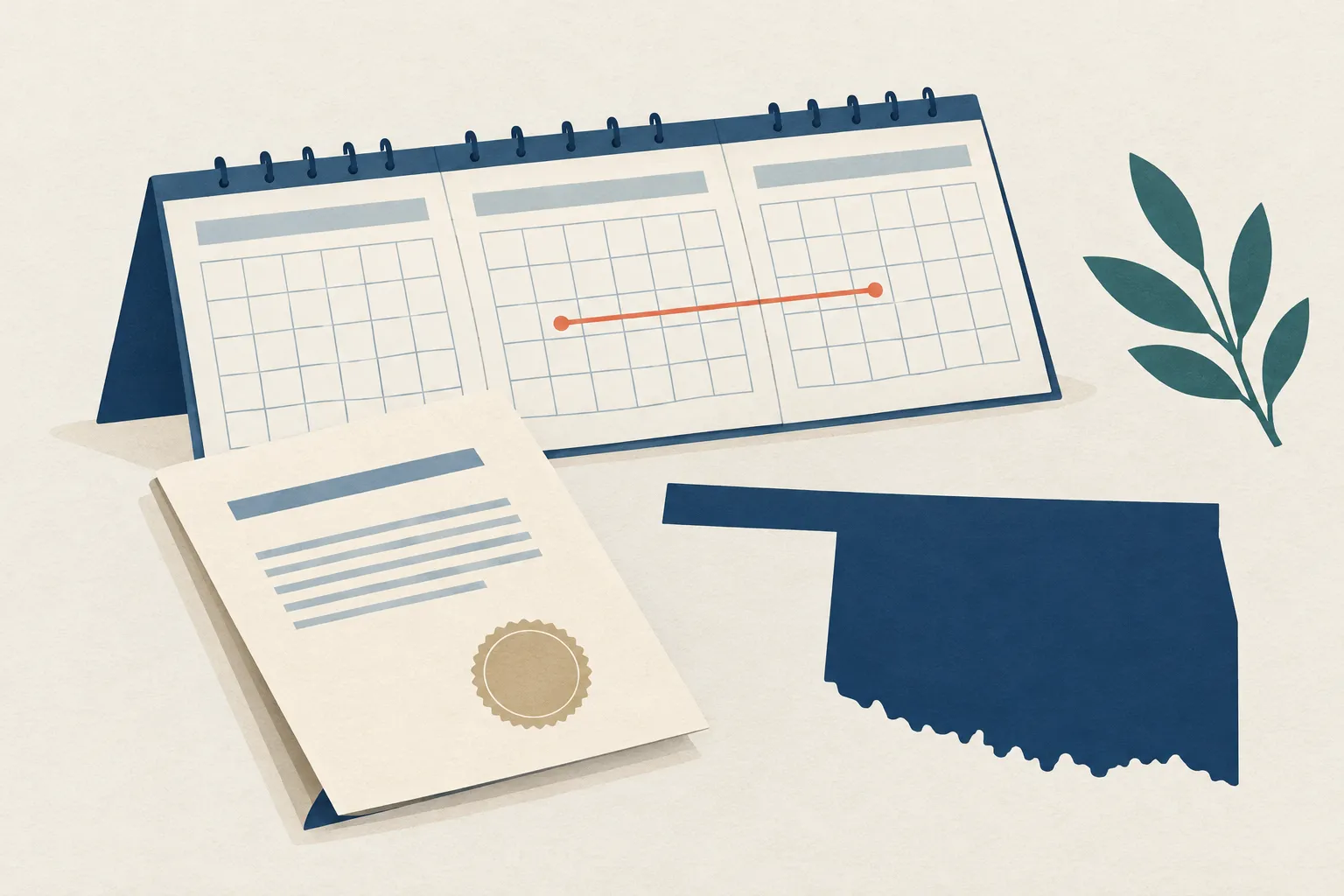
Payday-style lending is legal in Oklahoma. Since August 1, 2020, it has worked through installment loans under the Oklahoma Small Lenders Act (59 O.S. § 3150 et seq.), not the old two-week check loan. Interest is capped at 17% a month, which is about 204% a year. You can’t owe more than $1,824.60 in total to all small lenders at once, a limit that has applied since July 1, 2025.
Run the numbers
Your money, in brief
- The $500 two-week payday loan is gone. Small loans now run 60 days to 12 months.
- You can owe no more than $1,824.60 to all small lenders combined (effective July 1, 2025).
- Interest can’t go above 17% a month, and your monthly small-loan payments can’t exceed 20% of your gross monthly pay.
- Unpaid loans are civil debts. Oklahoma’s constitution bans jail for debt, and wages can be garnished only after a court judgment.
- Before you borrow, check that the lender holds an Oklahoma Small Lender license from the Department of Consumer Credit.
Fact-checked
We checked these key facts against the sources named, on November 27, 2026:
- Section 3150.10 of Title 59 set a base aggregate of $1,500 (source: oscn.net)
- On a $1,000 loan, the first month’s interest is $170 (17% of $1,000) (source: oksenate.gov)
- The phone number is 405-521-3653 (source: oklahoma.gov)
- Since August 1, 2020, it has worked through installment loans under the Oklahoma Small Lenders Act (59 O.S. § 3150 et seq.), not the old two-week check loan (source: hudsoncook.com)
- The CFPB’s Payday Lending Rule (12 CFR part 1041) originally required lenders to check whether borrowers could repay, but that requirement was repealed in 2020 (source: files.consumerfinance.gov)
Oklahoma small-loan rules at a glance (November 2026)
The Small Lenders Act controls the four things that matter most: how much you can owe, the interest rate, the loan term and how big your payments can be. The table gives each rule with its legal source. It reflects the rules as of November 27, 2026.
| Rule | Current limit | Legal source | Effective / period |
|---|---|---|---|
| Legal status | Legal with an Oklahoma Small Lender (OSL) license | 59 O.S. § 3150 et seq. | Since August 1, 2020 |
| Total owed to all small lenders | $1,824.60 per borrower | 59 O.S. § 3150.10; DoCC adjustment chart | July 1, 2025 to June 30, 2027 |
| Interest rate | Up to 17% per month | 59 O.S. § 3150.10 | Current |
| Term | 60 days minimum, 12 months maximum | Oklahoma Small Lenders Act | Current |
| Payment-to-income limit | Payments due in any month capped at 20% of gross monthly income | 59 O.S. § 3150.10 | Current |
| Income proof | Lender must keep documentation or third-party verification | 59 O.S. § 3150.10 | Current |
| Database check | Lender must check outstanding balances through an approved database | 59 O.S. § 3150.10(C) | Current |
| Time limit to sue | 5 years on a written contract | 12 O.S. § 95 | Current |
Did you know?
The combined limit on what you can owe Oklahoma small lenders is no longer $1,500. According to the Oklahoma Department of Consumer Credit’s adjustment chart, inflation adjustments raised it to $1,824.60 on July 1, 2025.
What happened to the two-week payday loan in Oklahoma?
It no longer exists. Senate Bill 720, passed in 2019, ended Deferred Deposit Lending Act licenses on August 1, 2020, when the Oklahoma Small Lenders Act took effect. The department’s list of licenses it regulates now includes an Oklahoma Small Lender license and no deferred deposit license.
Many websites still describe a $500 loan due in a few weeks as current law. It isn’t. If a page quotes a $500 cap or a 45-day term as current law, its information is out of date.
The old deferred-deposit rules (for reference only)
From 2003 until its repeal, the Oklahoma Deferred Deposit Lending Act (59 O.S. § 3101 et seq.) allowed the classic payday loan. You wrote a check, and the lender held it until your due date. Under 59 O.S. § 3104, that date could be no more than 45 days after the lender accepted the check.
What the Small Lenders Act changed
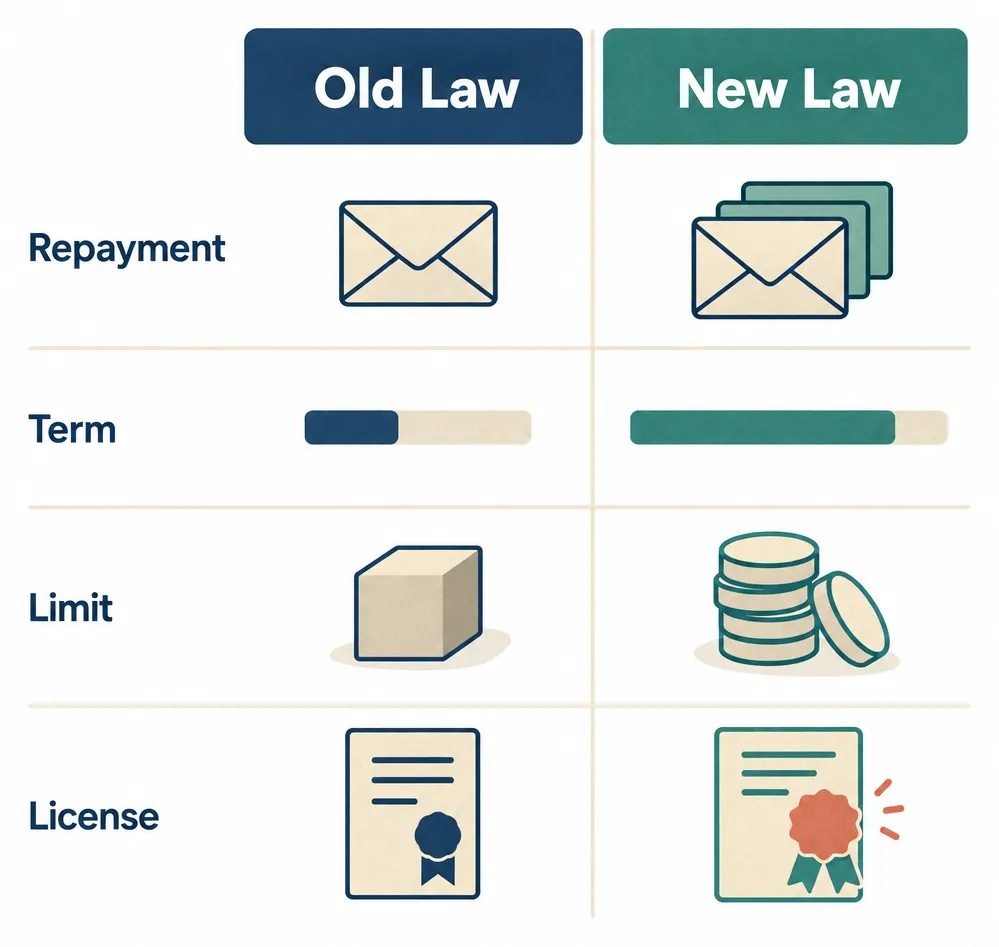
The new law replaced the single balloon payment with installments. It also replaced a limit on how many loans you could have with a dollar limit on how much you could owe, and it added a payment test tied to your income.
| Feature | Deferred Deposit Lending Act (2003 to 2020) | Oklahoma Small Lenders Act (2020 to today) |
|---|---|---|
| License | Deferred Deposit Lender | Oklahoma Small Lender (OSL) |
| Loan size | Up to $500 | Up to $1,824.60 owed in total, across all lenders |
| How you repay | One postdated check | Installments over 60 days to 12 months |
| Due date | No later than 45 days | At least 60 days, at most 12 months |
| Limit on borrowing | Number of open loans | Dollar total plus the 20%-of-income payment test |
| Price cap | Flat finance charge per loan | 17% interest per month |
How much you can borrow: the $1,824.60 cap and the 20% income test
Two limits apply at the same time, and the lower one decides how much you can borrow. First, everything you owe to all small lenders combined can’t exceed $1,824.60. Second, the payments coming due in any one month can’t exceed 20% of your gross monthly income.
Section 3150.10 of Title 59 set a base aggregate of $1,500. The Administrator of Consumer Credit adjusts it every other year for inflation. Under the department’s rules, the adjustment uses the CPI-W for Region 6, which the Bureau of Labor Statistics publishes each December.
| Effective date | Cap per borrower (all lenders) | Source |
|---|---|---|
| August 1, 2020 | $1,500 (statutory base) | 59 O.S. § 3150.10 |
| July 1, 2023 to June 30, 2025 | $1,718.25 | DoCC OSL aggregate chart |
| July 1, 2025 to present | $1,824.60 | DoCC OSL aggregate chart |
Adjustments happen every other year, so the next change to the aggregate is expected on July 1, 2027. The DoCC will publish the new figure ahead of time.
How the statewide database stops loan stacking
Before every loan, the lender must check an approved private database for what you already owe other small lenders (59 O.S. § 3150.10(C)). That check is why lenders can’t stack loans. Suppose you owe one lender $1,200. A second lender can lend you no more than $624.60, and only if the payments also pass the income test.
This answers a common question: “Why am I being denied for a second loan when I’m under $1,500?” The 20% payment test usually explains it. Your existing loan payments may already use up most of your allowed monthly total.
Worked example: what your paycheck allows
Multiply your gross monthly pay by 0.20. The result is the most that all your small-loan payments due in a month can add up to. The table shows the largest 12-month loan at the full 17% rate that fits under each payment limit.
| Gross monthly income | Max small-loan payments per month | Largest 12-month loan at 17%/month | Largest 6-month loan at 17%/month |
|---|---|---|---|
| $1,500 | $300 | About $1,497 | About $1,077 |
| $2,000 | $400 | $1,824.60 (aggregate cap applies) | About $1,436 |
| $2,500 | $500 | $1,824.60 (aggregate cap applies) | About $1,795 |
| $3,500 | $700 | $1,824.60 (aggregate cap applies) | $1,824.60 (aggregate cap applies) |
For people with lower incomes, the income test sets the limit before the dollar cap does. Choosing a shorter term means bigger payments, so you can borrow less.
Do the 20% math first
Multiply your gross monthly pay by 0.20. If a lender offers payments above that total, counting payments on loans you already have, the offer breaks 59 O.S. § 3150.10.
What a small loan really costs at 17% a month
A 17% monthly rate works out to about 204% a year (17 × 12). Disclosures usually show an APR close to 200%. That rate is legal in Oklahoma for licensed small lenders. Dollar amounts show the cost more clearly than percentages.
The table assumes equal monthly payments at the full 17% cap, with interest charged on the falling balance. Figures are rounded. Your contract may set a lower rate.
| Amount borrowed | Term | Approx. monthly payment | Total finance charge | Total repaid |
|---|---|---|---|---|
| $500 | 3 months | $226.29 | $178.86 | $678.86 |
| $500 | 6 months | $139.31 | $335.85 | $835.85 |
| $1,000 | 6 months | $278.62 | $671.70 | $1,671.70 |
| $1,000 | 12 months | $200.47 | $1,405.58 | $2,405.58 |
| $1,500 | 12 months | $300.70 | $2,108.37 | $3,608.37 |
| $1,824.60 | 12 months | $365.77 | $2,564.64 | $4,389.24 |
Here is how the math works. On a $1,000 loan, the first month’s interest is $170 (17% of $1,000). Each payment lowers the balance, so later months cost less in interest. Over 12 months you still pay about $1.41 in interest for every dollar you borrowed.
Prepaying cuts the cost sharply. Oklahoma small loans can be paid off early with no penalty. If you clear the 12-month $1,000 loan after six months, you avoid most of the remaining interest.
Prepay whenever you can
At 17% a month, paying off a month early saves real money, and Oklahoma small loans carry no prepayment penalty. Ask the lender for a written payoff amount first.
Fees lenders may and may not charge
The Small Lenders Act limits the extra charges a lender can add, with separate sections on returned-payment (NSF) fees and attorney fees. Your contract must list every fee in writing before you sign. A fee that isn’t in your contract, or that is bigger than the Act allows, is grounds for a complaint to the DoCC.
Reading the Truth in Lending box
Under the Truth in Lending Act and Regulation Z (12 CFR 1026), the lender must show four numbers before you sign: the APR, the finance charge, the amount financed and the total of payments. Compare the total of payments with the amount you’ll actually receive. That gap is what the loan costs you.
Car title loans in Oklahoma
Oklahoma has no law that authorizes high-rate car title loans of the kind sold in Texas or Missouri. Any consumer loan backed by your vehicle falls under the Oklahoma Uniform Consumer Credit Code (Title 14A). Under that code, a lender needs a supervised lender license from the DoCC and must stay within the code’s rate limits.
Those limits are far below 17% a month. Under 14A O.S. § 3-508A, annual rates are set in tiers that fall as the balance gets bigger. The Department of Consumer Credit adjusts the dollar bands for inflation. Its newest “Changes in Dollar Amounts” chart took effect July 1, 2026.
If a website offers an Oklahoma title loan at triple-digit rates, it is either unlicensed or claims to be exempt from state law. Treat that as a red flag. You could also lose the car you need to get to work.
Installment and personal loans: rate caps and licensing
Larger personal loans from finance companies are “supervised loans” under Title 14A. Section 3-508A sets the main tiered rate limits. Section 3-508B sets a separate schedule for smaller loans, with its own charges. Lenders need a supervised lender license from the Department of Consumer Credit. Banks and credit unions answer to their own banking regulators.
Online and tribal lenders in Oklahoma
The Small Lenders Act applies to small loans made to Oklahoma residents, including online loans. The DoCC publishes current rosters of licensed lenders on its website, including lenders based in other states.
Tribal lenders are the main exception lenders claim. Some online lenders say tribal sovereign immunity keeps state rate caps from applying, and Oklahoma has its own tribal lenders, such as the Otoe-Missouria Tribe’s Great Plains Lending. Courts have split on these claims. In Gingras v. Think Finance (2019), the federal Second Circuit allowed borrowers to sue tribal officials and the outside companies behind a lending operation. If something goes wrong with a lender that claims immunity, you may have few practical options.
How to verify a lender’s license in 2 minutes
How to check a lender
- Get the company’s full legal name from its loan agreement, not from its ads.
- Search the Department of Consumer Credit’s Oklahoma Small Lender rosters, or its supervised lender list for bigger loans.
- If the company gives an NMLS number, look it up on NMLS Consumer Access.
- Call the DoCC at 405-521-3653 if you can’t find the company.
- If it isn’t licensed and claims state law doesn’t apply, don’t share bank login details with it.
Other red flags: a fee charged before you get any money, pressure to pay by gift card, no physical address, or a loan above $1,824.60 called a “payday loan.”
Debt collection and wage garnishment limits in Oklahoma
Collectors must follow the federal Fair Debt Collection Practices Act and Regulation F. Your wages can be garnished only after a creditor sues you and wins a court judgment. Even then, state law protects most of your pay.
| Protection | What it says | Source |
|---|---|---|
| No jail for debt | Imprisonment for debt is prohibited | Oklahoma Constitution, Art. 2, § 13 |
| General wage exemption | 75% of earnings from the last 90 days is exempt | 31 O.S. § 1; 12 O.S. § 1171.1 |
| Consumer-loan judgments | Garnishment limited to the lesser of 25% of disposable earnings or the amount above 30 × federal minimum wage ($217.50 a week) | 14A O.S. § 5-105 |
| Hardship | You can ask the court to exempt more if garnishment would cause undue hardship for you and your dependents | 31 O.S. § 1.1 |
| Collector calls | No more than 7 calls in 7 days about a debt | 12 CFR 1006.14 |
| Old debts | Collectors can’t sue or threaten to sue once the time limit has passed | 12 CFR 1006.26 |
Can’t pay? What happens next, step by step
If you miss a payment, you’re in default under the terms of your contract. That doesn’t mean a lawsuit right away. The usual order is: a missed payment, then a failed withdrawal and a returned-payment fee, then calls and letters, then a collector, and maybe a lawsuit.
- Read your contract’s default section. It says when a missed payment counts as default and what fees apply.
- Call the lender before the due date. Ask in writing for a payment plan or a new due date. Nothing in the law forces the lender to agree, but many do.
- Watch your bank account. Under the CFPB’s rule at 12 CFR 1041.8, a lender whose withdrawal fails twice in a row must get your new authorization before it tries again. This rule has applied since March 30, 2025.
- Revoke automatic payments if you need to. Under the Electronic Fund Transfer Act and Regulation E, a lender can’t require automatic payments as a condition of a loan. You can also stop a preauthorized payment by notifying your bank at least three business days before it’s scheduled.
- Use your rights if it goes to collections. You can ask for validation of the debt and tell the collector in writing to stop contacting you.
- Don’t ignore court papers. A lender can garnish your wages only after it gets a judgment. If you skip a court hearing, the court can rule against you by default.
This also answers a common question: “The lender keeps trying to pull money from my account and I’m getting overdraft fees. Can they keep doing that?” After two failed withdrawals in a row, no. Not without your new permission.
Stopping debits is not cancelling the debt
Revoke ACH authorization in writing to the lender and send a copy to your bank. Keep bank statements that show any failed withdrawals. You still owe the loan, so offer a payment method you control.
Can you go to jail for an unpaid payday loan in Oklahoma?
No. Article 2, Section 13 of the Oklahoma Constitution prohibits jail for debt. Under the FDCPA, a collector can’t threaten arrest or criminal charges it can’t or doesn’t intend to bring. “They said they’ll press charges” is a pressure tactic, and you can report it to the DoCC and the CFPB.
How long can they come after you? The 5-year rule
Under 12 O.S. § 95, a lender has five years to sue on a written loan contract. The clock generally starts when you default. Under 12 O.S. § 101, a partial payment or a written promise to pay can restart it. Once the time limit runs out, a collector can still ask you to pay but can’t sue or threaten to sue. The debt can stay on your credit report for up to seven years under the Fair Credit Reporting Act.
Should you keep paying an old debt?
It depends on how old the debt is. For a recent debt, a written payment plan stops fees from piling up and usually prevents a lawsuit. For a debt close to five years old, check the date of your last payment before you send any money, because a payment can restart the clock.
Federal rules that apply in Oklahoma
Three federal laws protect every Oklahoma borrower. The Truth in Lending Act requires cost disclosures before you sign. The Military Lending Act (10 U.S.C. § 987) caps the military annual percentage rate at 36% for active-duty service members and their dependents, so a 200% small loan to them is illegal. The FDCPA governs third-party collectors.
What is the payday lending rule?
The CFPB’s Payday Lending Rule (12 CFR part 1041) originally required lenders to check whether borrowers could repay, but that requirement was repealed in 2020. Oklahoma’s own 20% income test still applies. The rule’s payment provisions took effect March 30, 2025. They cover the two-failed-withdrawals limit and advance notices of withdrawals.
Two days before that date, the Bureau said it wouldn’t prioritize enforcement of those provisions. The rule text itself is unchanged.
New for 2026: what changed and what didn’t
Less changed in 2026 than many “2026 guide” headlines suggest. On July 1, 2026, the DoCC published a new “Changes in Dollar Amounts” chart based on the CPI-W at the end of 2025. That chart covers figures in the Uniform Consumer Credit Code, such as the rate bands for installment loans.
The small-loan aggregate did not change in 2026. It stays at $1,824.60 until its next adjustment, expected July 1, 2027. The 17% monthly rate, the term limits and the 20% income test are written into the statute, and inflation adjustments don’t change them.
How to file a complaint against a lender
Start with the Oklahoma Department of Consumer Credit, which licenses small lenders, supervised lenders and collectors. Its phone number is 405-521-3653. You can file online, email supporting documents to [email protected], or mail them to 629 N.E. 28th Street, Oklahoma City, OK 73105, the address listed on the department’s complaint page.
You can also file with:
- The Oklahoma Attorney General’s Consumer Protection Unit, for unfair or deceptive practices under the Oklahoma Consumer Protection Act (15 O.S. § 751 et seq.).
- The Consumer Financial Protection Bureau, through its online complaint portal, for federal issues such as repeated failed withdrawals, collector abuse or Military Lending Act violations.
- The FTC’s ReportFraud site, for fake lenders and advance-fee scams.
Keep your loan agreement, the Truth in Lending disclosure, your payment receipts, bank statements showing withdrawals, and dated notes of every call.
Lower-cost options in Oklahoma
Several options cost far less than 17% a month. Some take a few days to arrange, and some have their own limits.
| Option | Typical cost | Limits | Source |
|---|---|---|---|
| Credit union Payday Alternative Loan (PAL I) | Max 28% APR, application fee up to $20 | $200 to $1,000, 1 to 6 months, membership often required | NCUA, 12 CFR 701.21(c)(7)(iii) |
| PAL II | Max 28% APR | Up to $2,000, 1 to 12 months | NCUA, 12 CFR 701.21(c)(7)(iv) |
| Hardship plan with your original creditor | Often no extra cost | Creditor decides | Your creditor |
| Nonprofit credit counseling | Free session; small monthly fee for a debt management plan | Lowers rates on cards more than on small loans | Nonprofit agency |
| Utility help (LIHEAP) through Oklahoma Human Services | Free | Income limits, seasonal | Oklahoma Human Services |
| Dial 211 | Free referrals | Local programs vary | 211 Oklahoma |
If you’re searching for debt relief in Oklahoma, be careful with settlement companies. Under the FTC’s Telemarketing Sales Rule (16 CFR 310.4(a)(5)), a company that sells debt relief by phone can’t charge fees until it has settled at least one of your debts.
Did you know?
Oklahoma small loans can be paid off early with no prepayment penalty, so every month you cut from the term saves a month of interest at up to 17%.
Before you borrow
At the full 17% monthly rate, a $1,000 loan over 12 months costs about $2,406 in total. Check the lender’s license, run the 20% income math, and ask a credit union about a PAL first.
FAQ
Are payday loans legal in Oklahoma?
Yes, but only as installment loans from lenders licensed under the Oklahoma Small Lenders Act. The two-week deferred-deposit payday loan ended on August 1, 2020.
What is the maximum payday loan amount in Oklahoma in 2026?
Your total balance with all small lenders combined can’t exceed $1,824.60, the cap in effect since July 1, 2025 under 59 O.S. § 3150.10. The 20% income test may limit you to less.
How much interest can a payday lender charge in Oklahoma? Is a 200% APR legal?
Under 59 O.S. § 3150.10, a licensed small lender can charge up to 17% a month on the first $1,500 of principal and up to 10% a month on principal above $1,500. A 17% monthly rate works out to 204% a year before compounding. So a roughly 200% APR is legal for a licensed small lender. It is illegal for a loan to a covered service member, where the Military Lending Act caps the rate at 36%.
How many payday loans can you have at once in Oklahoma?
No set number. The limits are the $1,824.60 total and the 20% monthly payment test, and lenders enforce both through the statewide database check.
How long until an old payday loan can’t be collected anymore?
Under 12 O.S. § 95, the lender has five years from default to sue on a written contract. A payment or a written promise to pay can restart the clock under 12 O.S. § 101.
Are tribal loans legal in Oklahoma?
Tribal lenders say sovereign immunity exempts them from state caps, and courts have ruled both ways. A lender that isn’t on the DoCC’s Oklahoma Small Lender rosters offers you none of the state-law protections described here.
Sources and how we checked
Under the Oklahoma Small Lenders Act, every licensed small lender has to work within the same numbers: no more than $1,824.60 owed in total across all small lenders, interest of no more than 17% a month, terms of 60 days to 12 months, and monthly payments of no more than 20% of your gross pay. If you’re offered something outside those limits, the lender is either unlicensed or breaking state law. Check its license on the Department of Consumer Credit’s rosters before you share any bank details. The figures above come from the statutes cited in each section and from the Department of Consumer Credit’s own charts and reports; the cost tables are our own math at the full 17% rate. Rules checked November 27, 2026.
Laws and regulations referenced
- Oklahoma Small Lenders Act, 59 O.S. 3150 et seq.
- Oklahoma Consumer Credit Code, 14A O.S. 3-501 (Supervised loans and supervised lenders)
- Truth in Lending Act, 15 U.S.C. 1601
- Regulation Z, 12 CFR Part 1026
- Fair Debt Collection Practices Act, 15 U.S.C. 1692
- Regulation F (debt collection), 12 CFR Part 1006
- Fair Credit Reporting Act, 15 U.S.C. 1681
- Electronic Fund Transfer Act, 15 U.S.C. 1693
- Regulation E (electronic transfers), 12 CFR Part 1005
- Military Lending Act, 10 U.S.C. 987
- CFPB payday lending rule, 12 CFR Part 1041
Links go to the official text on government sites.
Check, verify or complain
Sources
- Oklahoma Department of Consumer Credit: OSL Dollar Change Aggregate Chart, July 1, 2025 oklahoma.gov · official source
- Oklahoma Department of Consumer Credit 2024 Annual Report oklahoma.gov · official source
- DoCC Changes in Dollar Amounts, July 1, 2026 oklahoma.gov · official source
- DoCC Small Lender 2025 Annual Report Form oklahoma.gov · official source
- DoCC roster of Oklahoma Small Lenders outside Oklahoma, October 22, 2026 oklahoma.gov · official source
- Oklahoma Small Lender License Application (DoCC) oklahoma.gov · official source
- Oklahoma Department of Consumer Credit: Complaints oklahoma.gov · official source
- DoCC: Submit a Complaint oklahoma.gov · official source
- Oklahoma SB 720 (2019-2020), engrossed oklegislature.gov · official source
- Oklahoma Statutes Title 14A, Consumer Credit Code oklegislature.gov · official source
- OSCN: Oklahoma Small Lenders Act, Short Title oscn.net · official source
- CFPB: What can I do if I can't repay my payday loan? consumerfinance.gov · official source
- CFPB's 2026 Regulatory Agenda Tees Up NPRM to Reconsider Payday Lending Rule natlawreview.com
- CFPB Plans Limited Enforcement of Payday Lending Rule natlawreview.com
- NCLC: Rule on bounced payday and high-cost loan payments now in effect library.nclc.org
- Hudson Cook: Oklahoma Enacts Small Lenders Act hudsoncook.com
- 59 O.S. § 3150.10 (Justia) law.justia.com
- Oklahoma Administrative Code 160:20-1-20 regulations.justia.com
- 59 O.S. § 3104 (Justia) law.justia.com
- 12 O.S. § 95 (Justia 2024) law.justia.com
- CFPB Releases 2026 Regulatory Agenda consumerfinancialserviceslawmonitor.com
- CFPB Payday Rule Relief Is Not a Repeal fintechlaw.ai
- OK Policy: Installment loans not the answer to financial hardship okpolicy.org
- Bell Finance: Oklahoma Loan Regulations bell-finance.com

Elena writes about getting through a money emergency, assistance programs, budgeting on a tight income, banking basics and borrower rights. Her guides list the cheaper options first and link the agency or program that can actually help.
Ruth is US Financer's standards editor. Every article goes through her checks before and after it is published: each rate, fee, cap, deadline and rule is matched against its primary source, every law named is linked to its official text, and anything that cannot be…
What changed
- Nov 27, 2026 First published.
Comments are closed