

General information, not legal advice. Laws change, so confirm with the official statute, your state regulator or a licensed attorney before you act.
Payday lending is legal in Kansas, but only within limits set by K.S.A. 16a-2-404. A licensed lender can advance no more than $500 for 7 to 30 days and can charge a fee of no more than 15% of the amount advanced. On a $100 loan due in 14 days, the state’s banking regulator calculates that fee at about 391% APR, which is ten times the 36% cap that now applies to most other Kansas consumer installment loans.
Run the numbers
Your money, in brief
- A Kansas payday loan tops out at $500, with a fee of no more than 15% ($75 on $500) and a term of 7 to 30 days.
- You can’t have more than two payday loans open with one lender, or take more than three from that lender in 30 days.
- After the due date, the lender can add only 3% a month plus one bounced-check fee. Nothing else.
- To get the extended payment plan, you have to ask before close of business on the last business day before the due date and sign an amendment to the loan agreement.
- Not repaying is a civil debt, not a crime. A lender generally has five years to sue on a written contract.
This guide explains Kansas law as of November 2026. It is general information, not legal advice. If you’ve been sued or served, contact Kansas Legal Services (316-267-3975) or a Kansas attorney.
Fact-checked
We checked these key facts against the sources named, on November 28, 2026:
- That law, 1993 HB 2197, took effect April 8, 1993 (source: klrd.gov)
- If you pay $15 on $100 for the 7-day minimum term, the APR is about 782% (source: ksrevisor.gov)
- 2024: HB 2247 set a flat 36% cap on supervised consumer loans from January 1, 2025 (source: reinhartlaw.com)
- The old tiered rate (36% up to $860, 21% above) became a flat 36%, effective January 1, 2025 (source: reinhartlaw.com)
- Its 2026 regulatory agenda, released in July 2026, planned a proposal to reconsider the rule (source: consumerfinancemonitor.com)
Kansas payday loan laws at a glance (2026)
Kansas regulates payday loans under one section of the Kansas Uniform Consumer Credit Code (UCCC): K.S.A. 16a-2-404. The table summarizes the 2026 Kansas Statutes edition, last checked November 2026. The 2024 Legislature last amended the section (L. 2024, ch. 6, effective January 1, 2025), and the 2026 Statutes carry that text unchanged.
| Rule | What Kansas law says | K.S.A. 16a-2-404 subsection |
|---|---|---|
| Loan size | Cash advance of $500 or less, one anticipated repayment | (1) |
| Maximum fee | 15% of the amount advanced | (1) |
| Term | At least 7 days, no more than 30 days | (2) |
| Loans outstanding | No more than 2 at once with the same lender and its related interests | (3) |
| Loan frequency | No more than 3 loans to one borrower in 30 calendar days | (3) |
| Record keeping | Lender must keep a journal of each borrower’s loans | (3) |
| Required notice | Bold “Notice to Borrower” in English and Spanish, signed or initialed by you | (4) |
| After maturity | Up to 3% per month; no insurance or other charges, including check-cashing fees | (5) |
| Rollovers | A loan can’t be repaid with another payday loan from the same lender or related interest | (6) |
| Hardship option | Extended payment plan once every 12 months, at least 4 installments | (7) |
Is payday lending legal in Kansas?
Yes. Kansas allows payday loans from lenders licensed under the UCCC, subject to the caps above. Kansas was one of the first states to pass a law written specifically for payday lending. That law, 1993 HB 2197, took effect April 8, 1993. Every reform bill that would have capped payday loans at 36% has failed since then.
Who regulates payday lenders in Kansas
The Office of the State Bank Commissioner (OSBC) licenses and examines payday lenders. Its Deputy Commissioner for Consumer and Mortgage Lending oversees UCCC lenders. Licensing runs through the Nationwide Multistate Licensing System (NMLS), so you can look up any lender’s status yourself. The Kansas Attorney General enforces the state’s consumer protection laws and also takes complaints.
What a Kansas payday loan can cost you
The most a Kansas payday lender can charge is a fee of 15% of the amount you borrow. On $500 that is $75. The fee looks small in dollars, but because the term is so short it works out to a very high annual rate.
The 15% fee and what it means as an APR
According to the OSBC’s consumer FAQ, a 15% fee on a $100 loan with a 14-day term equals roughly 391% APR. The math works like this. Divide the $15 fee by the $100 borrowed to get 15%. That 15% covers 14 days, and a year has about 26 periods of 14 days (365 ÷ 14 = 26.07). Multiply 15% by 26.07 and you get about 391%.
The shorter the term, the higher the APR for the same dollar fee. If you pay $15 on $100 for the 7-day minimum term, the APR is about 782%. Stretch the loan to the 30-day maximum and it drops to about 183%. Either way, you pay the same $15. The Truth in Lending Act requires the lender to show you the APR before you sign, so check it against these figures.
| Amount borrowed | Max fee (15%) | APR if 14-day term | Amount due at maturity | Extra cost per month after maturity (3%) |
|---|---|---|---|---|
| $100 | $15 | About 391% | $115 | $3 |
| $300 | $45 | About 391% | $345 | $9 |
| $500 | $75 | About 391% | $575 | $15 |
What happens to the cost after the due date
Once the loan matures, K.S.A. 16a-2-404(5) caps the contract rate at 3% per month of the loan proceeds. The OSBC adds that the lender may also charge one fee for a returned check or failed payment (an NSF fee). Kansas Legal Services gives this example: if a $300 payday loan goes unpaid at maturity, the lender can charge $9 every month until it is paid in full.
Here is how that adds up. You borrow $300, owe $345 on the due date, and can’t pay. Six months later, you would owe the $345 plus $54 in post-maturity charges, plus one NSF fee if your check or debit bounced. That growth is far slower than paying a new $45 fee every two weeks, which is why the law bans renewals.
Fees that are illegal on a Kansas payday loan
Under subsection (5), a payday lender can’t add insurance charges or “other charges of any kind.” That includes fees for cashing the check the lender gave you as loan proceeds. The lender also can’t split one loan into several smaller ones to collect more fees, a practice the required notice warns against.
Work out the late cost yourself
Take 3% of the amount you originally borrowed. That is the most the lender can add each month after the due date. On $300 that is $9 a month. You can avoid it completely by asking for the extended payment plan before close of business on the last business day before your due date.
Limits on how many loans you can have
A Kansas lender can’t make you more than three payday loans in 30 days, and you can’t have more than two open with it at once. The limits apply to the lender together with its “related interests,” which means a company can’t get around them by sending you to an affiliated storefront or website.
The two-loan and three-in-30-days rules
Both limits are in K.S.A. 16a-2-404(3). The lender has to keep a journal of every loan it makes to you so OSBC examiners can check the limits. The statute gives “related interest” the same meaning as “person related to” in K.S.A. 16a-1-301, the UCCC’s definitions section. The two-loan limit came from 2001 HB 2193, which the Deputy Commissioner for Consumer and Mortgage Lending requested after seeing borrowers carry several loans at once.
The limits have a gap. They apply per lender and its related interests, not statewide, and Kansas law sets up no statewide payday database. So if you have loans from three different, unrelated payday companies, each of those loans can be legal. If that is your situation, the extended payment plan and the refinance programs covered below are the practical way out. You can ask each lender separately for its own plan.
The Notice to Borrower you must sign
Every Kansas payday agreement must include a Notice to Borrower in at least 10-point bold type, under K.S.A. 16a-2-404(4). It opens with this sentence, and you should find it word for word in your agreement:
NOTICE TO BORROWER: KANSAS LAW PROHIBITS THIS LENDER AND THEIR RELATED INTEREST FROM HAVING MORE THAN TWO LOANS OUTSTANDING TO YOU AT ANY ONE TIME.
The notice goes on to say that the lender cannot divide the amount you want to borrow into several loans to increase your fees. Before the loan closes, the lender must give you the notice in both English and Spanish. You sign or initial next to the English version, or next to the Spanish version if you tell the lender you read Spanish better than English. If the wording is different, missing or unsigned, the agreement doesn’t meet subsection (4).
Why Kansas has no “rollover” option, and the workaround lenders use
Kansas bans repaying a payday loan with the proceeds of another payday loan from the same lender or a related interest (K.S.A. 16a-2-404(6)). That rule rules out a true rollover, where you pay only the fee and the loan is extended for another $45 or $75.
Some borrowers still find that a lender takes the fee and “renews” the loan every two weeks. In practice that can mean paying off a loan and taking a new one minutes later. Whether that is legal depends on the facts. If the new money is used to pay off the old loan, it falls under subsection (6). If it puts you over three loans in 30 days, it breaks subsection (3). Ask the lender in writing whether a “renewal” is a new loan, and keep its answer for a complaint.
The extended payment plan: your right if you can’t repay
If you can’t repay a Kansas payday loan when it is due, K.S.A. 16a-2-404(7) lets you choose an extended payment plan once every 12 months. You must ask before close of business on the last business day before the due date and sign an amendment to your loan agreement. The plan splits the balance into at least four roughly equal installments with no extra interest or fees while you stay current.
Who can use it, and the deadline that matters
Any borrower who can’t repay a payday loan as agreed can elect the plan. The choice is yours, not the lender’s, but the statute sets two conditions in subsection (7)(a):
- Timing: you have to request the plan before close of business on the last business day before the loan’s due date. Asking on the due date itself is too late.
- Paperwork: you have to sign an amendment to the original loan agreement that sets out the plan terms.
Here is a worked example. Your loan is due Monday, December 14, 2026. The last business day before that is Friday, December 11, so your request has to reach the lender before it closes that Friday. Storefront hours vary and some open on Saturdays, so don’t count on a weekend. Make the request by Thursday or Friday and ask the lender to confirm its closing time.
The lender has to make the plan visible. Under subsection (7), it must prominently display that extended payment plans are available where it makes loans, and disclose the plans in the payday loan agreement.
The once-every-12-months limit
You can use a plan once every 12 months with each lender. The statute measures the 12 months from the date you paid off your last plan with that lender in full, not from the date that plan started. If you finished paying a plan on March 15, 2026, you can enter a new one with the same lender on or after March 15, 2027. Ask the lender to confirm in writing the date it recorded your last plan as paid in full.
How the payments work
The plan must let you repay the outstanding loan, including any fee due, in at least four substantially equal installments. Under subsection (7)(b), each installment must fall on or after a day you receive regular income, such as a payday. If you have no regular income, the due dates must be at least two weeks apart. Prepayment is allowed at any time with no penalty.
| Item | Example: $300 loan |
|---|---|
| Balance at due date (loan plus 15% fee) | $345 |
| Minimum number of installments | 4 |
| Each installment | About $86.25 |
| Installment dates if paid every other Friday | On or after each of your next four paydays |
| Installment dates with no regular income | At least two weeks apart |
| Added interest or fees while current | $0 |
| Total repaid | $345 |
How to elect the extended payment plan
- Find your due date on the agreement and work out the last business day before it.
- Before the lender closes on that day, tell it in writing (email, letter or its online message system) that you elect the extended payment plan under K.S.A. 16a-2-404(7). Keep a copy with the date and time.
- Ask for the amendment to your loan agreement, read it, and sign it. The plan isn’t in place until you do.
- Check that the amendment shows at least four roughly equal payments, dated on or after your paydays, with no new fees or interest.
- Keep a signed copy of the amendment and pay each installment on time. Pay extra whenever you can, since prepayment is free.
A short written request can read: “My name is [Your full name], loan number [Account number]. I am unable to repay my payday loan due [Due date], and I elect the extended payment plan under K.S.A. 16a-2-404(7). Please send me the amendment to my loan agreement to sign, with at least four substantially equal installments due on or after my paydays, which are [Your pay dates], and no additional fees or interest. Date: [Date].”
What the lender can and can’t do during the plan
The lender can’t charge added interest or fees while you are current, and it can’t make you a new payday loan until the plan is finished. If you miss an installment, the lender may accelerate the debt, meaning the whole remaining balance becomes due at once. From then on, the post-maturity rules apply. If the lender refuses a plan you asked for on time, or adds fees, attach your dated request to an OSBC complaint.
What happens if you don’t pay a payday loan in Kansas
An unpaid payday loan becomes an ordinary civil debt. The lender can add 3% a month and one NSF fee, try to collect, and sue. If it wins a judgment, it can garnish part of your wages. It has five years from a missed payment on a written contract to file suit.
If you can’t pay on the due date and haven’t elected a plan, this is the usual sequence:
- Due date: the lender tries your check or bank debit. If it fails, one NSF fee can be added.
- After maturity: up to 3% a month on the amount advanced starts building.
- Collection: calls and letters from the lender, or from a collection agency it hires or sells the debt to.
- Lawsuit: the lender or debt buyer can sue in Kansas district court, usually in the limited actions division for small claims.
- Judgment and garnishment: if you lose or don’t respond, the court can order wages or bank funds garnished.
If you keep paying every month and the balance isn’t falling, the 3% monthly charge is often the reason. Ask for a payoff statement that splits principal from charges.
Can you go to jail for an unpaid payday loan?
No. Kansas treats failing to repay a loan as a civil matter, and a court can’t jail you for it. The Fair Debt Collection Practices Act bars debt collectors from threatening arrest or other action they can’t legally take or don’t intend to take (15 U.S.C. 1692e). A collector who says you will be arrested over a payday debt is breaking federal law. Report it.
The one way a court becomes involved is if you ignore a court order, such as a summons to a hearing on your assets. Go to every court date, even if you can’t pay.
How long a lender can sue you in Kansas
Under K.S.A. 60-511(1), a lawsuit on a written agreement must be filed within five years. Payday loans are written contracts, so this deadline normally applies. Paying part of the debt can restart the clock in some cases, so get legal advice before you make a payment on a very old debt.
A judgment lasts longer than that. Under K.S.A. 60-2403, a Kansas judgment becomes dormant only if, within five years, the creditor neither files a renewal affidavit nor issues an execution such as a garnishment. Each of those steps restarts the five years, so a creditor that keeps acting can enforce a judgment for many years.
Lawsuits, judgments and garnishment
Under K.S.A. 60-2310, a creditor can garnish no more than the lesser of 25% of your weekly disposable earnings or the amount above 30 times the federal minimum hourly wage. At $7.25 an hour, the federal minimum, that protected amount is $217.50 a week. A 2026 bill to rewrite this section, SB 323, died in committee on April 10, 2026, so the current limits stand.
| Weekly disposable earnings | 25% of earnings | Amount above $217.50 | Most that can be garnished |
|---|---|---|---|
| $250 | $62.50 | $32.50 | $32.50 |
| $400 | $100.00 | $182.50 | $100.00 |
| $600 | $150.00 | $382.50 | $150.00 |
Federal benefits such as Social Security get separate protection. Under the Treasury rule at 31 CFR part 212, a bank must protect two months of directly deposited federal benefits from garnishment.
Payday loans and bankruptcy
Payday loans are unsecured debt, so they can generally be wiped out in bankruptcy like credit card balances. A lender may challenge cash advances taken shortly before you file. Bankruptcy has real costs and stays on your credit report for years, so talk to Kansas Legal Services or a nonprofit credit counselor first.
Online and out-of-state payday lenders
An online lender that makes payday loans to people in Kansas has to follow Kansas law and hold an OSBC license, the same as a storefront. Lenders that claim tribal immunity or an offshore base often say state law doesn’t apply to them. If such a lender has no Kansas license, report it to the OSBC before you pay anything more.
How to verify a lender’s license
The OSBC licenses payday lenders through NMLS and lets you check a lender’s status as Active, Inactive or Pending.
How to check a Kansas lender
- Get the lender’s full legal name and NMLS number from its agreement or website footer.
- Search the name or number in NMLS Consumer Access, or in OSBC Online.
- Confirm the license shows Kansas, the right license type and an Active status.
- Match the address and company name to the one on your loan agreement.
- If the license is missing, inactive or doesn’t match, don’t borrow or hand over bank access, and contact the OSBC.
Warning signs of an unlicensed lender
These are the red flags that most often mark an unlicensed lender:
- No NMLS number, or one that doesn’t match a Kansas license.
- A fee above 15%, a loan over $500 or a term longer than 30 days on a “payday” product.
- An offer to let you pay only the fee and renew automatically.
- No Notice to Borrower in English and Spanish.
- A demand for an upfront “insurance” or “processing” fee before the money is sent. That is a classic advance-fee scam.
- Claims that tribal or offshore status means Kansas rules don’t apply.
Payday loans vs. other Kansas small loans
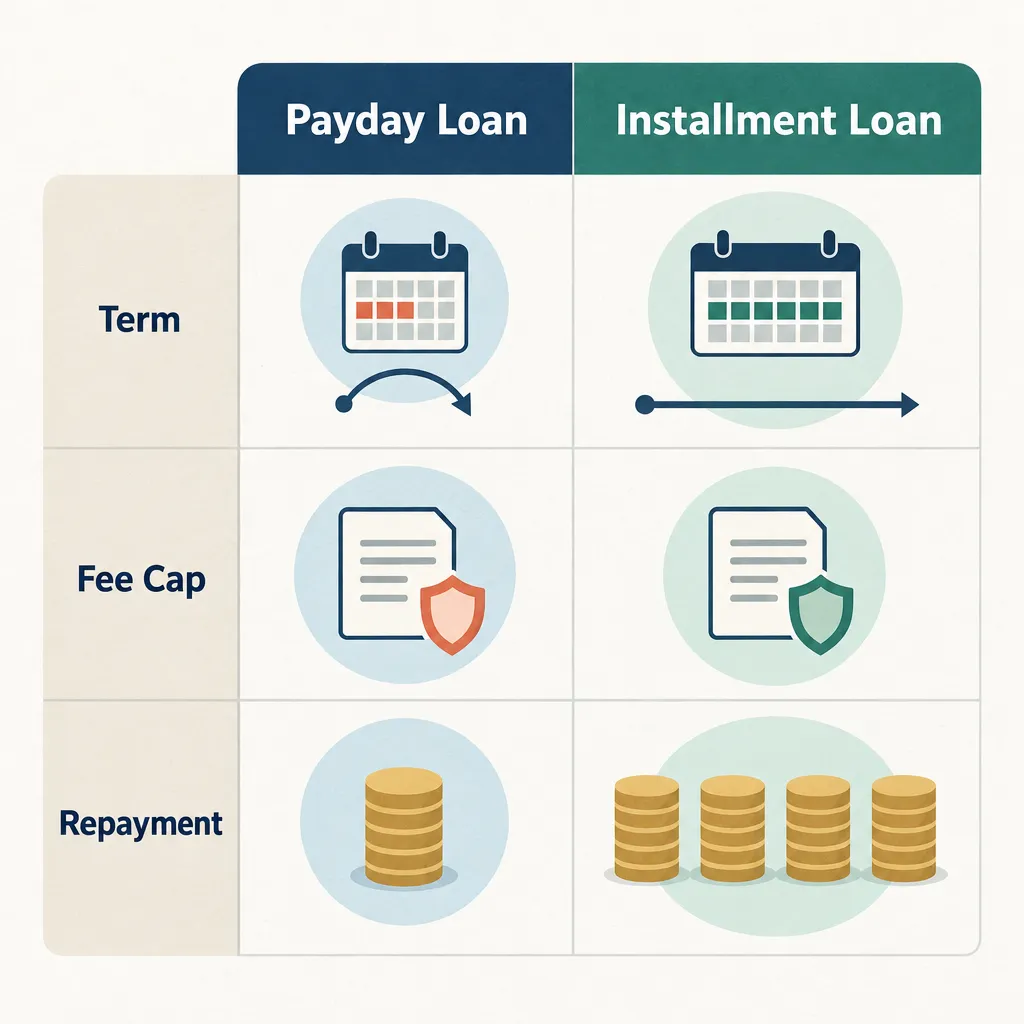
Kansas has different rules for different loan types, and payday rules don’t apply to installment or title loans. Since January 1, 2025, most closed-end consumer loans from supervised lenders are capped at a flat 36% APR. Payday loans stay at the 15% fee, and car title loans built as open-end credit have no set rate cap.
The 2025 flat 36% cap and why it doesn’t cover payday loans
HB 2247, signed March 29, 2024, changed the finance charge on supervised-lender consumer loans under K.S.A. 16a-2-401. The old tiered rate (36% up to $860, 21% above) became a flat 36%, effective January 1, 2025. The same law limits supervised loans of $1,000 or less to a maximum term of 25 months. It also extends the ban on false or misleading loan ads to everyone, not only licensed lenders. HB 2247 also amended the payday section, but the 15% fee, the $500 limit and the 7-to-30-day term are all still in the 2026 text of 16a-2-404.
Car title loans in Kansas
Kansas has no statute written specifically for vehicle title loans. Testimony from the Pew Charitable Trusts on 2021 HB 2189 described Kansas as the only state where title lenders operate exclusively under the open-end credit rules. Under the current K.S.A. 16a-2-401, a supervised lender can charge any finance charge the parties agree to on open-end credit, with limits only on prepaid charges. Title lenders still need an OSBC supervised-lender license, but in practice no APR ceiling applies. Because the loan is secured by your car, missing payments can mean losing it.
How to tell which law your loan falls under
Look at the agreement. A single repayment of $500 or less within 30 days is a payday loan. A fixed schedule of payments is a closed-end installment loan. A credit line with a revolving balance, often secured by a car title, is open-end credit.
| Feature | Payday loan (16a-2-404) | Supervised-lender consumer loan (post-HB 2247) | Federal overlay (CFPB rule / MLA) |
|---|---|---|---|
| Price limit | 15% fee on amount advanced | Flat 36% APR (closed-end) | 36% MAPR for covered service members |
| Size or term | $500 max, 7 to 30 days | 25-month max term if $1,000 or less | No size limit |
| Renewals | Can’t repay with another loan from same lender | Refinancing allowed under UCCC rules | MLA bars many same-creditor rollovers |
| Hardship right | Extended payment plan once per 12 months | No payday-style plan in statute | Payment-withdrawal limits under 12 CFR part 1041 |
| License | OSBC | OSBC | Federal rules apply on top of state license |
Federal rules that also apply in Kansas
Three federal laws cover payday borrowers everywhere, including Kansas. The Truth in Lending Act and Regulation Z (12 CFR 1026) require the lender to disclose the APR and finance charge before you sign. The Fair Debt Collection Practices Act limits how third-party collectors treat you. The Military Lending Act protects active-duty service members.
What the CFPB payday rule does today
The surviving payment provisions of the CFPB Payday Lending Rule (12 CFR part 1041) took effect March 30, 2025. After two failed attempts in a row to withdraw a payment from your account, a lender needs your new authorization before trying again. It must also send notices before certain withdrawals. On March 28, 2025, two days before the effective date, the CFPB said it would not prioritize enforcement or supervision of these provisions. Its 2026 regulatory agenda, released in July 2026, planned a proposal to reconsider the rule. As of mid-October 2026 none had been published, and the rule remains on the books. State regulators and attorneys general, including Kansas’s, can still enforce it.
Military Lending Act protections
If you are on active duty, or a covered spouse or dependent, the Military Lending Act caps the military annual percentage rate on payday loans at 36%. That rate counts most fees, and the law bars mandatory arbitration. In practice, a standard Kansas payday loan at a 15% fee can’t legally be made to you.
How to file a complaint against a Kansas payday lender
Start with the OSBC for licensing or statute problems. Use the Kansas Attorney General for deceptive practices, and the CFPB for federal issues or collectors. Include your loan agreement, payment records, any written requests you sent, and dates.
| Problem | Agency or organization | How to reach them |
|---|---|---|
| Fee over 15%, too many loans, no plan offered, unlicensed lender | Office of the State Bank Commissioner (OSBC) | Consumer Assistance Form on the OSBC website |
| Deceptive or abusive business conduct | Kansas Attorney General, Consumer Protection Division | Online complaint center |
| Collector threats, bank-withdrawal problems, federal violations | Consumer Financial Protection Bureau (CFPB) | Complaint portal at consumerfinance.gov |
| Lawsuit, garnishment, bankruptcy questions | Kansas Legal Services | 316-267-3975 |
| Refinancing payday or title debt | Catholic Charities of Northeast Kansas, Kansas Loan Pool Project | (913) 433-2050 |
Filing with the OSBC
The OSBC’s Consumer Assistance Form is the right place for violations of K.S.A. 16a-2-404, because the OSBC holds the lender’s license. Name the subsection you believe was broken. For example, say the lender refused a subsection (7) payment plan you requested before the deadline, and attach the dated request.
Check your paperwork
Look for the bilingual Notice to Borrower with your initials in your loan agreement. If it is missing, say so in your OSBC complaint, because subsection (4) makes it mandatory.
Filing with the Kansas Attorney General
The Attorney General’s Consumer Protection Division handles complaints about deceptive or unconscionable conduct under the Kansas Consumer Protection Act. It is a good second filing for scam lenders and fake collectors.
Free legal help
Kansas Legal Services offers free civil legal help to eligible low-income Kansans, including help with debt lawsuits and garnishment. Call 316-267-3975. If you have been sued, call right away: you usually have only a short window to respond to the summons.
Ways out of payday debt in Kansas
The cheapest way out is usually the extended payment plan you already have a right to. After that, a refinance at a far lower rate, a credit union alternative loan or free counseling can help. Each of them costs a fraction of a payday loan’s fee.
Cheaper options first
Federal credit union Payday Alternative Loans run $200 to $1,000 (PAL I) or up to $2,000 (PAL II), with APR capped at 28% and an application fee of $20 at most.
The Kansas Loan Pool Project refinances payday and title debt through partner banks, with coaching.
Nonprofit credit counseling can build a budget and talk to creditors at little or no cost.
| Option | Cost | Best fit | Main limit |
|---|---|---|---|
| Extended payment plan | No added interest or fees while current | One payday loan you can repay in four installments | Must be requested before close of business on the last business day before the due date; once per 12 months per lender |
| Kansas Loan Pool Project | Lower-interest loan from a community bank partner | Several payday or title loans totaling $1,500 or less | Requires stable income and case management |
| Credit union PAL | APR capped at 28%, application fee up to $20 | Credit union members who need $200 to $2,000 | Only at federal credit unions that offer them |
| Nonprofit credit counseling | Little or no cost | Several debts beyond payday loans | Check nonprofit status and fees in writing |
- Extended payment plan: at least four fee-free installments under K.S.A. 16a-2-404(7).
- Kansas Loan Pool Project: run by Catholic Charities of Northeast Kansas, it pays off payday and title loans and replaces them with lower-interest loans from community bank partners. It pairs each participant with a case manager and a financial education series. Its current page sets a $1,500 limit on total payday or title debt and requires stable income.
- Credit union PALs: under NCUA rules, PAL I loans run one to six months and PAL II loans up to 12 months. If you already belong to a federal credit union, ask whether it offers a PAL that could pay off your payday balance.
- Nonprofit credit counseling: an agency can review your budget and creditors. Check that it is a nonprofit and ask about fees in writing.
How Kansas payday law got here
Kansas has regulated payday loans for more than 30 years, and the core price rules have barely moved. Reform attempts have repeatedly stalled, so the 15% fee from the 1990s is still the law. The Kansas Legislative Research Department (KLRD) summarizes the history:
- 1991: Before any regulation, APRs on these loans ranged from 600% to 1,600%, and the Attorney General shut down unregulated lenders.
- 1992: A payday bill died after a House member warned it would raise the rate “tenfold from 36 percent to 360 percent.”
- 1993: HB 2197 created the payday statute, effective April 8, 1993.
- 1999: SB 272, a 36% reform bill, did not pass.
- 2001: HB 2193 added the two-loan limit and the Notice to Borrower.
- 2021: HB 2189 would have capped rates at 36% and allowed installments up to $2,500. It did not pass.
- 2024: HB 2247 set a flat 36% cap on supervised consumer loans from January 1, 2025. It amended the payday section too, but payday loans kept their 15% fee.
Did you know?
According to the history note in the 2026 Kansas Statutes, K.S.A. 16a-2-404 has been amended in 1999, 2001, 2004, 2005 and 2024 since it was enacted in 1993, and the 2024 change took effect January 1, 2025.
Before you borrow, and what to do next
Before you borrow
A Kansas payday loan can legally cost about 391% APR. The law limits loans per lender, not statewide, so you can still end up with several loans at once. If you already owe, ask in writing for the extended payment plan before close of business on the last business day before your due date, and sign the amendment.
If you don’t owe anything yet, check a credit union PAL or the Kansas Loan Pool Project before you visit a payday lender. If you already owe, put your due date and the last business day before it in your phone calendar today, so you can still use the plan the law gives you.
FAQ
Can you get in trouble for not paying back a payday loan in Kansas?
You can’t be arrested or jailed for an unpaid payday loan. It is a civil debt. The lender can add up to 3% a month and one NSF fee, send the account to collections, and sue you. A judgment can lead to garnishment. A collector threatening jail violates the Fair Debt Collection Practices Act.
How long can a payday lender come after you in Kansas?
A lender generally has five years to sue on a written loan agreement under K.S.A. 60-511(1). A partial payment on an old debt can restart that clock in some cases, so get legal advice first. If the lender wins a judgment, the five-year limit no longer applies, and the judgment can be kept alive for years through renewal affidavits or garnishment under K.S.A. 60-2403.
What is the payday lending rule?
The CFPB’s Payday Lending Rule is 12 CFR part 1041. Only its payment provisions survive, and they took effect March 30, 2025. After two failed withdrawals in a row, a lender needs your new authorization before trying again, and it must send notices before certain withdrawals. The CFPB has said it won’t prioritize enforcement, but the rule remains in force and state regulators can enforce it.
How much can a payday lender charge in Kansas?
Up to 15% of the amount advanced under K.S.A. 16a-2-404(1), which is $75 on a $500 loan. After the due date, the lender can add no more than 3% per month and one returned-payment fee. Insurance, check-cashing and other fees are banned.
How many payday loans can you have at once in Kansas?
No more than two open loans with the same lender and its related interests, and no more than three loans from that lender in 30 days. Unrelated lenders each have their own limit, because Kansas has no statewide payday database.
When do you have to ask for an extended payment plan?
Before close of business on the last business day before the loan’s due date, under K.S.A. 16a-2-404(7)(a). You also have to sign an amendment to the loan agreement that sets out the plan. If you ask on the due date itself, the lender doesn’t have to agree.
Does Kansas allow payday loan rollovers?
No. K.S.A. 16a-2-404(6) bars repaying a payday loan with another payday loan from the same lender or a related interest. If you can’t pay, the legal route is the extended payment plan in subsection (7).
Can a payday lender garnish my wages in Kansas?
Only after suing you and winning a court judgment. K.S.A. 60-2310 then limits garnishment to the lesser of 25% of weekly disposable earnings or the amount above $217.50 (30 times the $7.25 federal minimum wage).
Which states have banned payday loans?
Several states ban high-cost payday loans outright or cap them at about 36%, which ends storefront payday lending. They include New York, New Jersey, Pennsylvania, Georgia, North Carolina, Arkansas, Colorado, South Dakota, Nebraska and Illinois. Kansas allows payday loans with the limits described above. If you have moved here from another state, compare the rules, because Kansas is among the more permissive states.
This guide is checked against the 2026 Kansas Statutes and the Revisor of Statutes text of K.S.A. 16a-2-404, 16a-2-401, 60-511, 60-2310 and 60-2403, the 2024 session law for HB 2247, the OSBC’s consumer pages, Kansas Legal Services, the KLRD and CFPB rule records. Last checked November 28, 2026.
Laws and regulations referenced
- Kansas Statutes Annotated 16a-2-404 (Payday Loans; Finance Charges; Rights and Duties)
- Truth in Lending Act, 15 U.S.C. 1601
- Regulation Z, 12 CFR Part 1026
- Fair Debt Collection Practices Act, 15 U.S.C. 1692
- Military Lending Act, 10 U.S.C. 987
- CFPB payday lending rule, 12 CFR Part 1041
Links go to the official text on government sites.
Check, verify or complain
Sources
- 2026 Kansas Statutes, K.S.A. 16a-2-404 kslegislature.gov · official source
- K.S.A. 16a-2-404, Kansas Office of Revisor of Statutes ksrevisor.gov · official source
- K.S.A. 16a-2-401, Kansas Office of Revisor of Statutes ksrevisor.gov · official source
- OSBC consumer FAQ on payday loans osbckansas.gov · official source
- OSBC Consumers page osbckansas.gov · official source
- Kansas Legislature: HB 2247 (2023-24) kslegislature.gov · official source
- K.S.A. 60-511, Kansas Office of Revisor of Statutes ksrevisor.gov · official source
- K.S.A. 60-2310, Kansas Office of Revisor of Statutes ksrevisor.gov · official source
- Kansas Legislature: SB 323 (2025-26) kslegislature.gov · official source
- KLRD: Payday Loan Regulation and Update on Small Dollar Lending in Kansas klrd.gov · official source
- OSBC testimony – Payday Lending under the UCCC (2021) kslegislature.gov · official source
- Kansas Legal Services: Avoid the Payday Lender Trap kansaslegalservices.org
- Kansas Changes Consumer Credit Code Impacting Finance Companies January 1, 2025 reinhartlaw.com
- NCLC: Rule on bounced payday and high-cost loan payments now in effect library.nclc.org
- CFPB payday rule non-prioritization is not a repeal fintechlaw.ai
- Pew testimony on Kansas HB 2189 (2021) pew.org
- Catholic Charities of Northeast Kansas: Kansas Loan Pool Project catholiccharitiesks.org
- CFPB's 2026 Regulatory Agenda Tees Up NPRM on Payday Rule legal500.com
- Catholic Charities – Kansas Loan Pool Project catholiccharitiesks.org
- KCUR – Kansas coalition pushes payday loan reform kcur.org

Elena writes about getting through a money emergency, assistance programs, budgeting on a tight income, banking basics and borrower rights. Her guides list the cheaper options first and link the agency or program that can actually help.
Ruth is US Financer's standards editor. Every article goes through her checks before and after it is published: each rate, fee, cap, deadline and rule is matched against its primary source, every law named is linked to its official text, and anything that cannot be…
What changed
- Nov 28, 2026 First published.
Comments are closed