


General information, not legal advice. Laws change, so confirm with the official statute, your state regulator or a licensed attorney before you act.
No Massachusetts law bans payday lending by name, but the Division of Banks says the typical payday loan is illegal in the state because its APR is far too high. Any lender making consumer loans of $6,000 or less at more than 12% a year needs a state small loan license. Licensed lenders can charge at most 23% a year plus a one-time $20 fee. All rules below were checked as of November 24, 2026.
Run the numbers
Key takeaways
- Loans of $6,000 or less above 12% a year need a Division of Banks small loan license (M.G.L. c. 140, §§ 96–114A).
- Licensed small lenders may charge up to 23% a year plus a $20 fee, once per borrower every 12 months (209 CMR 26.01).
- Above 20% a year, a lender can also face criminal usury charges unless it has filed notice with the Attorney General (M.G.L. c. 271, § 49).
- The Division of Banks says loans made without the required license are void and collecting on them is illegal.
- You can stop automatic withdrawals through your bank, and owing a debt is never grounds for arrest.
What this guide covers. Already have a loan? Skip to “Already took out a payday loan? What to do now,” then read the sections on stopping debits, felony threats and wage garnishment. Still deciding whether to borrow? Read the sections in this order:
- Are payday loans legal in Massachusetts?
- Massachusetts payday loan laws in plain English
- What a licensed Massachusetts small lender may and may not charge
- Payday loan vs. legal Massachusetts small loan: the cost gap
- Online, tribal and “rent-a-bank” lenders
- Already took out a payday loan? What to do now
- Can you get in trouble for not paying a payday loan in Massachusetts?
- Car title loans in Massachusetts
- Cash advance and earned wage access apps in Massachusetts
- Enforcement timeline: what Massachusetts has done to illegal lenders
- Legal alternatives when you need cash fast in Massachusetts
- Federal rules that apply everywhere
- Massachusetts vs. neighboring states, and which states ban payday loans
- FAQ
Fact-checked
We checked these key facts against the sources named, on November 24, 2026:
- DOB treats an unlicensed loan over 12% on $6,000 or less as void (source: mass.gov)
- Licensed lenders can charge at most 23% a year plus a one-time $20 fee (source: mass.gov)
- Any lender making consumer loans of $6,000 or less at more than 12% a year needs a state small loan license (source: mass.gov)
- By November 2016, DOB said about $2.3 million, roughly 93% of the refunds, had reached 1,673 Massachusetts residents (source: mass.gov)
- For consumer loans of $6,000 or less, licensed lenders can charge up to 23% a year plus a $20 fee under 209 CMR 26.01 (source: regulations.justia.com)
Are payday loans legal in Massachusetts?
A typical payday loan can’t legally be made to a Massachusetts resident. The Massachusetts Division of Banks (DOB) says payday lending itself is not prohibited, but the product people call a “payday loan” is illegal in the state because of its high APR. DOB’s payday loan consumer page says these loans average APRs over 500% and are usually due in full within 14 days. That is many times the 23% small-loan cap.
What a payday loan is
A payday loan is a short-term, unsecured loan of a few hundred dollars. You repay it in one lump sum from your bank account on your next payday, usually within 14 days. You give the lender a post-dated check or permission to debit your account, and the fee is set per $100 borrowed rather than as an annual rate.
DOB’s payday loan overview lists the other names these loans go by: cash advance loans, check advance loans, post-dated check loans and deferred deposit loans. The name changes nothing. Any loan of $6,000 or less at more than 12% a year needs a Massachusetts small loan license, and a licensed lender is held to the 23% cap, whatever the lender calls it.
The four numbers that matter
Four numbers decide whether a small loan is legal in Massachusetts. Each comes from a different rule, and together they leave no room for a $15-per-$100 two-week loan.
| Rule | Limit | Applies to | Legal source |
|---|---|---|---|
| License trigger | More than 12% a year | Loans of $6,000 or less | M.G.L. c. 140, §§ 96–114A |
| Small loan rate cap | 23% a year on the unpaid balance | Licensed small lenders, loans up to $6,000 | 209 CMR 26.01 |
| Administrative fee | $20, once per borrower per 12 months | Licensed small lenders | 209 CMR 26.01 |
| Criminal usury ceiling | 20% a year in interest and expenses | Most lenders, unless notice is filed with the AG | M.G.L. c. 271, § 49 |
Regulated small loans used to top out at $3,000. The limit in force today is $6,000, set in M.G.L. c. 140, § 96, and the Division of Banks administers the small loan licensing framework.
Why you still see “payday loans Massachusetts” ads online
Ads for “same day loans in Massachusetts” or “Boston payday loans” often come from online lenders and lead sites. None of them are Massachusetts-licensed payday lenders. Some are tribal lenders. Some are fintechs that partner with an out-of-state bank. Some just ignore state law. A loan being advertised online doesn’t make it legal for you. Massachusetts law protects Massachusetts residents wherever the lender’s servers are, and the enforcement record further down shows the state acting on that.
Massachusetts payday loan laws in plain English
Four laws do most of the work: the small loan licensing law, the rate order, the criminal usury statute and the Attorney General’s debt collection regulations. The Massachusetts Consumer Protection Act (M.G.L. c. 93A) backs all of them. It lets the Attorney General’s Office, and in many cases consumers, go after unfair or deceptive lending.
Small loan license: who needs one
Under M.G.L. c. 140, §§ 96–114A, anyone who lends $6,000 or less and charges more than 12% a year in interest and expenses must hold a DOB small loan license. The test counts interest and expenses together, so a lender can’t charge 11.9% “interest” and then pile on fees to get around it.
The 23% + $20 rate order
The Small Loan Rate Order, 209 CMR 26.00, sets the most a licensed lender may charge. Section 26.01 allows up to 23% a year on the unpaid principal balance, calculated by the actuarial method. The lender may also charge a $20 administrative fee when it makes the loan, but it can’t charge the same borrower that fee more than once in any 12-month period.
Criminal usury: the 20% line and the AG notice
M.G.L. c. 271, § 49 makes it a crime to lend at more than 20% a year in interest and expenses. A lender can go higher only by first filing a notice with the Attorney General, which the AG’s Chapter 271 usury notice filing page explains. Each filing is good for two years. Under § 49(c), a court can declare an usurious loan void or cut its rate to a lawful level. The Attorney General has used this statute against lenders that aren’t small-loan licensees, including fintechs making larger loans.
What “void” means for your loan
DOB’s April 8, 2013 industry letter, “Collection of illegal loans in Massachusetts,” is still posted on mass.gov. In it, DOB told lenders and collectors that loans made in violation of the small loan law are void and that collecting on them is illegal. In practice, that means a lender or debt buyer has no lawful right to collect on the loan in Massachusetts, and you may be able to recover illegal charges you already paid. How your case turns out depends on its facts. To get an answer on your own loan, file a complaint with DOB or the Attorney General, or ask a legal aid office.
Your own right to sue under Chapter 93A
You don’t have to wait for a regulator. Lending or collecting in violation of Massachusetts lending law can also be an unfair or deceptive practice under M.G.L. c. 93A. Under § 9 of that chapter, a consumer can sue for actual damages or $25, whichever is greater. If the violation was willful or knowing, a court can award up to triple damages, plus reasonable attorney’s fees and costs. Before you file, you generally must send the business a written demand letter describing the harm and wait 30 days for a settlement offer. A legal aid office can help you write it.
What a licensed Massachusetts small lender may and may not charge
A licensed lender gets the 23% rate and the $20 fee, plus a short list of small, conditional charges. 209 CMR 26.01 sets each one. Any other charge that counts as interest or an expense is off-limits. The table covers what the rate order addresses.
| Charge or rule | Allowed? | Maximum or limit | Conditions | Source |
|---|---|---|---|---|
| Interest | Yes | 23% a year on unpaid principal | Actuarial method, so you pay interest only on what you still owe | 209 CMR 26.01 |
| Administrative fee | Yes | $20 | Charged when the loan is made, once per borrower per 12 months | 209 CMR 26.01 |
| Default (late) charge | Yes, limited | 5% of the installment in default or $5, whichever is less | Allowed only when a payment is more than 10 days late. Charged once for the same default. If it is taken out of a later payment, that deduction can’t make the next installment late | 209 CMR 26.01 |
| First installment date | Limited | No later than one month and 15 days after the loan date | If the first installment comes more than one month after the loan, the lender may add an extension charge of 1/30 of one month’s finance charge for each extra day | 209 CMR 26.01 |
| Deferment charge | Yes, when you and the lender agree to defer | The first month’s finance charge under the original contract, times the number of months deferred | Only whole months can be deferred. No deferment charge on an installment that already carried a default charge unless that default charge is refunded in full. If you pay off the loan during the deferment, you get back the share of the deferment charge for the months that hadn’t run yet | 209 CMR 26.01 |
| Interest long after maturity | Reduced | 6% a year | Starts one year after the loan’s maturity date | 209 CMR 26.01 |
| Early payoff | Allowed at any time | Interest stops on the paid-off balance | Under the actuarial method you never owe interest for months you no longer borrow | 209 CMR 26.01 |
| Rollover or renewal fees | No | None beyond the rules above | The $20 fee can’t be charged again within 12 months | 209 CMR 26.01 |
On a $47.04 monthly installment, the late charge tops out at $2.35, because 5% of the payment is less than $5. The lender can’t charge even that until the payment is more than 10 days late. On a $150 installment, 5% would be $7.50, so the $5 cap applies instead.
Fees lenders can’t add
Under the license law, every charge that counts as interest or an expense goes toward the 12% trigger and the 23% cap. “Membership fees,” “service fees” and “expedite fees” that push the real cost over the cap are the kind of add-ons DOB treats as violations. And because interest only runs on the remaining balance, paying a loan off early cuts the interest you owe.
Did you know?
According to 209 CMR 26.01, a Massachusetts small lender can charge its $20 administrative fee only once per borrower in any 12 months. That stops the fee from piling up on every renewal the way payday rollover fees do.
What a $500 loan can legally cost
A licensed lender charging the maximum on a $500, 12-month installment loan would collect about $84 in total charges. At 23% a year, the monthly payment is about $47.04. Twelve payments add up to $564.48, so the interest is $64.48. Add the $20 fee and the total cost is $84.48. Counting the fee, the APR disclosed under the Truth in Lending Act comes to roughly 31%.
Payday loan vs. legal Massachusetts small loan: the cost gap
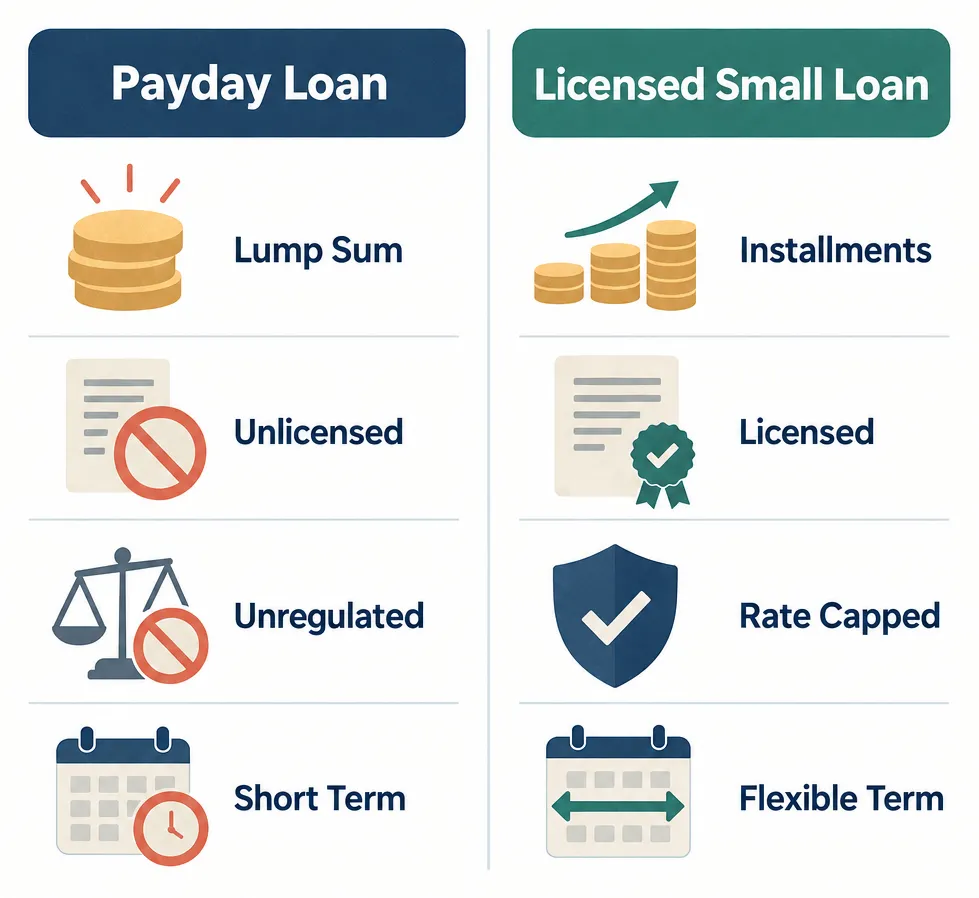
A payday loan costs many times the legal maximum, and the gap grows with every rollover. The example below uses a common payday price of $15 per $100 borrowed for two weeks. That is below the 500%+ average APR DOB cites, so the comparison is generous to payday lenders.
| Scenario | Amount | Price | Term | Total charges | Total repaid |
|---|---|---|---|---|---|
| Payday loan, repaid on time | $500 | $15 per $100 (391% APR) | 14 days | $75 | $575 |
| Payday loan, rolled over 5 times | $500 | $75 every 2 weeks | 12 weeks | $450 | $950 |
| Licensed MA small loan, single payment | $500 | 23% + $20 fee | 14 days | $24.41 | $524.41 |
| Licensed MA small loan, installments | $500 | 23% + $20 fee (about 31% APR) | 12 months | $84.48 | $584.48 |
The payday fee of $75 is 15% of $500. A year holds about 26.07 two-week periods, so 15% times 26.07 works out to about 391% a year. On the licensed single-payment loan, 14 days of interest at 23% is $4.41. Add the $20 fee and the cost is $24.41, or about 4.9% for two weeks. On a very short loan the fixed fee pushes the APR up, but the dollar cost stays small.
The rollover row is where borrowers get hurt. After 12 weeks of renewals, the payday borrower has paid $450 and still owes the full $500.
Online, tribal and “rent-a-bank” lenders
Massachusetts law covers loans made to Massachusetts residents, including loans made online from other states. Lenders that skip the license usually claim one of three exemptions: they are out of state, they are tribal, or a bank is the “real” lender. State regulators and the Attorney General have rejected all three.
Tribal lenders and “sovereign immunity” claims
DOB’s consumer alert on payday loans from tribal lenders strongly advises residents to avoid these loans and says tribal lenders are not licensed in Massachusetts. Such lenders often argue that state law can’t reach them because they are affiliated with a federally recognized tribe. Even if a lender raises that defense in court, its loan to you is still unlicensed under Massachusetts law. Collectors working those accounts are bound by Massachusetts collection rules.
Lenders that use an out-of-state bank’s charter
In a “rent-a-bank” or “true lender” setup, a bank in a state with no rate cap is named on the loan, while a non-bank company markets it, services it and takes most of the profit. Massachusetts looks at who is really behind the loan. In May 2024, Attorney General Andrea Campbell reached a settlement with EasyPay, a California-based non-bank lender. The AG alleged EasyPay was the true lender on loans made through an out-of-state bank. According to the AG, its Massachusetts loans averaged APRs above 100%, while the usury limit is 20%. Under the Assurance of Discontinuance, EasyPay had to:
- leave the Massachusetts market
- stop collecting on active Massachusetts loans
- pay $625,000 in pro-rata restitution to customers going back to 2018
- ask the credit bureaus to delete the tradelines for those loans
Banker & Tradesman reported that EasyPay denied wrongdoing.
Red flags that a lender is operating illegally in Massachusetts:
- An APR above 23% on a loan of $6,000 or less, or a fee per $100 borrowed
- The whole loan due in a single payment on your next payday
- A demand for your online banking login or an ACH authorization before anything else
- Terms that say tribal law, or the law of another state or country, governs the loan
- No Massachusetts license number, or a name that doesn’t show up in DOB’s licensee search
Check before you share bank details
Before you give any lender your bank login or routing number, look up its exact legal name in the Division of Banks licensee search. DOB treats an unlicensed loan over 12% on $6,000 or less as void.
Already took out a payday loan? What to do now
If you already have an online payday or title loan, you have more rights than the lender’s emails suggest. Take these steps in order and keep a copy of everything.
What to do if you have an illegal loan
- Look up the lender’s legal name in DOB’s licensee search, or call DOB to ask.
- Save your contract, the emails and every bank statement that shows a payment to the lender.
- Send the lender a written notice revoking your ACH authorization.
- Tell your bank in writing to stop the lender’s debits.
- If a collector contacts you, dispute the debt in writing within 30 days.
- File complaints with the Division of Banks and the Attorney General’s Office.
How to check whether a lender is licensed
DOB keeps a public licensee search on mass.gov, and many licensees also appear in NMLS Consumer Access. Search by the company’s legal name, not its brand or website. You can also call DOB toll-free at 1-800-495-BANK (2265), extension 501, or the Consumer Assistance Unit directly at 617-956-1501, and ask whether a company holds a small loan license.
How to stop automatic withdrawals
To stop a lender’s recurring debits, tell your bank at least three business days before the next scheduled transfer. That right comes from the Electronic Fund Transfer Act and Regulation E (12 CFR 1005.10). The bank can ask you to confirm in writing. Regulation E also bars lenders from making automatic repayment a condition of credit. Some payday lenders switch to remotely created checks once you block their ACH debits, so ask your bank to stop payment on those too.
Put the revocation in writing
Send a written revocation of ACH authorization to both the lender and your bank, and keep dated copies. If debits continue after notice, those records back up a dispute with your bank.
How to file a complaint with the Division of Banks or the AG
Each agency does a different job. If the lender is unlicensed, file with both.
| Problem | Agency | How to reach | What they can do |
|---|---|---|---|
| Unlicensed lender, illegal rate | Massachusetts Division of Banks | Consumer complaint form at mass.gov/dob, 1-800-495-2265 ext. 501 or 617-956-1501 | Investigate, order a lender or collector to stop, pursue refunds |
| Deceptive lending or collection | Massachusetts Attorney General’s Office | Consumer hotline 617-727-8400, online consumer complaint form | Sue under M.G.L. c. 93A, seek restitution and penalties |
| Any lender, servicer or collector | Consumer Financial Protection Bureau | consumerfinance.gov/complaint | Forward the complaint to the company and track its response |
| Scam or fraud | FTC | ReportFraud.ftc.gov | Collect reports for enforcement |
| Unauthorized debits | Your bank or credit union | Branch, phone or written notice | Stop transfers, return unauthorized debits under Regulation E |
Can you get your money back?
Sometimes, yes. Refunds usually come through enforcement actions, not individual demands. The October 2015 AG and DOB settlement with Western Sky Financial and CashCall provided about $2.4 million in refunds to more than 1,800 borrowers. Banker & Tradesman reported that the deal also carried an estimated $17 million-plus in debt relief. By November 2016, DOB said about $2.3 million, roughly 93% of the refunds, had reached 1,673 Massachusetts residents. Refunds nobody claimed went to the Massachusetts Treasurer’s Unclaimed Property Division, so search there if you ever borrowed from those companies.
The other route is a Chapter 93A demand letter. If a court finds the lender acted willfully, it can award double or triple damages. Your payment records are your evidence, so keep them even after the loan is closed.
Can you get in trouble for not paying a payday loan in Massachusetts?
Not being able to pay a debt is not a crime. Nobody goes to jail in Massachusetts just for owing money. A collector who threatens arrest is breaking federal law, and the threat itself tells you the operation isn’t legitimate.
Is not paying a payday loan a felony?
No. Missing loan payments is a civil matter. The Fair Debt Collection Practices Act (15 U.S.C. § 1692e) bars collectors from falsely saying you will be arrested or charged, and Massachusetts debt collection rules prohibit the same tactics. If someone threatens criminal charges or says you will be “served at work” over an online payday loan, report it to DOB and the Attorney General.
How long can they come after you?
For most consumer debts, the deadline to sue is six years under M.G.L. c. 260, § 2. The Massachusetts Trial Court Law Libraries’ guide to debt collection law gives the same six-year period for consumer debt. A court judgment can be enforced for 20 years. On a void, unlicensed loan, though, the lender has no lawful claim to collect at all. If you are served with a lawsuit, respond by the deadline on the papers, raise the licensing problem and contact a legal aid office. If you ignore the suit, the court can enter a default judgment against you.
Wage garnishment limits
A creditor can take part of your wages only after winning in court, through a trustee process. M.G.L. c. 246, § 28 protects the larger of two amounts each week: 85% of your gross wages, or 50 times the higher of the federal or Massachusetts minimum wage. With the state minimum wage at $15 an hour, that floor is $750 a week. On a $1,000 weekly paycheck, no more than $150 can be taken.
What debt collectors can’t do under 940 CMR 7.00
The Attorney General’s debt collection regulations, 940 CMR 7.00, apply to collectors and to creditors collecting their own debts. Under 940 CMR 7.08, if you dispute a debt in writing within 30 days, the collector must stop collecting until it validates the debt. The regulations also limit how often collectors may call you and prohibit false threats and harassment.
Collection agencies working in Massachusetts need a DOB license, and DOB has used that license against collectors of illegal loans. On April 4, 2013, it issued a temporary order to cease and desist against Nevada-based Delbert Services Corp. and its owner John P. Reddam. The order told them to stop collecting on more than 100 illegal loans made to Massachusetts consumers. A consent order dated October 27, 2015 resolved the case.
Car title loans in Massachusetts
Car title loans fall under the same small-loan caps, so a typical triple-digit title loan is illegal in Massachusetts. The Attorney General has sued title lenders that lend to residents without a license.
The biggest case was against Liquidation, LLC, an unlicensed online auto title lender that also operated as Auto Loans, LLC, Car Loan, LLC and Sovereign Lending Solutions, LLC. The AG said its loans carried rates from 181% to 619%, and the company had repossessed and sold borrowers’ vehicles. On May 25, 2017, the AG announced a final judgment from Suffolk Superior Court. It made these changes:
- All of the company’s Massachusetts loans were void, which amounted to hundreds of loans.
- Repossessions were barred and the company was permanently banned from the state.
- It was ordered to pay $1.135 million in civil penalties and nearly $200,000 in restitution.
- More than 50 liens were dissolved, and the Registry of Motor Vehicles Title Division helped issue owners new, lien-free titles.
In 2022, New Hampshire-based NH Title Group signed an assurance of discontinuance with the AG. It agreed to pay $500,000 in restitution and forgive more than $400,000 in balances and post-repossession deficiencies.
Cash advance and earned wage access apps in Massachusetts
As of November 2026, Massachusetts has no law written specifically for earned wage access (EWA) or cash advance apps. DOB still enforces existing licensing laws against them.
On May 5, 2026, DOB signed a settlement with an EWA provider. DOB alleged the provider had acted as an unregistered third-party loan servicer since at least July 2021, in violation of the registration rule in M.G.L. c. 93, § 24A(b). Patch reported that the provider is Bridge IT Inc., which does business as Brigit and was bought in 2025 by Upbound Group. The legal-industry summaries from Orrick and Sheppard Mullin did not name the company. Under the settlement, the provider must:
- pay $1.9 million to DOB’s settlement trust
- stop any activity that needs a license or registration until it is approved
- put compliance policies in place
It neither admitted nor denied the allegations. Sheppard Mullin’s summary says it applied for registration through NMLS in June 2025.
On the legislative side, Senate Bill S.725 in the 194th General Court would have created a new Chapter 140F to license EWA providers and declare that compliant EWA is not a loan. On April 8, 2026, the committee on Financial Services reported out S.3047, which was discharged to the committee on Senate Rules on April 13, 2026. The House bill, H.1119, was sent to study through H.5224 on March 12, 2026. As of November 2026, no EWA licensing law has been enacted.
When you compare apps, add up the express-delivery fees, monthly subscriptions and “tips” the app suggests. On a $100 advance repaid in a week, a $5 fee works out to an APR in the hundreds.
Enforcement timeline: what Massachusetts has done to illegal lenders
Massachusetts enforces its lending laws regularly, and many cases end with refunds to borrowers. The cases below are the main payday, title, rent-a-bank and EWA actions since 2013, each from DOB or AG announcements or from published legal summaries of them.
| Year | Company / type | Agency | Outcome | Borrowers / amount |
|---|---|---|---|---|
| 2013–2015 | Delbert Services Corp. (debt collector) | DOB | Temporary cease-and-desist order April 4, 2013; consent order October 27, 2015 | 100+ illegal loans |
| 2015–2016 | Western Sky Financial / CashCall (online lender, 89%–135% interest) | AG and DOB | October 2015 settlement requiring them to stop lending in Massachusetts and refund borrowers; DOB announced distribution status November 22, 2016 | About $2.4 million for 1,800+ borrowers; $2.3 million paid to 1,673 by November 2016 |
| 2017 | Liquidation, LLC (online auto title lender, 181%–619%) | AG | Suffolk Superior Court judgment: loans voided, 50+ liens dissolved, permanent ban | $1.135M penalties, nearly $200,000 restitution |
| 2022 | NH Title Group (title lender) | AG | Assurance of discontinuance | $500,000 restitution, $400,000+ forgiven |
| 2024 | EasyPay (California-based non-bank lender, average APR above 100%) | AG | Assurance of discontinuance over alleged rent-a-bank lending; left the state; denied wrongdoing | $625,000 restitution |
| 2026 | Bridge IT Inc. (Brigit), per Patch (earned wage access provider) | DOB | Settlement over alleged unregistered loan servicing; no admission | $1.9 million |
Did you know?
According to the Division of Banks’ November 22, 2016 announcement, about $2.3 million had already been returned to 1,673 Massachusetts borrowers of Western Sky Financial and CashCall, whose loans carried interest of 89% to 135%.
Legal alternatives when you need cash fast in Massachusetts
The safest fast money in Massachusetts comes from credit unions, payment plans and assistance programs, not online lenders. The options below stay within the law, cheapest first.
Cheaper options first
Ask the company you owe for a hardship plan before you borrow at all.
Credit union payday alternative loans cap the APR at 28%.
Massachusetts assistance programs can cover rent, heat and food at no cost.
Credit union payday alternative loans
Federal credit unions can offer payday alternative loans under National Credit Union Administration rules (12 CFR 701.21(c)(7)).
| Feature | PAL I | PAL II |
|---|---|---|
| Loan amount | $200 to $1,000 | Up to $2,000 |
| Term | 1 to 6 months | Up to 12 months |
| Maximum APR | 28% | 28% |
| Application fee cap | $20 | $20 |
| Membership wait | Usually at least 1 month | None required |
Massachusetts-chartered credit unions are supervised by DOB and can offer small loans under state rules. Many fund on the same or next business day. If you are searching for same day loans in Massachusetts, this is the legal version.
Credit card cash advances
If you already have a credit card, a cash advance is expensive but still far cheaper than a payday loan. Issuers usually charge a cash advance fee plus a cash advance APR that is higher than the purchase rate, and interest starts the day you take the cash, with no grace period. Regulation Z requires your card agreement to disclose both numbers in its summary table, so check them before you use the card at an ATM.
Assume a 5% fee and a 29.99% cash advance APR, repaid in 30 days. Those terms are common but not universal.
| Option | Amount | Fee or APR | Term | Total charges | Total repaid |
|---|---|---|---|---|---|
| Credit card cash advance (example terms) | $500 | $25 fee + 29.99% APR | 30 days | About $37.32 | About $537.32 |
| Payday loan, repaid on time | $500 | $15 per $100 | 14 days | $75 | $575 |
Interest on the card is $500 times 29.99% times 30/365, or about $12.32, plus the $25 fee. That is about half the payday loan’s cost for twice as long. The catch is the balance itself: pay it off fast, because the higher APR keeps running until you do.
Financial assistance in Massachusetts that really exists
State programs often cover the bill that pushed you toward a payday loan in the first place:
- RAFT (Residential Assistance for Families in Transition): state help with back rent, mortgage arrears and some utility costs for eligible households.
- Home Energy Assistance (LIHEAP): help with heating bills, run through local agencies.
- Winter shutoff protection: each year from November 15 to March 15, regulated gas and electric utilities can’t shut off heating service for households that document financial hardship.
- SNAP through the Department of Transitional Assistance: frees up cash that would otherwise go to groceries.
- Mass 211: a free referral line that connects you to local emergency funds, fuel assistance and food pantries.
Debt relief in Massachusetts
Start debt relief with a nonprofit credit counseling agency, which DOB’s payday loan page also recommends. A counselor can review your budget and, if it fits, set up a debt management plan that lowers your card interest rates. Under the FTC’s Telemarketing Sales Rule, debt settlement companies that sell by phone can’t charge fees before they settle a debt, so a company that asks for money up front is a warning sign. If your debts can’t be repaid, bankruptcy can discharge payday and other unsecured debts. Federal law requires a credit counseling session within 180 days before you file. Massachusetts legal aid programs offer free help.
Employer advances and licensed small lenders
Some employers offer no-fee paycheck advances through HR. A licensed small lender charging within 23% plus $20 is also legal. Expect a credit check or an income review. Ads that promise “no credit check” or “guaranteed approval” usually mean one of three things: the lender is unlicensed, it runs only a soft pull, or it charges more to cover its risk.
Federal rules that apply everywhere
Federal protections sit on top of Massachusetts law:
- Truth in Lending Act and Regulation Z (12 CFR 1026): every lender must disclose the APR and the total finance charge before you sign.
- Military Lending Act: loans to active-duty service members and their dependents are capped at a 36% military APR.
- Servicemembers Civil Relief Act: interest on debts taken on before active service is limited to 6%.
- Fair Debt Collection Practices Act: bans harassment, false threats and deceptive collection by third-party collectors.
You can file a federal complaint with the Consumer Financial Protection Bureau.
Massachusetts vs. neighboring states
Massachusetts has one of the strictest limits in New England, and New York is the only neighbor that is as tight. If you live near a border, know each neighbor’s rules. US Financer’s guides to New Jersey and Maryland payday loan laws cover two more states that cap rates.
| State | Payday lending status | Key limit |
|---|---|---|
| Massachusetts | Effectively illegal | 23% + $20 small-loan cap; 20% criminal usury |
| Rhode Island | Being phased out | 2025-H 5042A / 2025-S 0229A, signed July 2025, repeals the deferred-deposit exemption effective January 1, 2027 |
| New Hampshire | Allowed with a cap | 36% APR on payday loans; no new payday loan within 60 days of a prior payday or title loan (RSA 399-A:17) |
| New York | Effectively illegal | 16% civil usury; 25% criminal usury |
| Connecticut | No licensed payday lending | Higher-rate small loans require a Department of Banking license |
If you live in Massachusetts and borrow online from a Rhode Island or New Hampshire lender, Massachusetts law still covers the loan. Rhode Island’s change matters for people who cross the border to borrow. Until December 31, 2026, licensed deferred-deposit lenders there can still make payday loans in person. From January 1, 2027, that exemption is gone.
Which states have banned payday loans?
Roughly 20 states plus the District of Columbia ban payday loans outright or block them with rate caps that payday pricing can’t meet. Some name the product in their laws. Others, like Massachusetts, simply cap rates at about 36% or lower. Counts vary depending on whether a state with a 36% cap that still licenses short-term lenders is included.
States generally counted as banning or effectively prohibiting high-cost payday loans:
- Arizona
- Arkansas
- Colorado
- Connecticut
- Georgia
- Illinois
- Maryland
- Massachusetts
- Montana
- Nebraska
- New Jersey
- New Mexico
- New York
- North Carolina
- Pennsylvania
- South Dakota
- Vermont
- West Virginia
- District of Columbia
Rhode Island joins this group on January 1, 2027. New Hampshire sits in between: it still licenses payday lenders but caps them at 36% APR. Caps change through legislation and ballot measures, so check a state’s banking regulator before you rely on its rules.
Before you borrow
In Massachusetts, a loan of $6,000 or less above 12% a year requires a small loan license, and a licensed lender can’t charge more than 23% a year plus a $20 fee, apart from a few limited charges the rules allow. A lender willing to break that rule may also break the rules on debits and collection. Check the license before you hand over your bank details.
FAQ
I took out an online loan and just found out payday loans are illegal in Mass. Do I still have to pay it back?
The Division of Banks says loans made without the required small loan license are void and illegal to collect. Don’t just stop paying without a plan, though. Revoke the ACH authorization in writing, tell your bank, keep your records and file with DOB and the Attorney General so they can review the loan. A legal aid office can tell you what this means in your case.
What is a payday loan, and is a “cash advance loan” the same thing?
A payday loan is a small, unsecured loan, usually a few hundred dollars, that you repay in one lump sum from your bank account on your next payday, typically within 14 days. DOB says the same product is also sold as a cash advance loan, check advance loan, post-dated check loan or deferred deposit loan. In Massachusetts all of them face the same 23% small-loan cap.
What is the maximum interest rate on a loan in Massachusetts?
For consumer loans of $6,000 or less, licensed lenders can charge up to 23% a year plus a $20 fee under 209 CMR 26.01. Lenders without that license can’t go above 12%. For larger loans, the criminal usury statute, M.G.L. c. 271, § 49, sets a 20% ceiling unless the lender has filed a notice with the Attorney General.
How much can a licensed lender charge for a late payment?
Under 209 CMR 26.01, a licensed small lender can charge a default fee only after a payment is more than 10 days late. The fee is capped at 5% of the late installment or $5, whichever is less, and can be charged only once for the same default. A lender also can’t add a deferment charge to an installment that already carried a default charge unless it refunds that default charge in full.
When is the first payment due on a Massachusetts small loan?
Under 209 CMR 26.01, the first installment can be due no later than one month and 15 days after the loan date. If it falls more than one month out, the lender may add a small extension charge: 1/30 of one month’s finance charge for each extra day.
A collector says I’ll be arrested for an unpaid payday loan. Is that real?
No. Unpaid debt is a civil matter, and threatening arrest violates the Fair Debt Collection Practices Act and Massachusetts collection rules. Write down the caller’s name, company and phone number, then report the call to DOB and the Attorney General.
Is a tribal lender legal if I live in Massachusetts?
DOB says tribal lenders are not licensed in Massachusetts and strongly advises residents to avoid their payday loans. Their loans go over state caps, so the same void-loan and collection rules apply.
Are cash advance or earned wage apps considered payday loans in Massachusetts?
Massachusetts has no EWA-specific law, and the S.725 licensing bill has not become law. DOB still applies existing law, as its $1.9 million settlement with an EWA provider in May 2026 shows. Add up every fee and tip to see what an advance really costs.
Which states have banned payday loans?
About 20 states and the District of Columbia ban payday loans or cap rates low enough to block them. They include Massachusetts, New York, New Jersey, Connecticut, Maryland, Pennsylvania, Georgia and North Carolina. Rhode Island’s repeal takes effect January 1, 2027.
Where can I get a small loan fast in Massachusetts with bad credit that isn’t a scam?
Start with a credit union payday alternative loan (28% APR cap, up to $2,000) or a licensed small lender that stays within 23% plus $20. If you already have a credit card, a cash advance repaid quickly also costs far less than a payday loan. Before you borrow, call Mass 211 or ask about RAFT or fuel assistance. A grant or a payment plan costs nothing to repay, so check those first, even before a legal loan.
Laws and regulations referenced
- Massachusetts General Laws, Chapter 140, Section 96 (Small Loans: License Required)
- Truth in Lending Act, 15 U.S.C. 1601
- Regulation Z, 12 CFR Part 1026
- Fair Debt Collection Practices Act, 15 U.S.C. 1692
- Electronic Fund Transfer Act, 15 U.S.C. 1693
- Regulation E (electronic transfers), 12 CFR Part 1005
- Military Lending Act, 10 U.S.C. 987
- Servicemembers Civil Relief Act, 50 U.S.C. 3901
Links go to the official text on government sites.
Check, verify or complain
Sources
- Payday loans - Massachusetts Division of Banks mass.gov · official source
- Collection of illegal loans in Massachusetts - DOB industry letter mass.gov · official source
- 209 CMR 26.00: Small Loans Regulatory Board mass.gov · official source
- 209 CMR 26.00: Small Loan Rate Order (mass.gov PDF) mass.gov · official source
- 209 CMR 26.00 final amendments mass.gov · official source
- Submit a Chapter 271 usury notice filing - Attorney General mass.gov · official source
- Consumer alert on payday loans from tribal lenders - DOB mass.gov · official source
- Bill S.725 - 194th General Court malegislature.gov · official source
- Unlicensed lenders to refund millions to consumers over illegal online lending scheme mass.gov · official source
- Temporary order to cease and desist: Delbert Services Corp. and John Reddam mass.gov · official source
- AG obtains judgment voiding hundreds of illegal loans in case against online auto title lender mass.gov · official source
- AG stops online auto title lender from collection on illegal loans mass.gov · official source
- AG Healey secures over $900,000 from auto title lending company mass.gov · official source
- Massachusetts law about debt collection mass.gov · official source
- M.G.L. c. 260, § 2 malegislature.gov · official source
- Rhode Island legislature press release on payday lending repeal rilegislature.gov · official source
- NH RSA Chapter 399-A: Small loans, title loans and payday loans gc.nh.gov · official source
- Senate No. 3047 study order malegislature.gov · official source
- 940 CMR 7.00 Debt collection regulations (mass.gov) mass.gov · official source
- Massachusetts fines earned wage access provider $1.9M infobytes.orrick.com
- Massachusetts AG settles claims against California-based financing company for $625,000 goodwinlaw.com
- AG Campbell forces usurious non-bank lender out of Mass. market bankerandtradesman.com
- Massachusetts Division of Banks announces return of $2.3 million goodwinlaw.com
- Mass-Peculiarities: wage garnishment under c. 246 § 28 content.seyfarth.com
- In re Stone Street Capital, LLC case-law.vlex.com
- Massachusetts AG settles with lender for alleged usury claims (Orrick) infobytes.orrick.com
- 940 CMR 7.08 (Justia) regulations.justia.com
- Massachusetts Division of Banks enters consent agreement (Goodwin) goodwinlaw.com
- Payday Loan Scams Lawyer (Rights Protection Law Group) rightsprotect.com

Elena writes about getting through a money emergency, assistance programs, budgeting on a tight income, banking basics and borrower rights. Her guides list the cheaper options first and link the agency or program that can actually help.
Ruth is US Financer's standards editor. Every article goes through her checks before and after it is published: each rate, fee, cap, deadline and rule is matched against its primary source, every law named is linked to its official text, and anything that cannot be…
What changed
- Nov 24, 2026 First published.
Comments are closed