

We are not a credit repair, debt relief or debt collection company and offer no services. Rules differ by state, so confirm with the agency or a nonprofit counselor before you act.
A debt validation letter is a written dispute that makes a debt collector prove a debt before it collects any more. Send it within 30 days of getting the collector’s validation notice. Federal law then requires the collector to stop collecting the disputed amount until it mails you verification. The letter doesn’t erase the debt, and it doesn’t count as a response to a lawsuit.
WARNINGRelated consumer alert, Nov 12, 2026
Pennsylvania AG warns veterans who paid Trajector to consider bankruptcy claimsKey takeaways
- The collector’s “validation notice” is required by law. Your “validation letter” is really a dispute and verification request.
- Use the end date printed on the notice. Get your dispute to the collector before that date.
- A written dispute sent on time pauses collection of the disputed amount until the collector mails verification.
- If the collector stays silent, the debt still exists. The collector just can’t keep collecting it.
- A validation letter doesn’t answer a court summons. If you are sued, the court’s deadline controls.
Fact-checked
We checked these key facts against the sources named, on November 13, 2026:
- The FDCPA, at §1692k, lets you sue for actual damages, statutory damages of up to $1,000 and attorney’s fees (source: uscode.house.gov)
- Under 15 U.S.C. §1692g(b) and 12 CFR 1006.38, I request verification and the name and address of the original creditor (source: consumerfinance.gov)
- Under the Fair Debt Collection Practices Act, 15 U.S.C. §1692g(b), and Regulation F, 12 CFR 1006.38, I request verification of the debt (source: law.cornell.edu)
- State that you dispute the debt and request verification and the original creditor’s name and address under 15 U.S.C. §1692g(b) and 12 CFR 1006.38 (source: law.cornell.edu)
- Here are the three claims that cause the most trouble. | Myth | Fact | |—|—| | “If they don’t answer in 30 days, the debt is gone.” | The 30 days is your deadline, not theirs (source: law.cornell.edu)
Debt validation letter: the 60-second answer
A debt validation letter asks a debt collector to prove that you owe a debt, that the amount is right, and that it has the right to collect. Send it in writing within the 30-day validation period. That puts a legal pause on collection of whatever you dispute.
Here’s how it works. Under the Fair Debt Collection Practices Act, 15 U.S.C. §1692g, a collector has to give you written details about the debt. Regulation F (12 CFR part 1006) sets the format and timing. If you dispute in writing during the window, §1692g(b) and 12 CFR 1006.38 require the collector to stop collecting the disputed amount until it sends you verification or a copy of a court judgment. A request for the original creditor’s name and address triggers the same pause.
Some things the letter can’t do. It doesn’t cancel the debt or wipe out a court case. It doesn’t take a collection account off your credit report. It also doesn’t bind original creditors that collect their own debts, because the FDCPA generally doesn’t treat them as “debt collectors.”
The letter is most useful when you don’t recognize a debt. That is common. The CFPB’s annual report on the FDCPA, released in November 2025, says “attempts to collect debt not owed” has been the top debt collection complaint issue every year since 2013. In about 45% of debt collection complaints, the consumer didn’t recognize the debt.
Validation notice vs. validation letter vs. verification request: who sends what
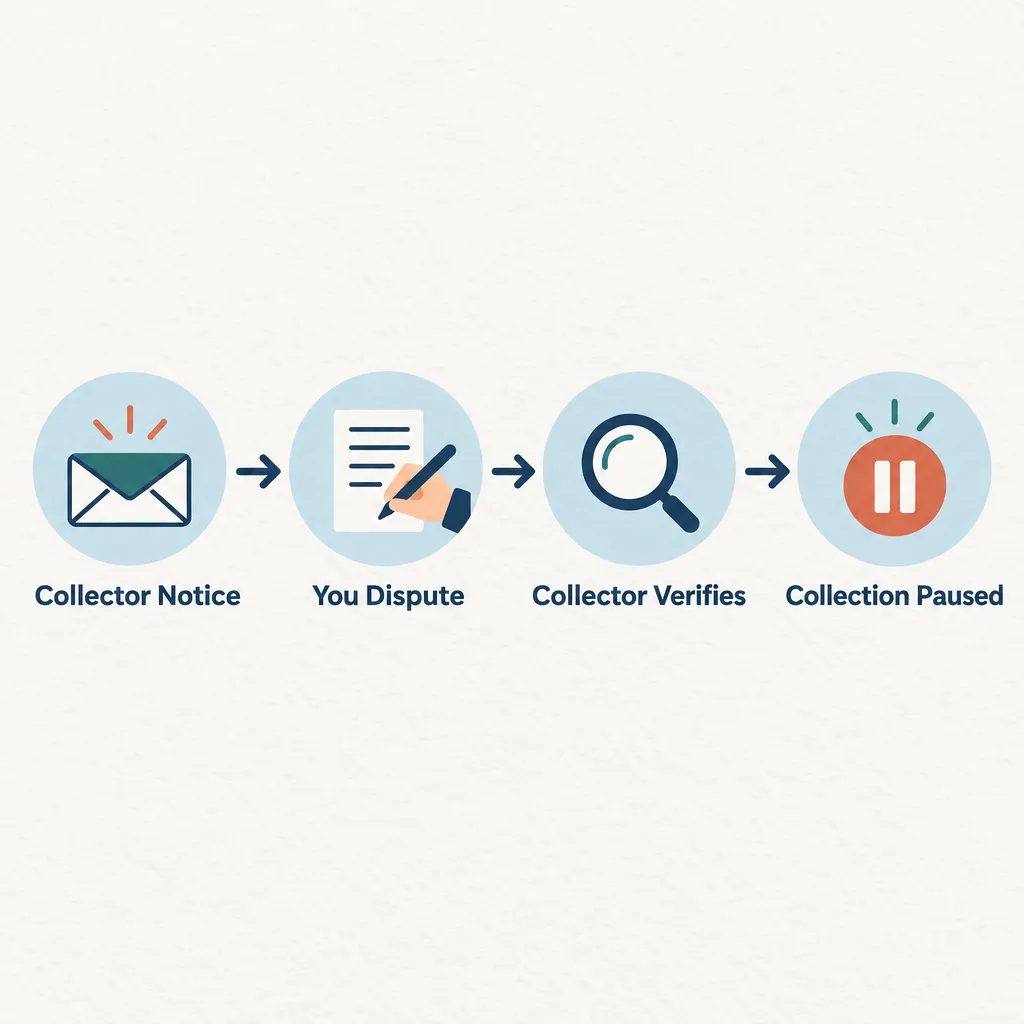
The naming confuses a lot of people. The validation notice comes from the collector, and the law requires it. The validation letter people search for is your written dispute, which the statute calls a request for verification. You never have to ask for the validation notice. The collector owes it to you either way.
| Document | Who sends it | When | Required by | What it does |
|---|---|---|---|---|
| Validation notice | Debt collector | In the first communication or within 5 days after it | 15 U.S.C. §1692g(a); 12 CFR 1006.34 | Tells you the creditor, amount, itemization and your dispute deadline |
| Dispute / verification request (“validation letter”) | You | Within the 30-day validation period | 15 U.S.C. §1692g(b); 12 CFR 1006.38 | Pauses collection of the disputed amount until verification is mailed |
| Original-creditor request | You | Within the 30-day validation period | 15 U.S.C. §1692g(a)(5), (b) | Pauses collection until the collector sends the original creditor’s name and address |
| Verification | Debt collector | No fixed deadline; collection stays paused until it is sent | 15 U.S.C. §1692g(b) | Lets the collector resume collecting |
The collector’s validation notice (what must be in it)
Regulation F §1006.34 says what the notice must contain, and most collectors use the CFPB Model Validation Notice to meet it. According to the CFPB, the collector has to provide the validation information in its first communication or send a written notice within five days after it. It can come by mail or electronically. It must list:
- A statement that the sender is a debt collector
- The collector’s name and the mailing address where it accepts disputes
- For consumer financial product debts, the creditor as of the “itemization date” and the account number
- The current creditor’s name
- An itemization of interest, fees, payments and credits since the itemization date
- The current amount owed
- The date your validation period ends, plus instructions for disputing or asking for the original creditor
The model form also includes a tear-off section with checkboxes such as “This is not my debt” and “The amount is wrong.” Mailing that form back counts as a written dispute. Your own letter lets you add detail and ask for specific documents.
Your dispute / verification request
Your letter is the dispute. The statute only requires you to “notify the debt collector in writing” that you dispute the debt or part of it. You don’t need special wording, a lawyer or a reason. A clear written reason does help if you later complain or go to court.
Original-creditor name request
Under §1692g(a)(5), you can ask for the original creditor’s name and address when it differs from the current creditor. This matters when a debt has been sold, sometimes several times. The request pauses collection just as a dispute does, so put both in the same letter.
Your 30-day deadline: how to find the exact date
Your deadline is the end date printed on the validation notice. Under Regulation F §1006.34(b)(5), the period starts when the collector provides the notice. It ends 30 days after you receive it, or after the date the collector may assume you received it. Your written dispute has to fall inside that window to get the automatic pause.
How the “assumed receipt” date is set
Regulation F lets the collector assume you received the notice on any date at least five days after sending it. Saturdays, Sundays and legal public holidays listed in 5 U.S.C. 6103(a) don’t count toward the five. The CFPB’s Official Comment 34(b)(5) says the collector can use that assumed date even if it later learns the notice reached you on another day. That’s why the printed date is the one to rely on.
Worked example (using the 2026 calendar):
| Step | Date | Why |
|---|---|---|
| Collector mails notice | Monday, Nov. 9, 2026 | “Provides” the notice |
| Day 1 | Tuesday, Nov. 10 | Business day |
| Not counted | Wednesday, Nov. 11 | Veterans Day, a legal public holiday |
| Days 2 and 3 | Thursday, Nov. 12, Friday, Nov. 13 | Business days |
| Not counted | Nov. 14 and 15 | Weekend |
| Days 4 and 5 | Monday, Nov. 16, Tuesday, Nov. 17 | Earliest assumed receipt: Nov. 17 |
| Validation period ends | Thursday, Dec. 17, 2026 | 30 days after Nov. 17 |
A collector can pick a later assumed date, which gives you more time, but never an earlier one. If the printed date seems early by this count, keep the envelope and write down the day it arrived.
Mark the end date first
Find the dispute end date on the notice and circle it. Then mail your letter at least a week before it, so it arrives inside the window and the tracking record shows it.
Where the end date appears on your notice
On the CFPB model form, the date sits in the “How can you dispute the debt?” section and the tear-off response form. It’s usually worded like “Call or write to us by [date] to dispute all or part of the debt.” Section 1006.34(c)(3) requires that date to be stated, so a notice without one is defective. Mention that in a complaint.
If you never got a validation notice
You can still dispute. If a collector calls or texts and no notice follows within five days, ask in writing for the validation information and dispute the debt in the same letter. The CFPB’s supervisory work found large collectors failing to send validation notices at all, according to its FDCPA report covering 2024. A missing notice is a possible violation that you can report.
Email and electronic notices
Collectors can send the notice electronically if they follow Regulation F’s delivery rules. In that case the five-day assumption runs from when the notice was sent. If the notice lists an email address or web portal for disputes, a dispute through that channel counts as written. Take a screenshot of the confirmation and save the sent email.
Before you write: check the notice line by line
Spend five minutes checking the notice against what the law requires. The gaps you find become the questions in your letter. They can also show the contact is a scam or the debt is too old to sue on.
| Required item | What to look for | Red flag |
|---|---|---|
| “This is a communication from a debt collector” | Clear statement near the top | Missing, or the sender claims to be a law firm with no other details |
| Collector’s name and dispute address | A physical mailing address | Only a phone number, P.O. box with no company name, or a payment link |
| Creditor on itemization date and account number | A name and number you can match to a past account | A creditor you never dealt with and no explanation of the sale |
| Itemization (interest, fees, payments, credits) | Numbers that add up to the current balance | Large unexplained fees, or interest added that your original contract didn’t allow |
| Current amount | Matches the itemization | Different amounts in different letters |
| Validation period end date | A specific calendar date | No date, or a date in the past when the notice arrived |
Is this collector real?
Check that the collector exists before you send any personal data. Look it up with your state’s financial regulator or attorney general, since many states license debt collectors, and some do it through NMLS Consumer Access. Call the original creditor using the number on an old statement and ask who holds the account now.
Warning signs: threats of arrest, demands for gift cards, wire transfers or crypto, refusal to send anything in writing, or pressure to pay “today only.” A real collector has to give you the debt’s validation information, either in its first communication or in a written notice within five days after it. A scammer usually won’t.
Keep private details out of the letter
Leave out your Social Security number, bank details and any phone number you want kept private. Don’t write anything that admits the debt is yours. The collector already has enough to find the account.
Is the debt past the statute of limitations?
Older debts can be “time-barred.” That means the state deadline for suing has passed. Regulation F §1006.26 bars collectors from suing or threatening to sue on time-barred debt. The debt can still be collected in other ways, though, and in some states a partial payment or a written acknowledgment revives the right to sue, according to the National Consumer Law Center. Limits differ by state and debt type and often fall between three and six years.
Is it an original creditor (FDCPA may not apply)?
Under 15 U.S.C. §1692a(6), a bank, card issuer or hospital collecting its own debt under its own name generally isn’t a “debt collector.” Third-party agencies, debt buyers and many collection law firms are. If the original creditor is the one billing you, §1692g rights may not apply, and you should dispute through its billing-error process instead. Some state laws, such as California’s Rosenthal Fair Debt Collection Practices Act, also cover original creditors.
Free debt validation letter template (copy and fill in)
The letter below works for most disputes. Replace everything in [square brackets] and delete the optional lines you don’t need. Keep it to one page if possible. The notes after the letter tie each paragraph to the rule behind it.
Core letter
[Your full name]
[Your mailing address]
[City, State ZIP][Date you mail this letter]
[Debt collector’s name]
[Dispute address exactly as printed on the validation notice]Re: Reference number [number shown on the notice]
Sent by USPS Certified Mail, Return Receipt Requested, tracking no. [tracking number]To whom it may concern:
I am responding to your notice dated [date printed on the notice], which I received on [date it arrived]. I dispute this debt in full. Under the Fair Debt Collection Practices Act, 15 U.S.C. §1692g(b), and Regulation F, 12 CFR 1006.38, I request verification of the debt. I also request the name and address of the original creditor.
[Optional: add one reason from the add-ons below.]
Please send me:
1. The name and address of the original creditor and the account number used by that creditor.
2. The amount owed on the itemization date, and an itemization of all interest, fees, payments and credits since then.
3. The date of last payment and the date the account was charged off or defaulted.
4. Documents showing that you, or the company you collect for, own this debt or are authorized to collect it, including any chain of assignment if the debt was sold.
5. A copy of any signed agreement or account statement that connects this debt to me.
6. Your debt collection license number for [your state], if your state licenses collectors.Until you mail verification, federal law requires you to stop collecting the disputed debt. If you report this debt to any consumer reporting agency, you must report it as disputed, as 15 U.S.C. §1692e(8) requires.
[Optional: Please contact me only in writing at the address above and do not call me.]
This letter is not an acknowledgment that I owe this debt and is not a promise to pay it.
Sincerely,
[Signature]
[Printed name]Enclosure: copy of your notice dated [date printed on the notice]
What each part does:
- Opening paragraph. Creates the written dispute and the original-creditor request, which turn on the pause under §1692g(b) and §1006.38. Stating the receipt date backs up your timing.
- Numbered list. Asks for the items the validation notice should already contain (§1006.34(c)) plus the documents that settle ownership and amount. The collector doesn’t have to produce all of them, but the list makes weak proof easy to spot.
- Pause and credit paragraph. Cites the stop-collection rule and §1692e(8), which treats reporting a debt without noting that it’s disputed as a false communication.
- Written-only line. Regulation F §1006.14(h) bars a collector from using a channel you have asked it not to use.
- Closing sentence. Keeps the letter from being read as an admission, which matters for old debts.
Optional add-ons by situation
Choose the one line that fits your situation and paste it where the template says “Optional”:
- Not my debt: “I have no record of this account and do not believe it belongs to me.”
- Wrong amount: “I dispute the amount. The balance you list does not match my records, and I dispute the fees and interest added after [date].”
- Already paid or settled: “This account was [paid in full / settled] on [date]. Copies of [receipt / settlement letter] are enclosed.” Always send copies, never originals.
- Identity theft: “This account was opened without my authorization. An FTC Identity Theft Report is enclosed.” File the report with the Federal Trade Commission first. It also supports blocking the account under the Fair Credit Reporting Act.
- Possibly time-barred: “Based on the dates available to me, this debt appears to be beyond [State]’s statute of limitations. Nothing in this letter acknowledges the debt or promises payment.”
Email version
Use this only if the notice lists an email address or portal for disputes:
Subject: Dispute and verification request, reference [number]
I dispute the debt in your notice dated [date], received [date]. Under 15 U.S.C. §1692g(b) and 12 CFR 1006.38, I request verification and the name and address of the original creditor. Please stop collection until you send verification by mail to [your mailing address]. This is not an acknowledgment of the debt or a promise to pay. [Your full name]
Phrases to avoid
- “I know I owe this, but…” (an admission that can help the collector in court and, for old debts, may revive the right to sue in some states)
- “I’ll pay $50 a month” (a promise to pay that you can make later, after the debt is verified)
- Insults, threats or long stories (they add nothing and can be quoted against you)
- Demands the law doesn’t support, such as “you must respond within 30 days or the debt is void”
The CFPB publishes its own free sample letters on its “What should I do when a debt collector contacts me?” page. They include “I need more information about this debt,” “I do not owe this debt” and letters that limit or stop contact. The National Consumer Law Center’s digital library hosts copies too.
How to send it and prove you did
Send the letter to the dispute address printed on the notice, by USPS Certified Mail with Return Receipt. Keep a full copy. If the collector ever claims it never got your dispute, the green card or electronic return receipt is your proof of timing.
How to send your dispute
- Make two copies of the signed letter and any enclosures.
- Mail the original by Certified Mail, Return Receipt, to the notice’s dispute address, not the payment address.
- Staple the certified mail receipt to your copy and write the mailing date on it.
- When the return receipt comes back, file it with your copy.
- Log every call, letter and email after that date.
A simple log keeps the paper trail usable:
| Date | Channel | Who | What was said or sent | Proof kept |
|---|---|---|---|---|
| Date mailed | Certified mail | Collector’s dispute dept. | Dispute and original-creditor request | Receipt, tracking number |
| Date delivered | USPS | Collector | Return receipt signed | Green card or e-receipt |
| Any later date | Phone, letter, text | Collector | Contact during the pause | Call log, screenshot |
If the debt shows up on your credit report, dispute it directly with Experian, Equifax and TransUnion as well. That’s a separate right under the Fair Credit Reporting Act, and the bureaus generally have 30 days to investigate.
What the collector must do after you dispute
Once your timely written dispute arrives, the collector must stop collecting the disputed amount until it mails you verification or a copy of a judgment. The law sets no deadline for that answer. The collector can take months or never reply. Either way, the pause stays in place until verification is mailed.
Did you know?
No federal rule gives a collector a deadline to answer your dispute. A fact-check carried by Yahoo News rated the popular claim that an unanswered dispute “invalidates” the debt as False. Silence keeps collection paused, but it doesn’t make the debt go away.
Can they still call, report or sue?
Calls and letters: During the pause, the collector can’t call, text or write to push for payment on the disputed amount. Separately, FDCPA §1692g(b) bars collection activity during the validation period that “overshadows” your right to dispute. Contact limited to sending you verification is allowed.
Credit reporting: Regulation F §1006.30(a) bars a collector from reporting a debt before it has communicated with you about it. If it reports or has already reported, §1692e(8) requires it to show the debt as disputed. Courts have split on whether a new report during the pause counts as “collection.”
Lawsuits: Courts disagree. In Bartlett v. Heibl, the Seventh Circuit said a collector may file suit during the 30-day window but must stop collection efforts between your verification request and the mailing of verification. Some courts have found that a lawsuit during the window can overshadow your dispute rights. If you’re served, the court’s deadline controls no matter what your letter says.
Did you know?
Debt collection complaints to the CFPB nearly doubled in one year, from about 109,900 in 2023 to about 207,800 in 2024, according to the CFPB’s FDCPA annual report released in November 2025.
What adequate verification looks like
Many federal courts read “verification” narrowly. In Chaudhry v. Gallerizzo, the Fourth Circuit said a collector can verify by confirming in writing that the amount demanded is what the creditor claims is owed. So a statement showing your name, the creditor, the account and an itemized balance may count, even though it feels thin.
What clearly falls short is a bare repeat of the balance with no creditor or account link, or a document about someone else. In court, the burden goes up. A debt buyer has to prove ownership and the amount under state evidence rules. Some states, such as California through its Fair Debt Buying Practices Act, require debt buyers to hold specific documents before suing.
What happens next: a decision tree for every outcome
Your next move depends on what comes back. The table covers the common outcomes, and the sections below go deeper on the ones that need it.
| Collector’s response | What it means legally | Your next step |
|---|---|---|
| Verification you agree with | Collector may resume collecting | Decide whether to pay, negotiate or check the statute of limitations first |
| Verification with a wrong amount | Disputed portion stays contested | Send a second dispute with new evidence (receipts, statements) |
| Thin statement (name and balance only) | May still count as verification in many courts | Dispute again if you have new, material information; dispute with credit bureaus |
| No response | Collection of disputed amount stays paused indefinitely | Keep records; report any new collection attempts |
| Keeps collecting without verifying | Possible violation of §1692g(b) and §1006.38 | Complaint to CFPB, state AG; talk to a consumer attorney |
| Debt sold to a new collector | New collector must send its own validation notice | Dispute again within the new window and enclose your earlier letter |
| Court summons | Separate legal process with its own deadline | File an answer with the court on time; contact legal aid |
If they verify
Check every number against your records. If the debt is yours and correct, you have three paths: pay it, negotiate a settlement in writing before you pay, or set up a plan you can afford. If it’s old, check the statute of limitations before paying anything, because a payment can revive the right to sue in some states.
Settling for less can lower the cost. Get the terms in writing first, including how the account will be reported. If several debts are overwhelming you, nonprofit credit counseling or Chapter 13 bankruptcy may fit better than paying one collector at a time.
Regulation F treats a second dispute as “duplicative” unless it has new and material information. The CFPB’s commentary gives a canceled check showing payment as an example. A repeat letter with no new facts may get a short reply saying the dispute is duplicative instead of a new pause.
If they never respond
The debt doesn’t disappear, but the collector can’t legally resume collecting the disputed amount until it mails verification. Some collectors close the file or return it to the creditor. The creditor, or a later buyer, can still pursue the debt within the legal limits. Keep your file at least until the statute of limitations has clearly run.
If they keep collecting without verifying
A reader question comes up often: “Sent a debt validation letter, no response, and now the collection company is calling again. Is that allowed?” Not for the disputed amount, if your dispute arrived inside the window. Log every call with the date and time, keep voicemails and letters, and file complaints.
The FDCPA, at §1692k, lets you sue for actual damages, statutory damages of up to $1,000 and attorney’s fees. You generally have one year from the violation to do it. Many consumer attorneys take FDCPA cases because the law makes the collector pay fees if you win.
If the debt is sold during the dispute
“Do I have to start over?” Mostly, yes. Each debt collector has its own duty to send a validation notice, so the new one should send a notice with a new 30-day period. Dispute again within that window and enclose a copy of your first letter and any reply.
If you’re sued
A validation letter doesn’t answer a lawsuit. If you’re served, file a written answer with the court by the court’s deadline, which in many states is short. If you don’t, the collector can win by default and may then garnish wages or levy a bank account where state law allows. Legal aid offices and consumer attorneys handle these cases often, and lack of verification, a time-barred claim or a missing chain of ownership can be defenses.
Missed the 30 days? What you can still do
You can still dispute after the window closes. You lose the automatic pause, and under §1692g(a)(3) the collector may assume the debt is valid for its own purposes. Section 1692g(c) adds that your failure to dispute can’t be treated by any court as an admission that you owe the debt.
After the window, you can still:
- Send a written dispute and request documents. Many collectors answer anyway, and the record helps later.
- Dispute the tradeline with Experian, Equifax and TransUnion under the Fair Credit Reporting Act.
- Tell the collector in writing to stop contacting you under §1692c(c), which allows only limited exceptions, or ask it not to use a contact method you don’t want. Be aware that a full stop request can leave a lawsuit as the collector’s main remaining option.
- Raise every defense if you’re sued, including that the debt isn’t yours, the amount is wrong or the debt is time-barred.
Myths vs. facts about debt validation
Social media advice about debt validation mixes real rights with wishful thinking. Here are the three claims that cause the most trouble.
| Myth | Fact |
|---|---|
| “If they don’t answer in 30 days, the debt is gone.” | The 30 days is your deadline, not theirs. Silence pauses collection but doesn’t erase the debt, and fact-checkers have rated the claim False. |
| “They must produce the signed original contract.” | No federal rule requires it. Many courts accept a basic written confirmation of the amount and creditor as verification. Proof standards are higher in a lawsuit. |
| “Validation removes it from your credit report.” | The FDCPA requires a disputed debt to be reported as disputed, not deleted. Removal depends on an FCRA dispute showing the information is inaccurate or unverifiable. |
One more question comes up often: “Will sending a validation letter restart the statute of limitations?” Asking for verification is not a payment and doesn’t admit the debt. Still, revival rules are state law, and some states treat a written acknowledgment as reviving the debt. That’s why the template ends with a non-acknowledgment sentence and contains no promise to pay.
Old debt, careful words
If the debt might be old, look up your state’s statute of limitations before paying anything or acknowledging the debt in writing. A legal aid office can tell you how your state counts the time.
How to file a complaint (and what the data shows)
If a collector skips the validation notice, ignores the pause or misstates your rights, file with the Consumer Financial Protection Bureau, the Federal Trade Commission and your state attorney general. Each route does something different. Filing with all three is reasonable.
- CFPB complaint portal. The CFPB forwards complaints to the company for a response. Of 2024 debt collection complaints, 77% were sent to companies and 18% were referred to other agencies.
- FTC (ReportFraud). The FTC doesn’t resolve individual cases, but it uses complaints in investigations. It was the only agency to announce public enforcement actions against debt collectors for FDCPA violations in 2024.
- State attorney general or financial regulator. States license and discipline collectors. Some have their own laws on top of the FDCPA, such as the Colorado Fair Debt Collection Practices Act, which the Colorado Attorney General’s office has interpreted in an administrative opinion on validation of debts.
- Consumer attorney or legal aid. For repeated violations, a lawsuit, or debts large enough to threaten wages or a bank account. The National Association of Consumer Advocates and local legal aid offices can refer you.
| Year | Total CFPB complaints | Debt collection complaints | Source |
|---|---|---|---|
| 2024 | About 3.2 million | About 207,800 (7% of the total) | CFPB FDCPA annual report (Nov. 2025); CFPB Consumer Response report |
| 2025 | About 6.6 million | Debt collection, credit cards, deposit accounts and money transfers together made up 11% | CFPB Consumer Response annual report (March 2026) |
Credit reporting disputes drove most of the 2025 jump. The CFPB’s semi-annual report, published October 27, 2026, describes a smaller bureau that closed about 40% of its pending investigations. It still lists FDCPA and Regulation F violations as enforcement priorities.
Debt in collections is widespread. Urban Institute data from August 2025 credit records shows about 23% of adults with a credit file had debt in collections, with a median of $2,528. An Urban Institute survey published in October 2026 found 27% of adults said they or a family member owed medical debt in 2025.
Before you rely on this letter
A validation letter pauses collection only if it’s in writing and inside the validation window, and it does nothing to stop a lawsuit’s deadline. If you’ve been served, or the debt is large or old, contact a legal aid office or consumer attorney before you pay or sign anything. This page is general information, not legal advice.
FAQ
Do debt validation letters really work?
They do what the law says: if the dispute is timely and in writing, collection of the disputed amount pauses until the collector mails verification. That often brings out errors, wrong amounts or debts the collector can’t document. They don’t guarantee the debt will be dropped. A debt that’s verified and yours can still be collected.
How do you write a debt validation letter?
Name the collector and the reference number. State that you dispute the debt and request verification and the original creditor’s name and address under 15 U.S.C. §1692g(b) and 12 CFR 1006.38. List the documents you want, and close by saying the letter isn’t an acknowledgment or a promise to pay. The template above covers all of this.
Is a debt validation letter the same as a debt verification letter?
In everyday use, yes. Both mean your written dispute. Strictly, the “validation notice” is the collector’s required disclosure, and “verification” is what the collector must send back after you dispute.
Can I send a debt validation letter by email?
Yes, if the collector’s notice lists an email address or online portal for disputes. Save the sent message and any confirmation. Certified mail with return receipt gives the strongest proof of the date, so use it when the deadline is close or the collector’s electronic options are unclear.
What happens if a debt collector doesn’t respond to a debt validation letter?
The collector can’t resume collecting the disputed amount until it mails verification. It can’t call or write you for payment, and if it reports the debt, it must show it as disputed. The debt itself still exists and could be pursued later by the creditor or another collector within legal limits.
Can a collector report to my credit or sue me after I send a validation letter?
If it reports, it must mark the debt as disputed. Courts are split on lawsuits during the 30-day window. The Seventh Circuit in Bartlett v. Heibl allowed a suit but required other collection efforts to stop. Any court summons needs a written answer by the court’s deadline, whatever your letter says.
Your next step today
Find the end date on the collector’s notice, check the notice against the required items above, and fill in the template. Mail it by certified mail at least a week before the deadline. Then keep the log. Whatever comes back, you’ll have the paper trail that a complaint, a credit bureau dispute or a court case depends on.
Laws and regulations referenced
- Fair Debt Collection Practices Act, 15 U.S.C. 1692
- Regulation F (debt collection), 12 CFR Part 1006
- Fair Credit Reporting Act, 15 U.S.C. 1681
- Bankruptcy Code, Chapter 13, 11 U.S.C. 1301
Links go to the official text on government sites.
Check, verify or complain
Sources
- 12 CFR 1006.34 Notice for validation of debts (CFPB) consumerfinance.gov · official source
- Official Interpretation of 1006.34 (CFPB) consumerfinance.gov · official source
- 12 CFR 1006.38 Disputes and requests for original-creditor information (eCFR) ecfr.gov · official source
- Official Interpretation of 1006.38 (CFPB) consumerfinance.gov · official source
- Debt Collection Practices (Regulation F) final rule, Federal Register federalregister.gov · official source
- What information does a debt collector have to give me about the debt? (CFPB) consumerfinance.gov · official source
- What should I do when a debt collector contacts me? Sample letters (CFPB) consumerfinance.gov · official source
- CFPB sample letter: I need more information about this debt files.consumerfinance.gov · official source
- 12 CFR 1006.26 Collection of time-barred debts (CFPB) consumerfinance.gov · official source
- Administrative Opinion: Colorado Fair Debt Collection Practices Act, Validation of Debts coag.gov · official source
- CFPB FDCPA Annual Report 2025 files.consumerfinance.gov · official source
- CFPB Consumer Response Annual Report 2025 files.consumerfinance.gov · official source
- NCLC Digital Library: CFPB sample debt collection response letter library.nclc.org
- Limits on collection of time-barred debt and new FDCPA rules (NCLC) library.nclc.org
- 15 U.S.C. 1692g Validation of debts (Cornell LII) law.cornell.edu
- CFPB reports complaint volume doubled in 2025 (Orrick InfoBytes) infobytes.orrick.com
- CFPB releases annual report on FDCPA (Consumer Finance Monitor) consumerfinancemonitor.com
- CFPB report flags widespread debt collection violations (CU Times) cutimes.com
- CFPB report flags rising complaints, persistent errors in debt collection (CU Today) cutoday.info
- CFPB semi-annual report 2026: enforcement and supervision changes receivablesinfo.com
- No, a debt isn't invalidated if collectors don't respond (Yahoo News) yahoo.com
- Debt collection statistics (Urban Institute data) americandefault.org
- Health insurance isn't stopping medical debt: 1 in 4 adults owe (Medical Economics) medicaleconomics.com
- ConServe Regulation F summary conserve-arm.com

Marcus covers credit scores, credit reports and getting out of debt: consolidation, nonprofit counseling, settlement and what debt collectors may and may not do. He works from the federal laws that apply, CFPB guidance and the credit bureaus' published rules.
Ruth is US Financer's standards editor. Every article goes through her checks before and after it is published: each rate, fee, cap, deadline and rule is matched against its primary source, every law named is linked to its official text, and anything that cannot be…
What changed
- Nov 13, 2026 First published.
Comments are closed