

We are not a credit repair, debt relief or debt collection company and offer no services. Rules differ by state, so confirm with the agency or a nonprofit counselor before you act.
Yes. Federal and private student loans can both be wiped out in bankruptcy, but filing Chapter 7 or Chapter 13 on its own almost never does it. You have to file a separate lawsuit inside your bankruptcy case, called an adversary proceeding, and show that repaying would cause “undue hardship.” The Justice Department reports that 98% of federal cases decided by courts under its newer process ended in full or partial discharge.
Run the numbers
Key takeaways
- A regular bankruptcy discharge leaves student loans in place unless a court finds undue hardship, usually through an adversary proceeding.
- For federal loans, a 2022 Justice Department attestation process means the government now recommends discharge in most cases it reviews.
- Some private loans (bar study loans, loans above cost of attendance, unaccredited schools) may be dischargeable without any hardship test.
- You can reopen a closed bankruptcy case to file the student loan claim later.
- Free federal options such as IBR, RAP and disability discharge may solve the problem without a court case.
Before you file
The standard bankruptcy discharge does not touch student loans. If nobody files an adversary proceeding for you, your loans survive the case even after your other debts are gone.
Fact-checked
We checked these key facts against the sources named, on November 12, 2026:
- Nearly 46,000 borrowers applied for RAP on launch day (source: thecollegeinvestor.com)
- As of the current federal fee schedule, a Chapter 7 petition costs $338 and Chapter 13 costs $313 (source: uscourts.gov)
- File for bankruptcy under Chapter 7 or Chapter 13, after completing the required credit counseling course (source: credit.org)
- Under 11 U.S.C. §525(c), the government cannot deny you federal student aid just because you filed bankruptcy (source: law.cornell.edu)
- New York State Higher Education Services Corp., a 1985 federal court decision later adopted by the Second Circuit (source: studicata.com)
Can you declare bankruptcy on student loans? The short answer
You can file student loans in bankruptcy, but they come out the other side unless a judge rules they are dischargeable. Under 11 U.S.C. §523(a)(8), education loans are excluded from the normal discharge unless repaying them “would impose an undue hardship on the debtor and the debtor’s dependents.”
The odds look very different now than they did a few years ago. Research by law professor Jason Iuliano, published in the Duke Law Journal in 2020, found that only about 0.1% of bankruptcy filers with student debt got relief from it. That figure describes the system before November 2022. Since then, the U.S. Department of Justice says courts have granted full or partial discharge in 98% of the federal cases they decided through March 2024.
What “discharge” actually means
A discharge is a court order that ends your personal legal duty to pay a debt. The lender can no longer sue you, garnish your wages or call you about it. It does not erase the history of the loan. Your credit report will still show the account, now marked as discharged in bankruptcy.
Why student loans are treated differently from credit cards and medical bills
Credit card and medical debt are discharged automatically in a successful Chapter 7. Student loans sit on a short list of exceptions, alongside most taxes, child support and debts from fraud. Congress added these protections in steps, starting in the 1970s, out of concern that new graduates would borrow and then file right away. That history explains why so many lawyers still tell clients “student loans can’t be discharged, period.” That statement is wrong. Discharge is harder, not impossible.
Step 1: Figure out which kind of student loan you have
Your loan type decides your route. Federal loans go through the Justice Department’s attestation process. Private “qualified education loans” need an undue-hardship case against the lender. Some private loans may not count as student loans in bankruptcy at all.
Know your loans before any consultation
Download your federal loan list from StudentAid.gov (log in and open “My Aid”), then pull your free credit reports from all three bureaus. Anything on the credit report that is missing from StudentAid.gov is private.
| Loan type | How to identify it | Route to discharge | Who opposes or decides | Realistic odds (dated) |
|---|---|---|---|---|
| Direct Loans, including Parent PLUS and Direct Consolidation | Listed on StudentAid.gov | Adversary proceeding plus DOJ attestation | Assistant U.S. Attorney recommends; judge decides | 98% full or partial among court-decided cases (DOJ, Nov 2022 to March 2024) |
| FFEL loans held by the Education Department | StudentAid.gov, holder shown as ED | Same as Direct Loans | DOJ; judge decides | Same DOJ data applies |
| FFEL held by a guaranty agency or bank, Perkins held by a school | StudentAid.gov, holder is not ED | Undue hardship case against that holder | Guaranty agency, bank or school; judge decides | No official outcome data |
| HEAL loans (older health-professions loans) | Loan papers, StudentAid.gov | Separate, stricter “unconscionable” standard | Federal government; judge decides | No official outcome data |
| Private qualified education loan | Credit report, promissory note | Undue hardship case against the lender | Lender or loan trust; judge decides | No official outcome data; settlements are common |
| Private loan outside §523(a)(8) | Promissory note shows bar study, K-12, unaccredited school or amount above cost of attendance | Ordinary discharge; may need a court ruling to confirm | Lender; judge decides | Supported by 2nd, 5th and 10th Circuit rulings |
Federal loans held by the Education Department
Most federal borrowers fall here: Direct Loans, Parent PLUS loans and FFEL loans the U.S. Department of Education owns. These are the loans the 2022 attestation process was built for.
FFEL or Perkins held by a guarantor or school
Older FFEL loans may still be owned by a bank or a guaranty agency, and some Perkins Loans are still held by the school. Those holders defend their own cases. Ask any lawyer you consult whether that holder follows the DOJ approach in practice.
Private qualified education loans
A “qualified education loan” is a loan used for qualified higher education costs at an eligible school, up to the cost of attendance. The Bankruptcy Abuse Prevention and Consumer Protection Act of 2005 (BAPCPA) pulled these private loans into the same undue-hardship rule as federal loans.
Private loans that may not count as student loans in bankruptcy
Bar exam study loans, loans for K-12 schooling, loans for schools that aren’t Title IV eligible, and amounts borrowed above the official cost of attendance may fall outside §523(a)(8). If so, a regular discharge can cover them.
How undue hardship is judged
Undue hardship has no definition in the Bankruptcy Code, so courts built tests. Most federal circuits use the three-part Brunner test. The Eighth Circuit, and many courts in the First Circuit, use a broader “totality of the circumstances” test. Either way, a judge can grant a full or partial discharge.
The Brunner test
The test comes from Brunner v. New York State Higher Education Services Corp., a 1985 federal court decision later adopted by the Second Circuit. You must prove all three parts:
- Minimal standard of living. On your current income and expenses, you cannot keep a basic standard of living for yourself and your dependents if forced to repay.
- Persistence. Your situation is likely to last for a large part of the repayment period. Age, disability, long-term low earnings and a degree that didn’t lead to work all count.
- Good faith. You made honest efforts to repay: payments, deferment or forbearance requests, income-driven repayment applications, staying in touch with the servicer.
Totality of the circumstances
The Eighth Circuit asks a single broader question: given your past, present and likely future finances, your reasonable expenses and any other relevant facts, would repayment be an undue hardship? This test is more flexible. It still requires real evidence.
Partial discharge: what it looks like
A court can cancel part of the balance and leave the rest, or cancel accrued interest only. In practice, DOJ often recommends partial discharge when a borrower can afford some payment but not the full balance.
Worked example: In re Rosen (March 25, 2025)
In In re Rosen, 668 B.R. 541 (Bankr. W.D. Va.), a 79-year-old borrower had taken out about $60,000 in federal loans. He had paid roughly $38,000, yet still owed more than $63,000. The court discharged the loans.
- Minimal standard of living: an older borrower on fixed income had no room in the budget for payments that would make a dent.
- Persistence: at 79, there was no realistic prospect of higher earnings later.
- Good faith: the payment history showed tens of thousands of dollars paid over time. The court treated income-driven payments that did not even cover the interest as evidence that further repayment was futile, rather than as a reason to deny relief.
Did you know?
According to Zuckerman Spaeder’s review of In re Rosen, the Virginia borrower paid about $38,000 on a $60,000 loan and still owed more than $63,000 before winning discharge in March 2025.
Federal loans: the DOJ attestation process, step by step
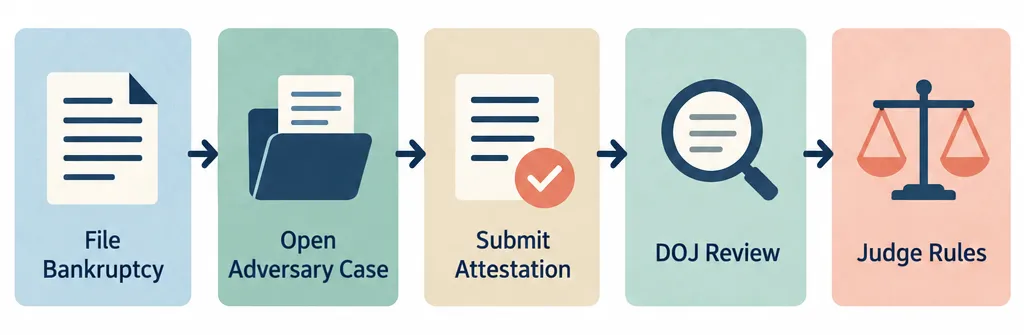
For federal loans, the Justice Department and the Education Department issued guidance on November 17, 2022, that changed how government lawyers respond. You fill out a sworn attestation about your finances. If the facts meet the guidance, the Assistant U.S. Attorney (AUSA) handling your case can agree to them and recommend discharge to the judge. DOJ revised the attestation form in May 2025, and the three-part framework stayed in place.
The process in order
- File for bankruptcy under Chapter 7 or Chapter 13, after completing the required credit counseling course.
- File an adversary proceeding. This is a separate complaint under Federal Rule of Bankruptcy Procedure 7001 asking the court to declare your student loans dischargeable.
- Serve the defendants. For federal loans, this means the Education Department and the U.S. Attorney’s office.
- An AUSA responds and typically asks you to complete the attestation form.
- DOJ reviews your form and documents, and decides whether to recommend full, partial or no discharge.
- Stipulation. If DOJ agrees, both sides file a stipulation of facts and the recommendation.
- The judge rules. The bankruptcy judge decides independently and isn’t bound by the recommendation.
What the attestation form asks
The form asks for your loan details, household size, income and expenses, along with your employment, education, health and repayment history. Expect to attach pay stubs, tax returns and bills.
How DOJ decides to recommend discharge
DOJ looks at the same three Brunner questions, with set benchmarks:
- Present ability to pay: your expenses are compared with the IRS Collection Financial Standards, allowances the IRS uses for living costs. Expenses above those standards can still count if you explain them.
- Future inability to pay: DOJ presumes hardship will continue if you are 65 or older, have a disability or chronic injury, have been unemployed at least five of the past ten years, didn’t finish the degree the loans paid for, or have had loans in repayment status for ten or more years.
- Good faith: a single payment, an application for deferment, forbearance or income-driven repayment, or contact with your servicer can count.
If DOJ doesn’t recommend discharge
You can still ask the judge to rule after a trial, negotiate a partial discharge, or dismiss the complaint and pursue other options. Without a stipulation, the case looks more like old-style litigation, and having a lawyer matters a great deal.
Build your good-faith file now
Keep every payment record, income-driven repayment application, forbearance letter and note of hardship. These records are your evidence for the good-faith prong.
Success rates over time, and what each number measures
The 0.1% and the 98% figures measure different things, so you can’t compare them directly. The old figure counts all bankruptcy filers with student debt, and almost none of them ever filed the adversary proceeding. DOJ’s figure counts only cases a court had already decided.
| Source | Period | Figure | What it counts |
|---|---|---|---|
| Iuliano, Duke Law Journal (2020) | Pre-2022 data | About 0.1% got relief | All bankruptcy filers with student debt |
| DOJ, first-year report (Nov 2023) | Nov 2022 to Nov 2023 | 99% full or partial discharge | Cases where courts had entered orders or judgments |
| Inside Higher Ed, DOJ data | First 10 months | 632 cases filed; 99% of resolved cases discharged in full or part | Filed and resolved cases |
| DOJ, continuing-success report | Nov 2022 to March 2024 | 1,220 cases filed; 98% full or partial discharge | Cases decided by courts |
So, is the attestation really as easy as people say? For the cases that reach a decision, the government overwhelmingly agrees to some relief. Cases still pending, withdrawn or dismissed aren’t in that 98%. Partial discharges count as wins in the data too.
Did you know?
In its first-year report, the Justice Department said that in 99% of cases where courts had entered orders, the government recommended full or partial discharge of federal student loans and the court agreed.
Private student loans: two paths
Private loans have no DOJ process. Either you prove undue hardship against the lender, or you show the loan falls outside §523(a)(8) and gets discharged like other unsecured debt.
When a private loan is a “qualified education loan”
If the loan paid for qualified costs at an eligible college and stayed within the cost of attendance, the undue-hardship rule applies. Lenders and loan trusts fight these cases more often than DOJ does, though many settle for a reduced balance before trial. Bring your promissory note, the school’s cost-of-attendance figures for your years, disbursement records and a full budget to any consultation.
Loans outside §523(a)(8)
Three federal appeals courts have narrowed what counts as a nondischargeable private student loan:
- Fifth Circuit (In re Crocker): a bar exam study loan was not an “educational benefit” covered by the statute.
- Second Circuit (Homaidan v. Sallie Mae, 2021): the “obligation to repay funds received as an educational benefit” clause covers only a narrow category of conditional payments, not all private student loans.
- Tenth Circuit (McDaniel v. Navient): private loans that don’t fit the statute’s categories can be discharged without proving undue hardship.
That explains why someone online says they “beat Navient.” The case is real, but it doesn’t make every private loan dischargeable. It turns on what the loan paid for and how much.
Cosigners: what happens to them
Your bankruptcy discharge protects only you. A parent or other cosigner stays fully liable unless they get their own discharge or the loan’s terms release them.
Where you live matters
Bankruptcy is federal law and available in every state, but the federal appeals court that covers your state shapes the rules. Here is how the key rulings line up.
| Circuit | States | What applies |
|---|---|---|
| Second | New York, Connecticut, Vermont | Brunner test; Homaidan limits which private loans are protected |
| Fifth | Texas, Louisiana, Mississippi | Brunner test; Crocker covers bar study loans |
| Tenth | Colorado, Kansas, New Mexico, Oklahoma, Utah, Wyoming | Brunner test; McDaniel limits which private loans are protected |
| Eighth | Arkansas, Iowa, Minnesota, Missouri, Nebraska, North Dakota, South Dakota | Totality of the circumstances test |
State law matters too. Your state’s bankruptcy exemptions decide what property you keep in Chapter 7, and state statutes of limitations limit how long private lenders can sue.
Chapter 7 vs Chapter 13: what happens to your student loans
In both chapters, the automatic stay under 11 U.S.C. §362 stops collection, including wage garnishment, as soon as you file. The difference is what happens next.
| Issue | Chapter 7 | Chapter 13 |
|---|---|---|
| Length | Usually a few months | 3 to 5 year repayment plan |
| Eligibility | Income below your state median or passing the means test | Regular income; within debt limits |
| Court filing fee | $338 | $313 |
| Collection | Stopped while the case is open | Stopped for the life of the plan |
| Student loan interest | Keeps accruing | Keeps accruing |
| Student loans at discharge | Survive unless you win an adversary proceeding | Remaining balance survives unless you win an adversary proceeding |
| Other debts | Most unsecured debts wiped out | Unsecured debts paid in part, rest discharged at the end |
| FY2026 filings (12 months to Sept 30, 2026) | 391,386 | 219,116 |
What happens to student loans in Chapter 7
Credit cards, medical bills and other unsecured debts are usually discharged within months. Student loans stay unless you file the adversary proceeding. Should you file Chapter 7 just to get rid of credit cards so you can afford your student loan payments? For some borrowers, that is a sound plan. Freeing up a few hundred dollars a month can make an income-driven plan workable, and you can still file the student loan claim during the case or later.
What happens to student loans in Chapter 13
In a chapter 13 repayment plan, student loans usually get the same pro-rata share as other unsecured debts. Interest keeps running, so you may owe more at the end. You can file the adversary proceeding during the plan.
Already filed? Reopening a closed case
If your bankruptcy is finished and your loans are still there, your attorney probably didn’t make a mistake. The standard discharge never covers student loans. Federal Rule of Bankruptcy Procedure 4007(b) lets a dischargeability complaint for student loans be filed at any time, and you can ask the court to reopen your old case for it. Many courts waive the reopening fee for this purpose, but practice varies by district.
Ask the right question
When you consult a bankruptcy attorney, ask directly whether they file student loan adversary proceedings. Many don’t, and the standard discharge won’t touch your loans.
What it costs and what it does to your credit
The court fees are modest. Legal fees and the hit to your credit are the real costs. As of the current federal fee schedule, a Chapter 7 petition costs $338 and Chapter 13 costs $313. Chapter 7 filers with low income can apply to have the fee waived. Adversary complaints carry a $350 fee, but many court fee schedules don’t charge it when the debtor is the plaintiff, so check your court’s schedule.
The table below shows the money at stake on a typical balance, using an illustrative 6.5% fixed rate.
| Scenario | Amount | Rate | Term | Monthly payment | Total repaid |
|---|---|---|---|---|---|
| Standard 10-year repayment | $60,000 | 6.5% | 10 years | About $681 | About $81,756 |
| Extended 25-year repayment | $60,000 | 6.5% | 25 years | About $405 | About $121,536 |
| Rosen-style history (IDR payments below interest) | $60,000 borrowed | Varies | Many years | Varies | $38,000 paid, $63,000+ still owed |
How the math works: on the 10-year plan, roughly $21,756 of the total is interest. Stretching the same loan to 25 years cuts the payment by about $276 a month, but adds nearly $40,000 more in interest. When payments don’t cover interest at all, as in Rosen, the balance grows no matter how long you pay.
Credit impact. Under the Fair Credit Reporting Act, a bankruptcy can stay on your credit report for up to 10 years. The major bureaus typically remove a completed Chapter 13 after seven. Many filers already have damaged credit from missed payments, so the extra damage is often smaller than people fear.
Can you file the adversary proceeding yourself? Yes. Self-represented borrowers do use the attestation process. Legal aid offices, law school clinics and some pro bono programs help with these cases, and that help matters most when a private lender or guaranty agency contests the claim.
Is bankruptcy worth it right now? The November 2026 picture
For many federal borrowers, the timing is unusual. Collections are paused, a new repayment plan just launched, and more people are filing for bankruptcy. Each of these shifts changes the calculation.
- Filings are rising. According to the federal judiciary, non-business bankruptcy filings rose 11.4% to 594,057 in the 12 months ending September 30, 2026.
- Delinquency is high. The New York Fed’s Q3 2026 report, released November 10, 2026, puts student loan balances at $1.66 trillion, with 10.9% of balances 90 or more days delinquent, up from 10.6% the quarter before.
- Involuntary collections are paused. On January 16, 2026, the Education Department announced it would delay administrative wage garnishment and Treasury Offset Program collections. As of early November 2026, no restart date had been announced.
- RAP launched July 1, 2026. The Repayment Assistance Plan is the only income-driven option for loans first disbursed on or after that date. ICR, PAYE and REPAYE phase out through July 2028, and Income-Based Repayment (IBR) remains. Nearly 46,000 borrowers applied for RAP on launch day.
- Deferments are shrinking. The One Big Beautiful Bill Act (Pub. L. 119-21) phases out economic hardship and unemployment deferments.
What this means for the decision: the pause takes away the urgency to file just to stop garnishment for now. A cheap income-driven payment can also make a judge or DOJ question whether you truly can’t pay. On the other side, an IBR or RAP payment that never touches the principal, like the one in Rosen, supports the argument that repayment is futile. And any time you spent enrolled in these plans counts as evidence of good faith.
Cheaper options first
Check IBR or RAP on StudentAid.gov before paying for any court case. If you have a disability, a total and permanent disability discharge is free and needs no court. Nonprofit credit counseling can help with the rest of your budget.
Alternatives for federal loans
- Income-driven repayment: IBR or RAP ties payments to income.
- Rehabilitation or consolidation: both can get a defaulted loan back in good standing.
- Total and permanent disability discharge: you qualify with Social Security Administration records or a physician’s certification. If you’re on disability and will never repay, this is usually faster and cheaper than bankruptcy. Being over 65 or disabled also helps an undue-hardship case if TPD doesn’t fit.
- Closed school and borrower defense discharges: for schools that closed or misled students.
Alternatives for private loans
Ask the lender about hardship programs, reduced-interest plans or a lump-sum settlement. Check your state’s statute of limitations before paying a very old debt. Under the Fair Debt Collection Practices Act, a debt collector working a private loan can’t harass you or misstate what you owe.
The “7-year rule” and other myths
There is no current rule that student loans become dischargeable after seven years. That waiting period existed in the past and was repealed in 1998. The separate seven-year credit-report window removes old negative marks from your report, but it does not cancel the debt.
| Year | Change | Effect on borrowers |
|---|---|---|
| 1976 | Education Amendments of 1976 limit discharge of federal loans | Loans dischargeable only after 5 years in repayment, or with undue hardship |
| 1978 | Bankruptcy Reform Act adds §523(a)(8) to the Bankruptcy Code | 5-year rule written into bankruptcy law |
| 1990 | Waiting period extended | 7 years instead of 5 |
| 1998 | Higher Education Amendments of 1998 | Waiting period removed; only undue hardship remains |
| 2005 | BAPCPA | Private qualified education loans added to the rule |
| 2022 | DOJ and Education Department guidance | Attestation process for federal loans |
Did you know?
According to the American Bankruptcy Institute, federal student loans could once be discharged after a waiting period of 5 years, then 7 from 1990, until Congress removed that option entirely in 1998.
What happens if you never pay your student loans
For federal loans, default usually comes after about 270 days without payment. The government can then garnish up to 15% of your disposable pay without going to court, take tax refunds through the Treasury Offset Program, and add collection costs. Federal student loans have no statute of limitations. Private lenders must sue you to garnish wages, and they have to do it within your state’s time limit. After that, the debt can still exist but can’t be enforced in court.
Will the law change?
Not yet. The Private Student Loan Bankruptcy Fairness Act of 2025 (H.R. 423), reintroduced on January 15, 2025, by Reps. Steve Cohen, Danny Davis and Eric Swalwell, would remove private loans from §523(a)(8). It was referred to the House Judiciary Committee and has not become law. Plan around the current rules, not around bills.
Your existing rights already help. Under 11 U.S.C. §525(c), the government cannot deny you federal student aid just because you filed bankruptcy. If a lender or servicer mishandles your account, you can file a complaint with the Consumer Financial Protection Bureau or contact the Federal Student Aid Ombudsman.
FAQ
Can you declare bankruptcy on student loans?
Yes. You file Chapter 7 or Chapter 13 and also file an adversary proceeding asking the court to find undue hardship. Without that second step, the loans survive.
Does Chapter 7 bankruptcy forgive student loans?
Not automatically. Chapter 7 wipes out most other unsecured debts. Student loans are usually discharged only if a court finds undue hardship, typically by winning the adversary proceeding, though a court may grant discharge without a contested case when no factual or legal dispute remains. A private loan that falls outside §523(a)(8) can also be discharged.
What happens to student loans in Chapter 7?
Collection stops while the case is open because of the automatic stay. Interest keeps accruing. When the case ends, the loans remain unless a judge has ruled them dischargeable.
Can student loans be discharged in Chapter 13?
Yes, through the same adversary proceeding, which you can file during the plan. Otherwise any unpaid balance survives the Chapter 13 discharge.
Can you declare bankruptcy on private student loans?
Yes. Qualified education loans need proof of undue hardship against the lender. Loans for bar study, unaccredited schools or amounts above cost of attendance may be dischargeable without that test in some circuits.
My private loan was discharged but my federal loans weren’t. Why?
Your private loan likely fell outside §523(a)(8), or the lender settled. Federal loans needed their own adversary proceeding, which you can still file by reopening the case.
What is the 7-year rule on student loans?
It was an old waiting period that let borrowers discharge loans after seven years in repayment. Congress repealed it in 1998. It does not apply today.
Why can’t you file bankruptcy on student loans?
You can. The law sets a higher bar, undue hardship, because Congress chose to protect lenders and the federal loan program from early bankruptcy filings.
Will filing bankruptcy stop wage garnishment for my defaulted student loans?
Yes, while the case is open, because the automatic stay halts garnishment. Federal garnishment has been paused since January 2026 anyway, but it can return once the stay ends if the loans aren’t discharged.
I’m 60+ with $100,000 in loans and IBR payments don’t cover interest. Do I qualify?
You may have a strong case. DOJ presumes continuing hardship at 65 or older, after ten or more years in repayment, or with a disability. Courts, including the Rosen court, have treated payments that don’t cover interest as a sign that repayment is futile.
How can I legally get rid of student loans?
The main routes are a bankruptcy discharge through undue hardship, a disability, closed-school or borrower-defense discharge, forgiveness after years on IBR or RAP, or a negotiated settlement with a private lender.
What is an adversary proceeding?
It is a lawsuit filed inside your bankruptcy case under Federal Rule of Bankruptcy Procedure 7001. For student loans, it asks the judge to declare the debt dischargeable.
If you are weighing this now, start by listing every loan, its holder and its type. That one list tells you which route applies, which questions to ask a lawyer or legal aid office, and whether a free federal option could fix the problem before you go to court.
Laws and regulations referenced
- Fair Debt Collection Practices Act, 15 U.S.C. 1692
- Fair Credit Reporting Act, 15 U.S.C. 1681
- Bankruptcy Code, Chapter 7, 11 U.S.C. 701
Links go to the official text on government sites.
Check, verify or complain
Sources
- Bankruptcy Filings Increase 11.4 Percent uscourts.gov · primary source
- Bankruptcy filings by chapter, 12 months ending Sept 30, 2026 uscourts.gov · primary source
- Justice Department and Department of Education Announce Successful First Year of New Student Loan Discharge Process justice.gov · primary source
- Justice Department and Department of Education Announce Continuing Success of Student Loan Discharge Process justice.gov · primary source
- U.S. Department of Education Delays Involuntary Collections ed.gov · primary source
- Filing Fees, U.S. Bankruptcy Court S.D. Mississippi mssb.uscourts.gov · primary source
- Fee Schedule, U.S. Bankruptcy Court N.D. Texas txnb.uscourts.gov · primary source
- Congressmen Cohen, Davis and Swalwell Reintroduce Private Student Loan Bankruptcy Fairness Act cohen.house.gov · primary source
- H.R. 423, 119th Congress congress.gov · primary source
- Inside Higher Ed: student loan bankruptcy process results insidehighered.com
- The DOJ Student Loan Attestation Form: What It Covers & How the Process Works tateesq.com
- Reconsidering Bankruptcy's Place in Student Debt Relief zuckerman.com
- Student Loan Wage Garnishment Returns thecollegeinvestor.com
- Student Loan Update: Report Warns That Millions Could See Wage Garnishment newsweek.com
- What Is the New Repayment Assistance Plan (RAP) nerdwallet.com
- Nearly 46,000 Borrowers Applied for the New RAP Plan on Day One thecollegeinvestor.com
- Household Debt Increased Moderately; Delinquency Transition Rates Remain Flat newyorkfed.org
- Student Loan Delinquency Hits 10.9% In New York Fed Q3 2026 Report thecollegeinvestor.com
- Second Circuit Holds That Certain Private Student Loans May Be Dischargeable jonesday.com
- Not All Student Loans Are Nondischargeable, Tenth Circuit Holds dev.abi.org
- Consensus Builds That Some Private Student Loans Can Be Discharged in Bankruptcy nelsonmullins.com

Marcus covers credit scores, credit reports and getting out of debt: consolidation, nonprofit counseling, settlement and what debt collectors may and may not do. He works from the federal laws that apply, CFPB guidance and the credit bureaus' published rules.
Ruth is US Financer's standards editor. Every article goes through her checks before and after it is published: each rate, fee, cap, deadline and rule is matched against its primary source, every law named is linked to its official text, and anything that cannot be…
Comments are closed