


We are not a credit repair, debt relief or debt collection company and offer no services. Rules differ by state, so confirm with the agency or a nonprofit counselor before you act.
Under federal law, one written sentence asking a debt collector to stop is enough to make it stop calling, texting, emailing and mailing you, from the day the letter arrives. A cease and desist letter does not erase the debt, stop a lawsuit or wipe a collection off your credit report. It makes the most sense once you know the debt is valid and you want the contact to end, or alongside a written dispute if you don’t think you owe it.
WARNINGRelated consumer alert, Nov 12, 2026
Pennsylvania AG warns veterans who paid Trajector to consider bankruptcy claimsKey takeaways
- A written or electronic request makes a third-party collector stop contacting you from the moment it receives the request.
- After that, the collector may only tell you it is stopping, or that it or the creditor may or will use a specific remedy, such as a lawsuit.
- The letter does not cancel the debt, stop a lawsuit or remove credit reporting. If you get a court summons, you still have to answer it.
- If you aren’t sure you owe the debt, dispute it within 30 days of the validation notice, either before the cease letter or in the same letter.
- If a collector ignores your letter, you have one year from the violation to sue under the FDCPA.
Fact-checked
We checked these key facts against the sources named, on November 13, 2026:
- The $1,000 cap applies per lawsuit, not per call (source: uscode.house.gov)
- You can recover actual damages, up to $1,000 in statutory damages per lawsuit, and attorney’s fees (source: cpmlegal.com)
- Under 15 U.S.C. §1692k, the FDCPA’s $1,000 in statutory damages is capped per lawsuit, not per illegal call (source: cpmlegal.com)
- Twenty calls after your letter do not add up to $20,000, though your actual damages and attorney’s fees are recoverable on top (source: cpmlegal.com)
- The CFPB’s November 2025 FDCPA report noted that the FTC was the only agency to announce public FDCPA enforcement actions in 2024 (source: cutimes.com)
What a cease and desist letter does (and doesn’t do)
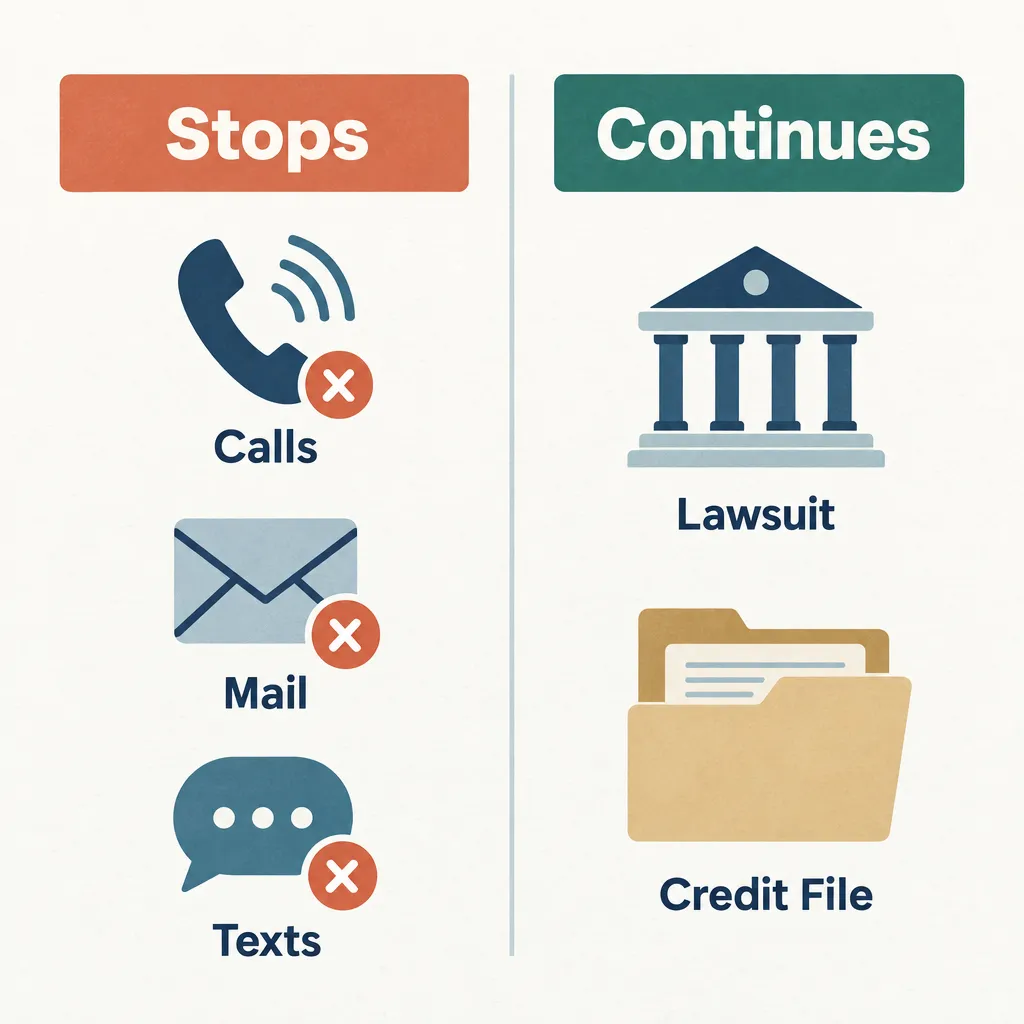
A cease and desist letter is a written notice telling a debt collector to stop communicating with you, or telling it that you refuse to pay. Either one triggers the same legal duty: the collector must stop contacting you about that debt. The debt itself stays where it was. So does the collector’s or creditor’s right to take you to court.
The law behind it: 15 U.S.C. §1692c(c) and 12 CFR 1006.6(c)
Two rules work together. Section 805(c) of the Fair Debt Collection Practices Act, codified at 15 U.S.C. §1692c(c), says that if you notify a debt collector in writing that you refuse to pay, or that you want it to stop communicating with you, it must stop. The statute adds that a notice sent by mail “shall be complete upon receipt.” The clock starts when the collector gets the letter, not when you mail it.
Regulation F (12 CFR Part 1006) is the Consumer Financial Protection Bureau’s rule implementing the FDCPA. It has been in force since November 30, 2021. Section 1006.6(c) repeats the cease-communication duty. The CFPB’s official commentary adds that the notice can be sent electronically, through any medium the collector accepts for consumer communications, and is complete when the collector receives it.
A phone request is not enough for a full stop. A full cease or refusal to pay must be in writing or electronic. A narrower request, such as “don’t call me at work” or “don’t text this number,” can be made out loud.
| Action | After the collector receives your letter | Legal basis |
|---|---|---|
| Phone calls, texts, voicemails | Must stop | 15 U.S.C. §1692c(c); 12 CFR 1006.6(c) |
| Collection letters and emails | Must stop, except the limited notices below | Same |
| Social media messages | Must stop | 12 CFR 1006.6(c) covers all communication attempts |
| A notice that collection is ending | Allowed | §1692c(c)(1) |
| A notice that a lawsuit or other remedy may or will be used | Allowed | §1692c(c)(2) and (3) |
| A lawsuit against you | Still possible | The letter limits contact; it does not limit court action |
| Reporting to Equifax, Experian, TransUnion | Can continue | The cease rule covers communication with you |
| Selling or returning the account | Still possible | The debt still exists |
| The debt itself | Still owed if valid | Nothing in §1692c(c) cancels it |
The only messages a collector can still send you
Once your letter arrives, the statute allows only three kinds of contact. In the words of 15 U.S.C. §1692c(c), the collector may communicate:
- “to advise the consumer that the debt collector’s further efforts are being terminated”;
- “to notify the consumer that the debt collector or creditor may invoke specified remedies which are ordinarily invoked by such debt collector or creditor”; or
- “where applicable, to notify the consumer that the debt collector or creditor intends to invoke a specified remedy.”
The CFPB groups these into two messages: “we’re stopping,” or “we may or will take a specific step, such as suing you.” Anything beyond that is a likely violation. A “settlement offer” letter, a friendly reminder text or a “just checking in” call all fall outside the exceptions.
What it can’t stop: lawsuits, credit reporting, the debt itself
The letter controls how a collector talks to you. It does not control what the collector or creditor does elsewhere. A lawsuit is the most serious of these. A collector that can no longer phone you has fewer ways to collect, and for some accounts that makes court the next step. That is the honest counter-argument to sending the letter. For a valid debt within the statute of limitations, silence can bring a summons instead of a phone call.
The letter also doesn’t make the debt disappear. If the creditor recalls the account and sells it, the buyer can start collecting again.
Does it work on the original creditor, a hospital or your bank?
Under federal law, mostly no. The FDCPA and Regulation F cover third-party debt collectors and debt buyers whose main business is collecting debts. A hospital, card issuer, bank or utility collecting its own debt under its own name is generally not a “debt collector” under the federal act. A cease letter to your bank carries no federal force, though many creditors will honor a written request anyway.
State law can fill the gap. California’s Rosenthal Fair Debt Collection Practices Act covers original creditors collecting their own debts. Massachusetts’s debt collection regulation, 940 CMR 7.00, also applies to creditors. The state section below covers both.
Which letter should you send? Validation, limited contact or full stop
Pick your letter by what you want to happen next. A full stop is the right choice when you want silence and you’re ready for whatever comes after it. When you aren’t sure the debt is yours, or you still want to negotiate, a different letter usually works better.
| Your situation | Send this | Deadline or timing | What it gets you |
|---|---|---|---|
| You don’t recognize the debt or the amount looks wrong | Written dispute (validation request), Template 2 if you also want contact to stop | Within 30 days of receiving the validation notice | Collection must pause until the collector mails verification (15 U.S.C. §1692g(b)) |
| You want to negotiate or settle | Limited-contact request (Template 4) | Any time | Contact continues on your terms, such as mail only and no work calls |
| You want all contact to end | Full cease letter (Template 1) | Any time; effective on receipt | Contact stops except the closing or remedy notices |
| The debt is old and may be time-barred | Time-barred version (Template 3) | Any time; check your state’s limit first | Contact stops; nothing in the letter acknowledges the debt |
| You’ve been served with a lawsuit | Talk to a consumer attorney or legal aid office | By the answer deadline on the summons | A defense in court. A letter is not a defense. |
| You have a lawyer | Tell the collector your attorney’s name and contact details | Any time | The collector generally may not contact you directly about the debt once it knows you have a lawyer and can readily ascertain the lawyer’s contact details, unless the lawyer consents or fails to respond in a reasonable time (15 U.S.C. §1692c(a)(2)) |
If you don’t recognize the debt or the amount
Dispute first. Under 15 U.S.C. §1692g, a collector must send a validation notice. Under Regulation F, that notice shows the date your 30-day dispute window ends. If you dispute in writing within that window, the collector must stop collecting until it mails you verification.
The CFPB’s FDCPA Annual Report (published November 2025) found that about 45% of the 2024 debt collection complaints it handled were about debts consumers said they did not owe. Wrong-person and wrong-amount errors are common.
Dispute before you go silent
If you’re still inside the 30-day window and aren’t sure the debt is yours, send the dispute first or use the combined dispute-and-cease letter. A plain cease letter can leave you with no paperwork showing what the collector says you owe.
If you want to negotiate or settle
Don’t cut off all contact. A full cease letter blocks settlement offers by phone too. Regulation F §1006.14(h) lets you tell a collector not to use a particular medium of communication, such as telephone calls, text messages or email. The FDCPA’s §1692c(a) also bars calls at inconvenient times and calls at work when the collector knows your employer prohibits them. A “mail only” request keeps the paperwork flowing without the phone calls.
If the debt may be time-barred
Each state sets a statute of limitations for suing on a debt, often three to six years and longer in some states. Under Regulation F §1006.26(b), a collector may not sue or threaten to sue you on a time-barred debt. The risk runs the other way too. In some states a payment, or a written acknowledgment of the debt, can restart the limitations clock. If the debt is “from like 8 years ago,” your letter should ask for silence and admit nothing. It should not include any payment or any promise to pay.
If you’ve already been sued or have a lawyer
If you’ve been sued, a cease letter does nothing for the case. The court’s deadlines apply no matter what you send the collector. If you’ve hired a lawyer, sending the collector your attorney’s details generally means the collector may not contact you directly about the debt, with limited exceptions.
What to include in your letter
A cease letter has no required wording. It needs to identify you and the account, ask clearly for communication to stop, and leave out anything that admits the debt. Have these ready before you start:
- The collector’s validation notice or most recent letter
- The collector’s exact name and mailing address, preferably the correspondence or dispute address on its notice
- The account or reference number the collector uses
- The original creditor’s name, if the notice lists it
- The date you first heard from this collector, and the date of your last payment on the original account if you know it
- A recent copy of your credit reports from Equifax, Experian and TransUnion, to check how the account is reported
The letter itself should state:
- Your name and mailing address (the address on the collector’s file, so it can match the account)
- The date, and the certified mail article number
- The account or reference number
- A clear request to stop all communication, naming every channel
- The legal citation (15 U.S.C. §1692c(c) and 12 CFR 1006.6(c)). It isn’t required, but it removes any doubt about what you’re asking.
- A statement that the letter is not an acknowledgment of the debt
- Your signature
Leave out your full Social Security number, your bank details and your employer’s name.
Free cease and desist letter templates
Copy the version that fits your situation and replace every field in [SQUARE BRACKETS]. Delete any line that doesn’t apply. Keep the tone flat and factual.
How to use the templates
- Template 1 is the standard full stop.
- Template 2 is for when you’re within the 30-day dispute window or doubt the debt.
- Template 3 is for old debts that may be past the statute of limitations.
- Template 4 only limits contact and keeps negotiation open.
Templates 1 to 3 match the “stop contact” approach in the CFPB’s own sample debt collection letters, published on consumerfinance.gov. Templates 2 and 3 add dispute and no-acknowledgment language.
Template 1: Stop all contact
[Your full name], [Your street address], [City, State ZIP]
[Date you mail the letter]
Sent by USPS Certified Mail, Return Receipt Requested, No. [Certified mail article number]
[Debt collector’s company name], [Collector’s mailing address from its notice], [City, State ZIP]
Re: Account or reference number [Number from the collector’s notice]. Original creditor as stated in your notice: [Original creditor name].
To whom it may concern:
Under the Fair Debt Collection Practices Act, 15 U.S.C. §1692c(c), and Regulation F, 12 CFR 1006.6(c), I request that you cease all further communication with me about the account referenced above.
This request covers every method of contact, including telephone calls to any number, text messages, voicemails, email, letters, social media messages, and contact at my home or my place of employment. Do not contact my family, my employer or other third parties about this account except as 15 U.S.C. §1692c(b) permits.
After you receive this letter, you may contact me only for the purposes 15 U.S.C. §1692c(c) allows: to tell me that your collection efforts are ending, or to tell me that you or the creditor may invoke, or intend to invoke, a specific remedy.
This letter is not an acknowledgment that I owe this alleged debt and is not a promise to pay any amount.
I am keeping a record of any communication I receive from you after the date you receive this letter.
Sincerely,
[Your signature]
[Your printed name]
Template 2: Dispute the debt and stop contact
[Your full name], [Your street address], [City, State ZIP]
[Date you mail the letter]
Sent by USPS Certified Mail, Return Receipt Requested, No. [Certified mail article number]
[Debt collector’s company name], [Collector’s mailing address from its notice], [City, State ZIP]
Re: Account or reference number [Number from the collector’s notice]
To whom it may concern:
I dispute the alleged debt referenced above [in full / in the amount of $[Disputed amount]]. Under 15 U.S.C. §1692g(b), please provide verification of the alleged debt and the name and address of the original creditor. Until you do, you must stop collection of this alleged debt.
I also request, under 15 U.S.C. §1692c(c) and 12 CFR 1006.6(c), that you cease all other communication with me about this account by telephone, text message, email, social media, or at my place of employment. The only communication I agree to receive is written verification mailed to the address above, plus the notices 15 U.S.C. §1692c(c) permits.
If you report this account to any consumer reporting agency, you must report it as disputed (15 U.S.C. §1692e(8)).
This letter is not an acknowledgment that I owe this alleged debt and is not a promise to pay any amount.
Sincerely,
[Your signature]
[Your printed name]
The trade-off is real. A collector that decides to stop collecting altogether never has to send the verification. If seeing the collector’s documents matters more to you than quiet, send the dispute alone first and the cease letter later.
Template 3: Old (possibly time-barred) debt
[Your full name], [Your street address], [City, State ZIP]
[Date you mail the letter]
Sent by USPS Certified Mail, Return Receipt Requested, No. [Certified mail article number]
[Debt collector’s company name], [Collector’s mailing address from its notice], [City, State ZIP]
Re: Account or reference number [Number from the collector’s notice]
To whom it may concern:
I do not acknowledge the alleged debt referenced above. I make no promise to pay it, in whole or in part, and nothing in this letter should be treated as an acknowledgment, a promise to pay, or an agreement to any amount or date.
Under 15 U.S.C. §1692c(c) and 12 CFR 1006.6(c), I request that you cease all further communication with me about this account by any method, including telephone, text message, email, letters, social media, and contact at my place of employment, except as 15 U.S.C. §1692c(c) permits.
I am also aware that under 12 CFR 1006.26(b), a debt collector may not bring or threaten to bring a legal action to collect a time-barred debt.
Sincerely,
[Your signature]
[Your printed name]
Template 4: Limit contact instead of stopping it
[Your full name], [Your street address], [City, State ZIP]
[Date you mail the letter]
[Debt collector’s company name], [Collector’s mailing address from its notice], [City, State ZIP]
Re: Account or reference number [Number from the collector’s notice]
To whom it may concern:
Under 12 CFR 1006.14(h) and 15 U.S.C. §1692c(a), I request that you communicate with me about the account referenced above only by letter mailed to the address above.
Do not call me at [Phone number(s)] or at any other number. Do not text me, email me, or contact me through social media. Do not contact me at work: my employer prohibits these communications.
This letter is not an acknowledgment that I owe this alleged debt.
Sincerely,
[Your signature]
[Your printed name]
Words to leave out
Phrases like “my debt,” “I know I owe this,” “I’ll pay when I can” or “I can only afford $50 a month” can be read as acknowledging the debt. For an old account, that can matter under your state’s statute of limitations. Leave out threats, insults and anything you can’t back up, because the letter may end up in front of a judge.
Say "the alleged debt"
Refer to “the alleged debt” or “the account referenced above,” never “my debt,” and make no offer of payment in a cease letter. Put the certified mail article number on the letter itself so the letter and the receipt match.
How to send it so it holds up
Send the letter in a way that proves the collector received it, because receipt is when the law starts protecting you. USPS Certified Mail with a return receipt is the standard method. Email or an online portal works if the collector accepts electronic communications from consumers.
How to send your cease letter
- Fill in the template, print two copies and sign both. Keep one.
- At the post office, send it by USPS Certified Mail with Return Receipt (the green card or the electronic receipt).
- Address it to the collector’s mailing address from its validation notice or latest letter.
- Write the article number on your copy and staple the mailing receipt to it.
- Track delivery. The delivery date is the date the collector’s duty to stop begins.
- Start your contact log that day.
Mail or email?
Both are valid under Regulation F. Certified mail gives you a dated, independent delivery record, which is the strongest evidence if the collector later claims it never got your letter. Email or a portal is faster. If you use it, send from an address you control, keep the sent message, and screenshot any confirmation page or ticket number.
If you’re worried the letter might not arrive, you can send it both ways.
What to keep in your file
Keep a copy of the signed letter, the certified mail receipt, the tracking printout showing delivery, and the return receipt when it comes back. Add the collector’s original notices. Also add every letter, text and voicemail you get afterward, with the date. Treat the file as evidence, because if you ever have to enforce the letter, that is what it becomes.
What happens after the collector gets your letter
The expected result: calls, texts and collection letters stop. You may get one written notice saying the collector is closing its file, or that it or the creditor may sue or take another specific step. Then one of three things usually happens. The account sits quietly, it goes back to the original creditor, or it is sold or placed with a new collector.
If the debt is sold to a new collector
Your letter binds the collector you sent it to. If the debt is sold or reassigned, the new collector has to send its own validation notice, and you need to send that company its own cease letter. Readers often ask: “The debt got sold to a different agency and they started calling again, do I have to send another letter?” Yes. Treat each new company as a fresh start, and check its notice for a new 30-day dispute window.
If you get sued anyway
“I sent a cease and desist and now they’re suing me, did I make it worse?” Not in a legal sense. The letter didn’t create the lawsuit right, which existed already. It may have moved the timing up, because the collector lost its phone channel. What matters now is answering the summons by the deadline printed on it. If you don’t answer, the court can enter a default judgment, which can lead to wage garnishment or a bank levy, depending on your state.
Defenses such as “this isn’t my debt,” “the amount is wrong” or “it’s past the statute of limitations” generally have to be raised in your court answer. The court won’t apply them for you. This is where a consumer attorney or a legal aid office earns its keep. Many consumer attorneys take FDCPA cases because the law makes a collector who loses pay your attorney’s fees.
Will it show on your credit report?
A cease letter doesn’t remove anything from your credit reports. A collector can keep reporting the account, update it, or start reporting it later. Before a collector first reports a debt, Regulation F §1006.30(a) requires it to speak with you or send you a letter or electronic message, then wait a reasonable time. The CFPB’s commentary treats 14 consecutive days after mailing as reasonable. After that, a cease letter doesn’t block reporting. Under the Fair Credit Reporting Act, most collection accounts can stay on your report for about seven years from the original delinquency.
“They stopped calling but it’s still on my credit report, is that legal?” Usually, yes. If you disputed the debt, though, the collector must report it as disputed (15 U.S.C. §1692e(8)). If the entry is wrong, file a separate dispute with Equifax, Experian or TransUnion, which generally have 30 days to investigate.
Risks of sending a cease and desist letter
Most people should weigh four risks before sending a full stop. Each one has a way to reduce it.
| Risk | Why it happens | How to reduce it |
|---|---|---|
| A lawsuit becomes more likely | The collector has no other way to reach you | Check the statute of limitations, and answer any summons on time |
| You lose phone settlement offers | All negotiation by phone ends | Use the limited-contact letter (Template 4) instead |
| Credit reporting continues | The cease rule covers contact, not reporting | Dispute errors with the bureaus; include dispute language (Template 2) |
| A careless letter admits the debt | Phrases like “my debt” or a payment offer | Use “the alleged debt” and make no payment promise |
| You never see the collector’s proof | It can stop collecting instead of verifying | Send the dispute first if you need documents |
The long view matters too. If the debt is valid, recent and large, a cease letter buys quiet but not a solution. For that situation, nonprofit credit counseling, a hardship plan with the original creditor, or, for broader debt problems, a Chapter 13 repayment plan through bankruptcy may deal with the debt itself.
If they keep contacting you: how to enforce the letter
If a collector keeps calling, texting or sending collection letters after it received your letter, it has likely violated the FDCPA. Document every contact, file complaints, and talk to a consumer attorney about a lawsuit before the one-year deadline runs out.
Keep a violation log
Start the log the day the letter is delivered. Screenshot texts, save voicemails, and keep every envelope.
| Date | Time | Channel | Number or address used | Name or company given | What was said or sent | Evidence saved |
|---|---|---|---|---|---|---|
| [Date] | [Time] | Call / text / email / letter | [Caller ID or sender] | [Name] | [Short summary] | Voicemail / screenshot / envelope |
File complaints: CFPB, FTC and your state attorney general
- CFPB: File online at consumerfinance.gov or by phone at (855) 411-2372. The CFPB forwards complaints to the company. Its 2025 Consumer Response Annual Report says companies responded to 97% of the debt collection complaints sent to them.
- FTC: Report at ReportFraud.ftc.gov. The Federal Trade Commission enforces the FDCPA against most collectors. The CFPB’s November 2025 FDCPA report noted that the FTC was the only agency to announce public FDCPA enforcement actions in 2024.
- Your state attorney general, and your state’s collection-agency licensing regulator where one exists, such as California’s DFPI.
A complaint creates a record. It does not get you damages.
Suing under the FDCPA: damages and the one-year deadline
Under 15 U.S.C. §1692k, you can recover your actual damages (lost wages, out-of-pocket costs, emotional distress where proven), plus statutory damages of up to $1,000, plus court costs and reasonable attorney’s fees. The $1,000 cap applies per lawsuit, not per call.
You have one year from the date of the violation to sue. In Rotkiske v. Klemm (2019), the Supreme Court held that the clock runs from the violation itself, not from when you discover it.
| Worked example | Figure |
|---|---|
| Calls after your letter was delivered | 20 |
| Statutory damages available | Up to $1,000 total (not $20,000) |
| Actual damages | Whatever you can prove, such as unpaid time off work |
| Attorney’s fees | Paid by the collector if you win |
| Deadline to file | One year from each violation |
Did you know?
Under 15 U.S.C. §1692k, the FDCPA’s $1,000 in statutory damages is capped per lawsuit, not per illegal call. Twenty calls after your letter do not add up to $20,000, though your actual damages and attorney’s fees are recoverable on top.
When a consumer attorney or legal aid helps
This page explains the law. It is not legal advice. Talk to a consumer attorney or a legal aid office in these situations:
- you’ve been served
- the collector keeps contacting you after receiving your letter
- the debt may be time-barred
- the collector threatened arrest, wage garnishment without a judgment, or a lawsuit on a time-barred debt
Because the FDCPA shifts fees to a losing collector, many consumer attorneys take strong cases without charging you upfront. Servicemembers can also use their installation’s legal assistance office.
Calling and contact rules you can quote
Even without a cease letter, federal law limits how collectors contact you. These rules help if you choose the limited-contact route.
- Hours: No contact before 8 a.m. or after 9 p.m. your local time unless you agree (15 U.S.C. §1692c(a)(1)).
- Work: No contact at work if the collector knows or has reason to know your employer prohibits it (§1692c(a)(3)).
- Attorney: If the collector knows you have a lawyer for the debt and can readily ascertain the lawyer’s name and address, it generally may not contact you directly, unless the lawyer consents or fails to respond within a reasonable time (§1692c(a)(2)).
- Call frequency: Under Regulation F §1006.14(b)(2), more than seven calls in seven days about one debt, or a call within seven days after a phone conversation about that debt, creates a rebuttable presumption of a violation. It is counted per debt, the collector can try to rebut it, and some calls are excluded.
- Specific channels: Under §1006.14(h), you can tell a collector not to use a particular medium of communication, such as telephone calls, text messages or email. The collector may send only one message confirming it will honor your request.
- Email and texts: Under Regulation F §1006.6(e), every collection email or text must include a clear, simple way to opt out of that channel.
Limit instead of stopping
If you still want to work out a payment plan, ask for mail-only contact rather than a full stop. You keep the paper trail and the settlement options, without the calls.
State rules that add protection
Several states go further than federal law, and two stand out. California’s law reaches original creditors, and Massachusetts caps calls at two per week. State rules apply on top of the FDCPA, not instead of it.
| Rule | Federal (FDCPA / Reg F) | California | Massachusetts |
|---|---|---|---|
| Who must follow it | Third-party collectors and most debt buyers | Collectors and original creditors (Rosenthal Act) | 940 CMR 7.00 applies to creditors collecting debts |
| Call frequency | More than 7 calls in 7 days per debt is presumed a violation (rebuttable) | Federal standards apply through the Rosenthal Act | No more than 2 calls per 7 days to personal numbers; 2 per 30 days to other numbers (940 CMR 7.04(1)(f)) |
| Licensing | No federal license | DFPI license under the Debt Collection Licensing Act | State licensing for collection agencies |
| Deadline to sue a collector | One year from the violation | One year under the Rosenthal Act | Varies by claim |
California
The Rosenthal Fair Debt Collection Practices Act covers original creditors collecting their own debts, not only third-party collectors. Its section 1788.17 requires covered collectors to comply with the federal FDCPA’s sections 1692b through 1692j, which include the cease-communication rule. That gives a written stop request to a California creditor real legal weight.
Collectors also need a license from the Department of Financial Protection and Innovation (DFPI) under the Debt Collection Licensing Act. In February 2026, the DFPI entered a consent order against a debt collection firm accused of breaking state and federal collection laws while operating without that license. You can check a collector’s license with the DFPI before you engage with it.
Massachusetts
The Attorney General’s regulation at 940 CMR 7.04(1)(f) limits creditors to two calls, texts or recorded messages per seven-day period to your home, cell or personal number. Other numbers get two per 30 days. That is far stricter than the federal 7-in-7 presumption. In Armata v. Target Corp. (2018), the Supreme Judicial Court of Massachusetts held that the limit applies to creditors using automated dialing.
Other states
Look up your state’s statute of limitations for the type of debt (written contract, open account such as a credit card, promissory note) on your state legislature’s code site or your attorney general’s site. Check too whether your state requires collectors to be licensed. Both matter before you send Template 3.
The ’11-word phrase’: what actually works
“Is the 11 word phrase real or just a TikTok thing?” The phrase is real, but the magic isn’t. “Please cease and desist all calls and contact with me, immediately” traces to a 2017 Larry King interview with credit expert John Ulzheimer. It went viral years later on social media.
No specific wording is required. The legal force comes from 15 U.S.C. §1692c(c), and the statute requires the request to be in writing. Regulation F adds electronic delivery. Said on the phone, the 11 words don’t trigger a full stop. Sent in a letter or a compliant email, any clear request to stop communicating does the same job.
Debt collection complaints by the numbers
Debt collection complaints to the CFPB nearly doubled in 2025. The latest full year shows the sharpest rise.
| Year | Debt collection complaints | Share of all CFPB complaints | Notable |
|---|---|---|---|
| 2024 | About 207,800 | About 7% | About 45% about debts consumers said they didn’t owe; a record ~11,700 from servicemembers |
| 2025 | About 387,400 | 8% | Up 86% from 2024, driven largely by credit reporting; companies responded to 97% |
The 2024 figures come from the CFPB’s FDCPA Annual Report (November 2025). The 2025 figures come from its Consumer Response Annual Report (March 2026).
Did you know?
According to the CFPB’s 2025 Consumer Response Annual Report, debt collection complaints rose about 86% in a single year, to roughly 387,400, with credit reporting problems a principal driver.
Common mistakes to avoid
- Calling instead of writing. A phone request can limit channels, but a full stop must be written or electronic.
- Sending a cease letter when you should dispute. If you’re inside the 30-day window and doubt the debt, dispute first or use Template 2.
- Admitting the debt. “My debt,” payment offers and promises can hurt you, especially on old accounts.
- Making a payment “to make them go away.” On a time-barred debt, a payment can restart the clock in some states.
- Mailing without proof. Ordinary first-class mail leaves you unable to prove receipt.
- Sending it to the wrong company. Use the collector’s address on its own notice, and send a new letter to each new collector.
- Ignoring a summons. The letter is not a court defense. Missing the answer deadline can mean a default judgment.
- Waiting too long to act on violations. The FDCPA gives you one year from the violation.
Your next step
Find the most recent notice from the collector and check the dispute date printed on it. If that date hasn’t passed and you have any doubt about the debt, dispute it. If you want quiet and accept the trade-offs, send Template 1 by certified mail and start your log. For broader context, our guide to what a debt collector can and cannot do covers the rest of the FDCPA’s rules.
Before you send a cease letter
A cease letter stops the calls but not the debt. A collector or creditor can still sue you, and a lawsuit you ignore can end in a judgment that leads to wage garnishment or a bank levy. If you’re served, answer by the deadline and get help from a consumer attorney or legal aid office.
FAQ
Can I just tell them on the phone to stop calling, or does it have to be in writing?
For a full stop, it has to be in writing or sent electronically through a channel the collector accepts. That is what 15 U.S.C. §1692c(c) and Regulation F §1006.6(c) require. On the phone, you can still limit contact, for example “don’t call this number” or “don’t call me at work,” under §1006.14(h) and §1692c(a). Follow up in writing anyway, so you have a record.
Can a debt collector still sue me after a cease and desist letter?
Yes, if the debt is within your state’s statute of limitations. The letter itself allows the collector to notify you that it or the creditor may or will sue. On a time-barred debt, Regulation F §1006.26(b) bars a collector from suing or threatening to sue. If you’re served, respond by the court’s deadline.
Will a cease and desist letter remove the collection from my credit report?
No. The letter controls communication, not reporting. A collector can keep furnishing information to Equifax, Experian and TransUnion. If you disputed the debt, it must be reported as disputed under 15 U.S.C. §1692e(8). Inaccurate entries can be disputed directly with the bureaus under the Fair Credit Reporting Act.
Can you dispute a debt if it was sold to a collection agency?
Yes. A debt buyer or new collector must send its own validation notice, and you get a new 30-day window to dispute in writing. Your earlier cease letter doesn’t carry over to the new company, so send it a new one if you want contact to stop.
No response to my debt validation letter, now what?
Silence isn’t a violation by itself. If you disputed within the 30-day window, the collector must not resume collecting until it mails verification. Calls, letters or a new collection push without verification can violate 15 U.S.C. §1692g(b). Keep logging, check your credit reports for a “disputed” notation, and file a CFPB complaint if collection continues.
They keep texting me even after I said stop, can I sue them?
Possibly. If the texts continued after the collector received your written cease letter, or after you opted out of texts, that is a likely FDCPA or Regulation F violation. You can recover actual damages, up to $1,000 in statutory damages per lawsuit, and attorney’s fees. You must file within one year of the violation, so save every text and talk to a consumer attorney soon.
Laws and regulations referenced
- Fair Debt Collection Practices Act, 15 U.S.C. 1692
- Regulation F (debt collection), 12 CFR Part 1006
- Fair Credit Reporting Act, 15 U.S.C. 1681
Links go to the official text on government sites.
Check, verify or complain
Sources
- How do I get a debt collector to stop calling or contacting me? (CFPB) consumerfinance.gov · official source
- CFPB sample debt collection letters consumerfinance.gov · official source
- CFPB Consumer Response Annual Report 2025 (March 2026) files.consumerfinance.gov · official source
- CFPB FDCPA Annual Report 2025 (November 2025) files.consumerfinance.gov · official source
- 12 CFR 1006.6 Communications in connection with debt collection (eCFR) ecfr.gov · official source
- FDIC Consumer Compliance Examination Manual: Fair Debt Collection Practices Act fdic.gov · official source
- 12 CFR 1006.14 Harassing, oppressive, or abusive conduct (CFPB) consumerfinance.gov · official source
- Regulation F Comment 30 (CFPB official interpretation) consumerfinance.gov · official source
- 940 CMR 7.00 Debt Collection Regulations (Mass.gov) mass.gov · official source
- CFPB Report Flags Rising Complaints, Persistent Errors in Debt Collection Market cutoday.info
- NCLC: FDCPA litigation using new Reg F library.nclc.org
- 12 CFR 1006.14 (LII) law.cornell.edu
- What counts as an attempt to contact a debtor (Alston & Bird) alston.com
- FDCPA statutory damages per action (federal appellate decision) law.justia.com
- Statute of limitations for an FDCPA case (Nolo) nolo.com
- California DFPI consent order on unlicensed debt collection (February 2026) infobytes.orrick.com
- California debt collection laws (Upsolve) upsolve.org
- What 11-word phrase can be used to stop debt collectors (CBS News) cbsnews.com
- Cease and Desist Letter for Debt Collection: Free Template (Hyslip Legal) hysliplegal.com
- Sample Debt Collection Cease and Desist Letter consumerhelpcentral.com
- Cease and Desist Letter (HELPS) helpsishere.org

Marcus covers credit scores, credit reports and getting out of debt: consolidation, nonprofit counseling, settlement and what debt collectors may and may not do. He works from the federal laws that apply, CFPB guidance and the credit bureaus' published rules.
Ruth is US Financer's standards editor. Every article goes through her checks before and after it is published: each rate, fee, cap, deadline and rule is matched against its primary source, every law named is linked to its official text, and anything that cannot be…
What changed
- Nov 13, 2026 First published.
Comments are closed