

WARNINGConsumer alert, published October 22, 2026
The Federal Trade Commission warned in a consumer alert dated September 28, 2026, that health insurance scams pick up during Open Enrollment for Medicare and the Marketplace. The alert focuses on fake websites and ads that look like Medicare.gov or HealthCare.gov. Medicare beneficiaries and anyone shopping for a health plan this fall should watch for them.
What is happening
The FTC alert is titled “What to know ahead of Open Enrollment to avoid health insurance scams.” It says these scams happen all year but increase during enrollment season.
The timing matters. Medicare Open Enrollment runs from October 15 to December 7, 2026. ACA Marketplace open enrollment runs from November 1, 2026, to January 15, 2027. Those dates come from local news reports of the official calendar. Medicare changes made now generally take effect January 1, 2027.
This is not a new kind of warning. The FTC issued a similar Medicare Open Enrollment alert in November 2024. The September 2026 alert does not give a dollar figure for losses from these scams.
Some outlets have reported larger numbers. On October 22, 2026, the personal finance site Considerable.com reported that a new FTC report on older consumers shows people 60 and older lost more than $3 billion to fraud in 2025. We could not confirm that against the FTC report itself, so treat it as unverified. A call-blocking company, Nomorobo, estimated that Medicare impersonation calls reached 7.6 million Americans in May 2026. That is a private company’s estimate, not a government number.
What the warning covers
The FTC says many people search online for a plan and click a paid result at the top of the page. Scammers and dishonest businesses sometimes pay to appear there.
These sites often use web addresses that look like government addresses. They add official-looking logos and keywords so you believe you are on the real Healthcare.gov or Medicare.gov.
According to the FTC, people who use the link or phone number in one of these ads might pay for a plan that is not health insurance at all. They might also expose themselves to medical identity theft.
Phone scams follow a familiar script. In its November 2024 alert, the FTC said callers claim you need to give your Medicare, bank or credit card number to get a “new” Medicare card. Others say they need it for a “medical equipment claim” you don’t remember.
How to spot it
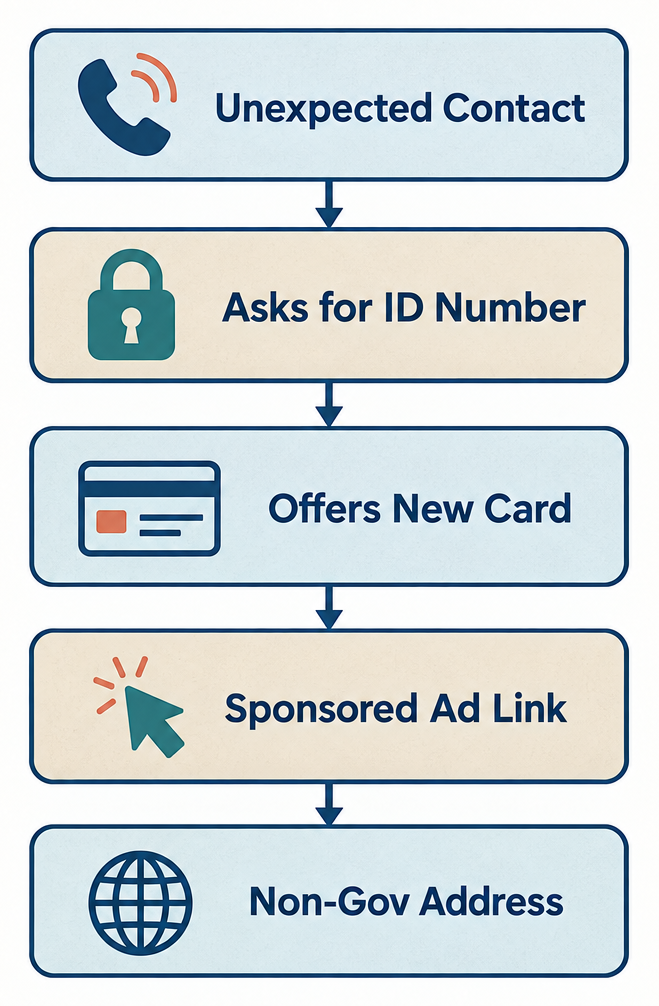
The FTC lists these red flags:
- An unexpected call, email, text or social media message from “Medicare” asking for your Medicare, Social Security or bank account number
- Someone from “Medicare” trying to sell you something
- A demand that you pay for your Medicare card
- Talk of a “new” Medicare card or an equipment claim you don’t recognize
- A search result marked with a small “Ad” or “Sponsored” label
- A website address that does not end in .gov
Medicare’s fraud booklet, “Protecting Yourself From Fraud” (publication 10111), says Medicare or its representatives call for personal information only in limited cases. Examples include a plan you already belong to, the agent who helped you join, or a 1-800-MEDICARE representative returning your call.
Caller ID can be faked
The FTC says scammers can make a call look like it comes from Medicare. If you are unsure, hang up. Then call 1-800-MEDICARE yourself.
If you were targeted
- Stop the conversation. Hang up the phone or close the website. Do not use any number or link from the ad or message.
- Call 1-800-MEDICARE (1-800-633-4227) directly to report the contact and confirm your coverage.
- If you shared a bank or card number, call your bank or card issuer using the number on the back of your card.
- If you shared your Social Security or Medicare number, report it at IdentityTheft.gov and consider freezing your credit with the three credit bureaus.
- If you paid for a plan that may not be real insurance, report it to the FTC. Get free help choosing real coverage from your State Health Insurance Assistance Program (SHIP) or local Senior Medicare Patrol.
To shop safely, the FTC says to type the site name yourself. Use Medicare.gov or call 800-633-4227. For Marketplace plans, use HealthCare.gov or call 800-318-2596. Scroll past paid ads until you find the .gov ending.
How to report it
Medicare’s fraud booklet says to report suspected Medicare fraud to 1-800-MEDICARE (1-800-633-4227). TTY users can call 1-877-486-2048. The FTC also says to report Medicare impersonators there.
You can report the scam to the FTC at ReportFraud.ftc.gov. If someone used your personal information, go to IdentityTheft.gov. Your state attorney general’s consumer protection office also takes complaints.
If you lost money or worry about legal or tax effects, a local SHIP counselor can help with Medicare questions. For legal questions, talk to a lawyer.
Check, verify or complain
Sources
- FTC Consumer Advice (consumer.ftc.gov), consumer alert dated Sept 28, 2026 consumer.ftc.gov · primary source
- Medicare.gov, 'Protecting Yourself From Fraud' (publication 10111) medicare.gov · primary source
- FTC Consumer Alert, Nov 2024 consumer.ftc.gov · primary source

Leah writes US Financer's Consumer Alerts: scam warnings and money rule changes issued by federal agencies, state attorneys general, regulators and courts. Each alert starts from the official notice, says what is confirmed and what is not known yet, and lists the agency's own page…

Ruth is US Financer's standards editor. Every article goes through her checks before and after it is published: each rate, fee, cap, deadline and rule is matched against its primary source, every law named is linked to its official text, and anything that cannot be…
Comments are closed