No credit check loans are small loans where the lender skips the hard inquiry at Equifax, Experian or TransUnion and decides based on your income, bank activity or collateral instead. They are real and legal in most states, but the price for skipping that check is steep: triple-digit APRs are normal, and the cheapest versions are not the ones advertised most loudly. This guide explains what lenders look at instead, what each type actually costs, where state law limits them, and which federal protections still apply to you.
What “no credit check” really means
The phrase does not mean nobody looks at you. It means the lender does not pull a traditional credit report with a hard inquiry, the kind that shows up on your file and can nudge your score down.
Almost every lender that advertises no credit check for loans still runs some form of screening. The three common methods:
- Soft inquiry. The lender views your credit file without recording a hard pull. Soft inquiries are visible only to you and do not affect FICO or VantageScore calculations.
- Alternative data. Specialty consumer reporting agencies such as Clarity Services (owned by Experian), FactorTrust (owned by TransUnion) and Teletrack collect records on small-dollar borrowing, bounced checks and prior payday activity. The CFPB publishes a list of these companies each year, and the Fair Credit Reporting Act covers them the same way it covers the big three.
- Bank account review. Cash advance apps and many online lenders connect to your checking account through a service like Plaid and read your deposits, balance history and overdrafts directly.
So “no check credit loans” is more accurately “no hard pull loans.” A lender with a license still has to confirm you have income and a way to repay. A company that promises money with no questions at all is usually a scam, which we cover below.
Hard pull vs soft pull: why lenders skip the hard one
A hard inquiry stays on your credit report for two years, and FICO says it counts toward your score for 12 months, usually costing fewer than five points. Lenders skip it for two reasons. Hard pulls cost them money, and many of their customers have scores so low that the report would not change the decision anyway. The pricing already assumes a high default rate.
What no credit check lenders look at instead
| What they check | How they check it | Why it matters to the lender |
|---|---|---|
| Steady income | Pay stubs, direct deposit history, employer verification | Confirms a paycheck is coming before the due date |
| Active checking account | Bank login or voided check | Needed to pull repayment automatically |
| Specialty credit files | Clarity, FactorTrust, Teletrack | Shows other open payday or installment loans and defaults |
| Prior loans with the same lender | Internal records | Repeat customers with clean records get bigger limits |
| Collateral | Car title, pawned item | Lender can seize and sell it if you default |
| Identity and residency | ID, address, Social Security number | Required by state licensing and federal anti-fraud rules |
Because specialty bureaus fall under the Fair Credit Reporting Act, you have the same rights there as with Experian. You can request your file, dispute errors, and the lender must send you an adverse action notice if a report is part of the reason for a denial.
The five main types and what each one costs
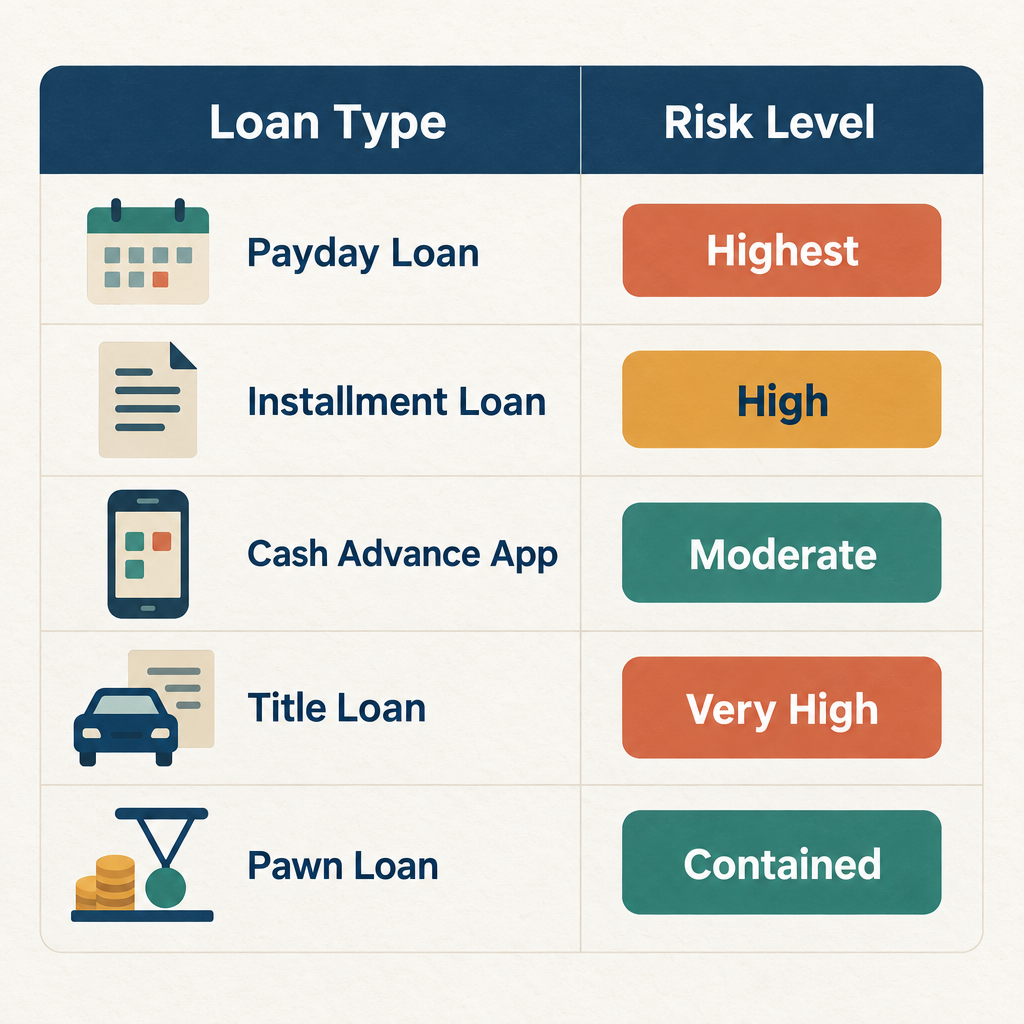
Every product below skips the hard inquiry. They differ enormously in price.
1. Payday loans
A payday loan is a single-payment loan, usually $500 or less, due on your next payday. The CFPB reports that fees typically run $10 to $30 per $100 borrowed, and that a common $15 fee per $100 for two weeks works out to an APR near 400%. The loan does not build credit because most payday lenders never report on-time payments to the big three bureaus. They do often report defaults.
2. Online installment loans
These spread repayment over three to twelve months with fixed payments. Lenders that skip hard pulls generally price them between roughly 100% and 300% APR depending on the state. Some report payments to the bureaus, which can help your score if you never miss one. The longer term makes each payment look manageable, but it also multiplies total interest.
3. Cash advance apps
Apps like Earnin, Dave, Brigit, Chime’s MyPay and EarnIn-style employer programs advance a slice of wages you have already earned, typically $20 to $750. They don’t run credit checks and instead read your bank deposits. Most charge no mandatory interest, but they make money from monthly subscriptions, optional tips and instant-transfer fees of a few dollars. Those small fees produce large APRs on short terms, which is why the CFPB proposed in July 2024 to treat paycheck advances as credit under the Truth in Lending Act. The agency withdrew that proposal in May 2025, so as of October 2026 there is no federal rule requiring these apps to show you an APR. Several states, including California, Connecticut, Kansas, Maryland, Nevada and Wisconsin, have passed their own earned wage access laws.
4. Auto title loans
You hand over your car title, keep driving, and borrow a fraction of the vehicle’s value for 30 days at a monthly fee that often equals 25%, or about 300% APR. In a 2016 study, the CFPB found that one in five single-payment title loan borrowers ended up having the vehicle repossessed. Title lending is banned or heavily restricted in more than half the states.
5. Pawn loans
A pawnshop lends you a portion of an item’s resale value, commonly 25% to 60%, and holds the item. Fees are set by state law, and in many states they translate to APRs well over 100%. The one genuine advantage: if you don’t repay, you lose the item and nothing else. No collections, no bank garnishment, nothing on your credit report.
Worked cost examples
The figures below use representative prices. Your lender’s Truth in Lending disclosure will show the exact APR and finance charge, which it must give you before you sign under Regulation Z (12 CFR 1026).
| Product | Amount borrowed | Fee or APR | Term | Total repaid | Effective APR |
|---|---|---|---|---|---|
| Payday loan | $300 | $15 per $100 | 14 days | $345 | 391% |
| Online installment loan | $1,000 | 199% APR | 9 months | about $1,860 | 199% |
| Cash advance app | $100 | $4 instant fee, no tip | 10 days | $104 | 146% |
| Auto title loan | $700 | 25% monthly fee | 30 days | $875 | 300% |
| Pawn loan | $150 | 20% monthly charge | 30 days | $180 | 240% |
| Credit union PAL (for comparison) | $500 | 28% APR plus $20 fee | 6 months | about $562 | 28% plus fee |
The APR math in plain words: divide the fee by the amount borrowed, then multiply by the number of loan periods in a year. On the payday example, $45 divided by $300 is 15%. A 14-day loan has about 26 periods in a year. Fifteen percent times 26 is roughly 391%. The same arithmetic turns a “small” $4 app fee into 146% because ten days fits into a year 36 times.
If you want to understand why a 24% credit card looks cheap next to these, our piece on “credit card apr explained” walks through the same math for revolving balances.
Before you borrow
The real danger is not the first fee but the rollover: CFPB research found that most payday loan fees are paid by borrowers who take seven or more loans a year, and a single $45 fee repeated every two weeks costs more than $1,100 over a year on a $300 balance you never actually pay down.
Where no credit check loans are banned or capped
State law, not federal law, decides whether these products exist where you live and how much they can charge. There is no nationwide no credit check lending market. An online lender that is licensed in Nevada cannot legally charge Nevada rates to a borrower in New York.
| State approach | What it means for you | Examples |
|---|---|---|
| Payday lending banned or capped near 36% APR | Storefront payday loans don’t exist; online lenders must follow the cap or stay out | Arizona, Arkansas, Colorado, Georgia, Illinois, Maryland, Massachusetts, Minnesota, Nebraska, New Jersey, New Mexico, New York, North Carolina, Pennsylvania, South Dakota, Vermont, West Virginia, Washington DC |
| Payday allowed with limits | Caps on loan size, number of rollovers, or a cooling-off period | Washington, Florida, Ohio (since 2019 reform), Virginia (since 2021 reform) |
| Payday allowed with few limits | Triple-digit APRs and repeat rollovers are legal | Texas, Utah, Nevada, Idaho, Missouri |
| Title lending allowed | 30-day title loans at around 300% APR | Alabama, Georgia (as “title pawn”), Mississippi, Missouri, Nevada, Tennessee, Texas, Utah |
The count of states with a 36% cap has grown steadily. Illinois passed its Predatory Loan Prevention Act in 2021, New Mexico passed its 36% cap in 2022 with an effective date of January 1, 2023, and Minnesota’s cap took effect in 2024. Check your state’s current rule with its financial regulator before assuming a product you saw advertised is legal where you live.
Tribal lenders and lenders using “rent-a-bank” arrangements sometimes claim your state’s cap does not apply to them. Courts and state attorneys general have challenged many of these structures. If a lender tells you a cap doesn’t apply, that’s a reason to be more careful, not less.
Who a no credit check loan can make sense for
We don’t recommend these products, but we also won’t pretend nobody has a rational reason to use one. A short-term advance can be the least bad option when all four of these are true:
- The expense is genuinely unavoidable, like a car repair you need to keep your job.
- You have confirmed income arriving before the due date that covers the full payment plus your normal bills.
- You have already been turned down for or cannot access the cheaper options below.
- You are borrowing once, with no plan to renew.
A one-time $200 app advance with a $4 fee is a very different decision from a $700 title loan you expect to roll over. If you’re searching for “loans emergency” because the car won’t start tomorrow, the app advance or a pawn loan limits your downside. The title loan puts the car itself at risk.
Cheaper options to check first
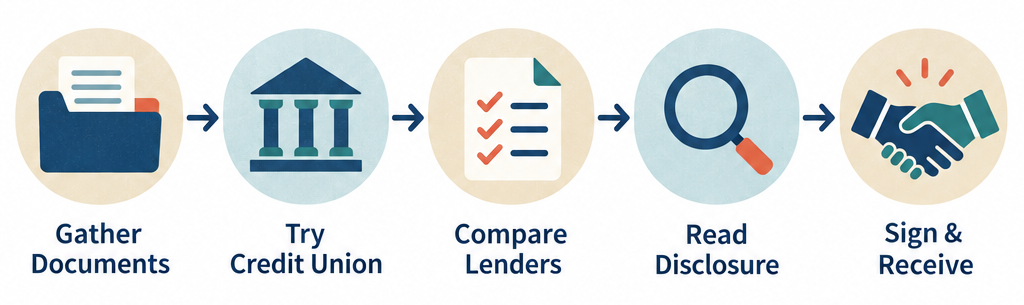
Cheaper options first
A federal credit union payday alternative loan caps APR at 28% and lends $200 to $2,000.
Your employer, utility company and hospital may offer a no-fee advance or payment plan if you ask.
Nonprofit credit counseling agencies and local assistance programs (211) cost nothing to call.
Credit union payday alternative loans (PALs)
Federal credit unions can offer two versions under NCUA rules (12 CFR 701.21). PAL I lends $200 to $1,000 for one to six months to members of at least one month. PAL II lends up to $2,000 for one to twelve months with no waiting period. Both cap the APR at 28% and the application fee at $20. Many credit unions make these without a hard pull, relying on your membership and income instead. You must be eligible to join the credit union, which is often as simple as living in its county.
Employer and app advances with no fee
Some employers offer earned wage access through payroll providers at no cost to you. Apps that charge nothing for standard transfers in one to three business days are also far cheaper than the instant option. Waiting two days can turn a 146% APR into 0%.
Hardship plans and bill negotiation
Utilities in most states must offer payment arrangements before disconnecting service. Hospitals that are nonprofits must have a financial assistance policy under IRS rules. Landlords, phone carriers and even the IRS offer payment plans. None of these involve a credit check.
Secured and credit-builder products
A secured credit card or a credit-builder loan from a credit union won’t fix tomorrow’s emergency, but either one gets you out of the no credit check market within a year. Credit-builder loans in particular report monthly to all three bureaus.
Help with the pattern, not just the loan
If you find yourself taking a new advance every pay period, the problem is usually the cash flow gap, not the lender. Nonprofit counseling through the National Foundation for Credit Counseling is free for a first session, and peer programs like “debtors anonymous” exist for people whose borrowing has become compulsive.
Your rights when you borrow without a credit check
Skipping the credit check does not skip the law. These federal protections apply whether the lender checked your credit or not.
Truth in Lending Act and Regulation Z. Before you sign, the lender must disclose the APR, the finance charge in dollars, the amount financed and the total of payments. If you don’t see an APR, you cannot compare the loan and should walk away.
Equal Credit Opportunity Act (Regulation B, 12 CFR 1002). Lenders cannot deny you based on race, sex, age, marital status, or because your income comes from public assistance. If denied, you get a written reason within 30 days.
Fair Credit Reporting Act. If a specialty bureau report contributed to a denial, you must be told which one and can get that report free. You can dispute inaccurate items.
Electronic Fund Transfer Act. Under 15 U.S.C. 1693k and Regulation E, a lender cannot require you to repay by preauthorized electronic debit as a condition of the loan. You can also revoke an authorization you gave, though you still owe the money.
Military Lending Act. Active-duty servicemembers and their dependents cannot be charged more than a 36% Military APR, and payday, title and refund-anticipation loans at higher rates are simply unlawful for them. The Servicemembers Civil Relief Act separately caps interest at 6% on debts taken on before active duty.
Fair Debt Collection Practices Act. Third-party collectors cannot threaten arrest, call you at work after you ask them to stop, or contact you before 8 a.m. or after 9 p.m. Defaulting on a civil debt is not a crime anywhere in the United States, no matter what a caller says.
Federal rules set a floor. Your state may add rollover limits, a right to cancel by the next business day, a free extended payment plan, or a database that blocks a second loan while one is open.
How to spot a scam lender
Advance-fee loan fraud is one of the most common complaints the FTC receives, and “guaranteed approval” ads are its favorite bait. Under the FTC’s Telemarketing Sales Rule (16 CFR 310.4), it is illegal for a telemarketer to ask you to pay any fee in advance for a loan they promise or claim is likely. A real lender deducts fees from the loan or adds them to your payments. It never asks for a gift card, wire or crypto payment up front.
Other red flags: no physical address, no state license number on the website, pressure to decide within minutes, and a request for your online banking password rather than a read-only connection. The claims behind “urgent loans guaranteed approval” ads deserve the same skepticism, because no licensed lender can lawfully approve a loan before it has seen an application.
How to check a lender before you share your bank details
- Search the company name and NMLS ID on NMLS Consumer Access to confirm it holds a license for your state.
- Check your state financial regulator’s own license lookup, since some states license small lenders outside NMLS.
- Search the CFPB Consumer Complaint Database for the company name and read the most recent complaints.
- Confirm the website lists a street address, a phone number that answers, and a Truth in Lending disclosure with an APR.
- Report suspected fraud to the FTC at ReportFraud, the CFPB complaint portal, and your state attorney general.
FAQ
Can I borrow money without a credit check?
Yes. Payday lenders, cash advance apps, pawnshops, title lenders and some credit unions all lend without a hard inquiry. Most still verify income and look at your bank activity or a specialty credit file, and the price is usually far higher than a loan that does check credit.
Where can I borrow money without a credit check?
The cheapest places are federal credit unions offering payday alternative loans at 28% APR or less, employer-sponsored wage advances, and apps that charge no fee for standard-speed transfers. Storefront payday and title lenders and online installment lenders are the most expensive, and they’re not legal in every state.
What is the easiest loan to get approved for with no credit?
A pawn loan is the easiest because approval depends only on the item you bring in. Cash advance apps are next, since they need only a checking account with regular direct deposits. Easiest does not mean cheapest, and pawn means losing the item if you can’t repay.
Can I get a genuine loan without a credit check?
Genuine, licensed lenders do offer no credit check loans, but they always ask for something: proof of income, bank access, or collateral. A lender that promises approval before seeing any information, or asks you to pay a fee before funding, is running a scam rather than a loan program.
Do no credit check loans build credit?
Rarely. Most payday, title and pawn lenders report nothing to Equifax, Experian or TransUnion when you pay on time. Some online installment lenders and most credit unions do report, so ask before you borrow if building a score is part of the goal.
What happens if I can’t repay?
With a pawn loan you lose the item and nothing more. With a title loan the lender can repossess the car. With payday and installment loans the lender may keep attempting debits, send the debt to collections, and in some states sue you. Ask about your state’s extended payment plan rules before the due date, since several states require lenders to offer one free of charge.